
Mail-in voting helped Florida Republicans win — so why is Trump attacking it? | Opinion
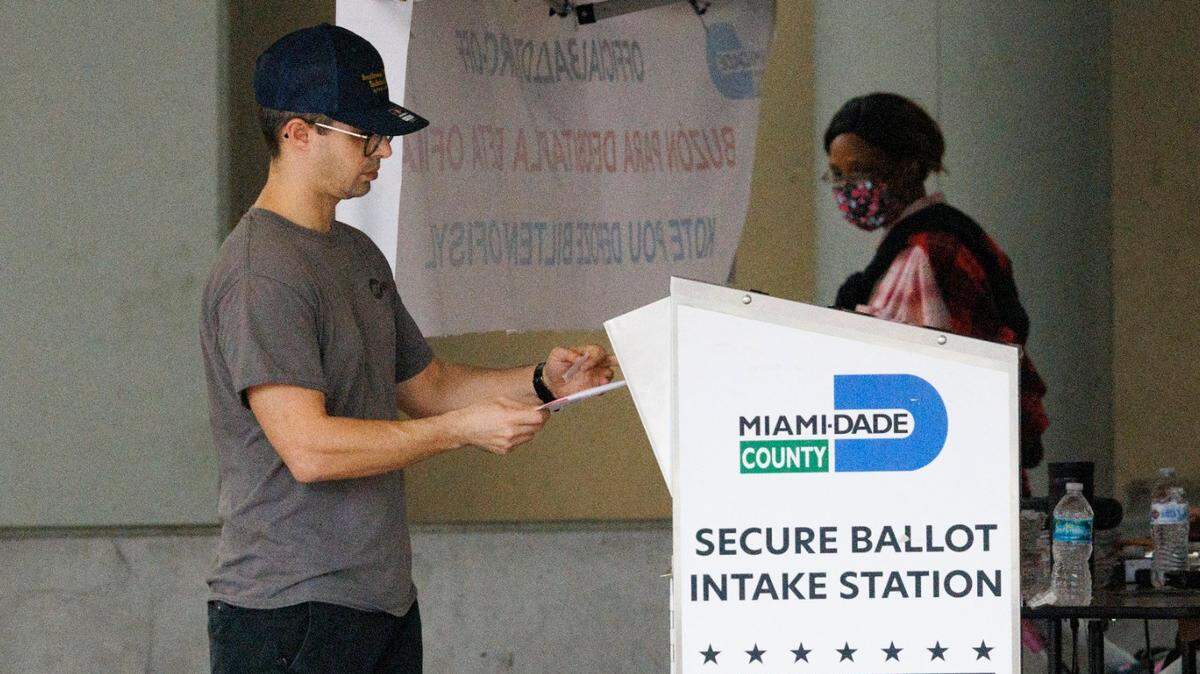
On Monday, President Donald Trump posted on Truth Social that he plans to lead a movement to get rid of mail-in ballots as well as “Seriously Controversial” voting machines.
Ending mail-in voting wouldn’t just be harmful to democracy. It could also backfire on Republicans, as well as harming Democrats, by disenfranchising Florida voters, especially in Miami-Dade, the most voter-rich county in the state.
For years, Trump has falsely claimed that mail ballots are rife with fraud, even though there has been no evidence of widespread fraud surrounding mail-in voting. Meanwhile, in 2020, Trump voted by mail in Florida.
As Sophia Lin Lakin, director of the ACLU’s Voting Rights Project, said in a statement after the president’s most recent pronouncement, “President Trump’s attempts to undermine a safe, proven, and reliable method of voting — that he himself uses — along with his attacks on voting technology, are just another part of his strategy to sow distrust in our elections and prevent voters from holding him accountable.”
This isn’t about election integrity. It’s about undermining institutions that allow for democratic participation.
Trump suggested he would use an executive order to eliminate mail-in ballots, but Article I Section 4 of the Constitution grants state legislatures authority over how elections are run. The Constitution gives Congress the power to alter those rules, not the president.
The 2026 midterm elections are still over a year away, but they seem to be at the forefront of Trump’s mind. His meeting with Russian Prime Minister Vladimir Putin may be playing a role. After Trump’s Friday meeting with Putin, he told Sean Hannity on Fox News that Putin told him, “Your election was rigged because you have mail-in voting. It’s impossible to have mail-in voting and having honest elections.”
Florida, it should be noted, administered a secure election, including using mail-in ballots, in the midst of a global pandemic. Shortly after the 2020 election, Gov. Ron DeSantis bragged, “The way Florida did it, I think inspires confidence, I think that’s how elections should be run.”
Even so, Florida took steps to limit vote by mail. In 2021, DeSantis signed into law SB90 which restricted mail-in ballot collection and drop boxes. Floridians also now have to request vote-by-mail ballots every general election cycle, rather than every four years. That’s another way of suppressing the vote.
Additionally, in 2022, DeSantis signed SB524, creating the Office of Election Crimes and Security and requiring annual reviews of voter rolls.
Mail-in voting continues to play a key role in Florida’s elections. A spokesman for the Miami-Dade Supervisor of Elections said 27% of eligible voters in Miami-Dade County relied on mail-in ballots in 2024. Statewide, more than 3 million Floridians voted by mail that same year.
The Office of the Miami-Dade Supervisor of Elections said in a statement to the Miami Herald that, “Unlike other states, Florida does not have universal vote by mail or absentee ballots. Our system is secure and has many checks and balances including signature verification and a review of identification, among other measures. We are here to strictly adhere to the law.”
Eliminating mail-in voting could hurt Republicans more than Democrats. Republicans in Florida have repeatedly benefited from vote by mail — just ask DeSantis and former Gov. Rick Scott, who won due in part to mail-in ballots.
More importantly, removing mail-in voting as an option would disenfranchise anyone who has a hard time getting to the polls — Florida seniors, working class voters and people with disabilities.
As the ACLU’s Lakin said, “Mail-in voting remains a vital safeguard of our democracy.”
Florida’s own electoral experience with vote-by-mail shows you can have secure elections with that method of voting, along with early voting and going to the polls. Protecting the right to vote means defending the tools, including mail-in ballots, that allow eligible voters, regardless of circumstance, to participate.
Voting is a civic duty afforded to all American citizens and must be protected — not restricted.
BEHIND THE STORY
MOREWhat's an editorial?
Editorials are opinion pieces that reflect the views of the Miami Herald Editorial Board, a group of opinion journalists that operates separately from the Miami Herald newsroom. Miami Herald Editorial Board members are: opinion editor Amy Driscoll and editorial writers Isadora Rangel and Mary Anna Mancuso. Read more by clicking the arrow in the upper right.
What's the difference between an op-ed and a column?
How does the Miami Herald Editorial Board decide what to write about?
The Editorial Board, made up of experienced opinion journalists, primarily addresses local and state issues that affect South Florida residents. Each board member has an area of focus, such as education, COVID or local government policy. Board members meet daily and bring up an array of topics for discussion. Once a topic is fully discussed, board members will further report the issue, interviewing stakeholders and others involved and affected, so that the board can present the most informed opinion possible. We strive to provide our community with thought leadership that advocates for policies and priorities that strengthen our communities. Our editorials promote social justice, fairness in economic, educational and social opportunities and an end to systemic racism and inequality. The Editorial Board is separate from the reporters and editors of the Miami Herald newsroom.
How can I contribute to the Miami Herald Opinion section?
The Editorial Board accepts op-ed submissions of 650-700 words from community members who want to argue a specific viewpoint or idea that is relevant to our area. You can email an op-ed submission to oped@miamiherald.com. We also accept 150-word letters to the editor from readers who want to offer their points of view on current issues. For more information on how to submit a letter, go here.
This story was originally published August 18, 2025 at 5:11 PM.