
No ‘foreign invasion’ as the American flag flew high at South Florida protest | Opinion
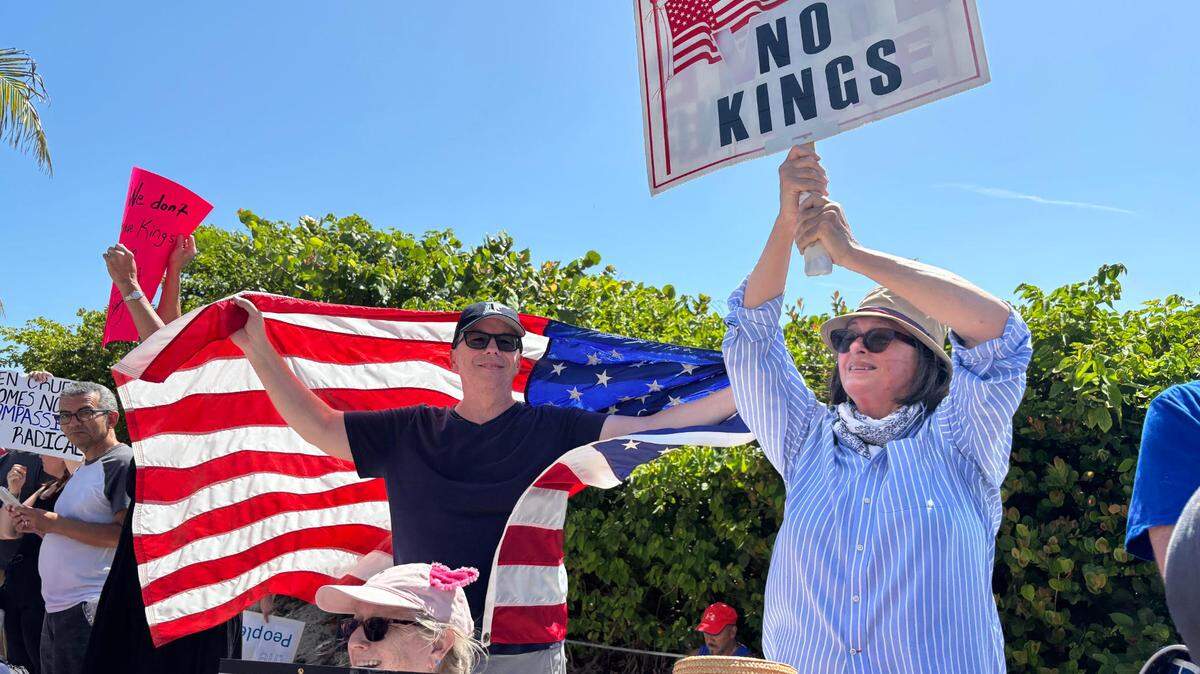
At the “No Kings” protest on Fort Lauderdale Beach Saturday morning, the real story was evident from the countless American flags of all sizes being waved: This was an American protest, not a foreign invasion.
President Donald Trump claimed to soldiers at Fort Bragg on Tuesday that sending Marines to Los Angeles was justified because protesters there were actually “rioters bearing foreign flags with the aim of continuing a foreign invasion.”
But on Saturday in Fort Lauderdale, the protesters lining State Road A1A were braving the hot sun to push back against the Trump administration’s escalating anti-immigrant offensive and abuse of power. These weren’t invaders but people who took to the streets to exercise a right that’s as American as it gets: to protest their government.
The patriotic display was fitting given that Saturday also marked Flag Day, which commemorates the adoption of the American flag on June 14, 1777.
“We’re here to protect the Constitution,” Nina McCamley of Davie told a member of the Herald Editorial Board. McCamley is a registered Democrat but was a Republican until Trump’s first election in 2016. She said she was particularly upset about the “mass deportations of people who have done nothing wrong.”
On one side sitting next to her was a woman wearing a shirt and hat emblazoned with the American flag. On the other side was Deter Partington of Fort Lauderdale, originally from London and a naturalized U.S. citizen. He said when he immigrated to the U.S. 40 years ago he felt a “relief” that his rights were protected by the Bill of Rights. (The U.K. does not have a single written constitutional document like the U.S.) Now, he said, the Bill of Rights is “being written all over.”
With protests across the country scheduled on the same day as the military parade in Washington, D.C. — a frivolous and expensive show of military might catering to the president’s ego — and coinciding with Trump’s 79th birthday, the protesters in South Florida decried Trump’s growing embrace of authoritarian tactics with chants like “Let’s let it rain on his parade” and signs like “No kings since 1776.” As cars drove down A1A, many honked in support.
And, yes, flags were also waved from other countries, such as Mexico and Ukraine, as well as from Puerto Rico — symbols of America’s and South Florida’s multiculturalism. This is a country where you can be as proud of the Stars and Stripes as you are of your heritage.
The Fort Lauderdale demonstration attracted at least hundreds, with the Sun Sentinel reporting a crowd of 2,000 people.
In Miami Beach, hundreds of people streamed into Pride Park Saturday morning at another rally. Monica Tracy, a 67-year-old retired real estate agent who organized the event, told the Herald: “Our founding principle is that we didn’t want a king, and now we have one.”
There were other rallies, too, including one at the Torch of Friendship in downtown Miami, where thousands gathered, the Herald reported.
The protests across the country and in Florida are a sign of the growing clash between visions for the United States.
There’s no question on which side Florida Gov. Ron DeSantis falls. He has embraced Trump’s vision as a way of trying to get back in the president’s good graces after challenging him for the Republican presidential nomination last year. He warned earlier in the week that law enforcement was at the ready, and that protesters would be arrested if they blocked streets or destroyed property.
He even went so far as saying that drivers who run over protesters who block roadways likely wouldn’t be at fault under the state’s anti-riot law passed in the wake of the Black Lives Matter protests in the summer of 2020.
This country cannot afford the continuing divisiveness and anger, a point driven home by the assassination attempts against Trump and, on the same day as the protests, the shooting of two Minnesota legislators in “what appears to be a politically-motivated assassination,” according to Minnesota Gov. Tim Walz.
Patriotism takes a lot of forms, and protest is one of them. No side of the political aisle owns patriotism. Protests sometimes get out of hand or become violent — in California last weekend, protests devolved into violent clashes. Demonstrators need to stay peaceful to be heard.
But these protests, stretching across the country, need to be heeded. Trump’s authoritarian tendencies are clear in the way he is handling immigration, in his craving for a military parade, in his shrugging off of due process. Protesters are drawing the line and exercising their right to criticize their government.
Click here to send the letter.
BEHIND THE STORY
MOREWhat's an editorial?
Editorials are opinion pieces that reflect the views of the Miami Herald Editorial Board, a group of opinion journalists that operates separately from the Miami Herald newsroom. Miami Herald Editorial Board members are: opinion editor Amy Driscoll and editorial writers Isadora Rangel and Mary Anna Mancuso. Read more by clicking the arrow in the upper right.
What's the difference between an op-ed and a column?
How does the Miami Herald Editorial Board decide what to write about?
The Editorial Board, made up of experienced opinion journalists, primarily addresses local and state issues that affect South Florida residents. Each board member has an area of focus, such as education, COVID or local government policy. Board members meet daily and bring up an array of topics for discussion. Once a topic is fully discussed, board members will further report the issue, interviewing stakeholders and others involved and affected, so that the board can present the most informed opinion possible. We strive to provide our community with thought leadership that advocates for policies and priorities that strengthen our communities. Our editorials promote social justice, fairness in economic, educational and social opportunities and an end to systemic racism and inequality. The Editorial Board is separate from the reporters and editors of the Miami Herald newsroom.
How can I contribute to the Miami Herald Opinion section?
The Editorial Board accepts op-ed submissions of 650-700 words from community members who want to argue a specific viewpoint or idea that is relevant to our area. You can email an op-ed submission to oped@miamiherald.com. We also accept 150-word letters to the editor from readers who want to offer their points of view on current issues. For more information on how to submit a letter, go here.
Click here to send the letter.
BEHIND THE STORY
MOREWhat's an editorial?
Editorials are opinion pieces that reflect the views of the Miami Herald Editorial Board, a group of opinion journalists that operates separately from the Miami Herald newsroom. Miami Herald Editorial Board members are: opinion editor Amy Driscoll and editorial writers Isadora Rangel and Mary Anna Mancuso. Read more by clicking the arrow in the upper right.
What's the difference between an op-ed and a column?
How does the Miami Herald Editorial Board decide what to write about?
The Editorial Board, made up of experienced opinion journalists, primarily addresses local and state issues that affect South Florida residents. Each board member has an area of focus, such as education, COVID or local government policy. Board members meet daily and bring up an array of topics for discussion. Once a topic is fully discussed, board members will further report the issue, interviewing stakeholders and others involved and affected, so that the board can present the most informed opinion possible. We strive to provide our community with thought leadership that advocates for policies and priorities that strengthen our communities. Our editorials promote social justice, fairness in economic, educational and social opportunities and an end to systemic racism and inequality. The Editorial Board is separate from the reporters and editors of the Miami Herald newsroom.
How can I contribute to the Miami Herald Opinion section?
The Editorial Board accepts op-ed submissions of 650-700 words from community members who want to argue a specific viewpoint or idea that is relevant to our area. You can email an op-ed submission to oped@miamiherald.com. We also accept 150-word letters to the editor from readers who want to offer their points of view on current issues. For more information on how to submit a letter, go here.