
Pope Leo XIV’s first international trip should begin in Miami. Here’s why | Opinion
If Pope Leo XIV wants his first international trip to send a message across the Americas, he should start in the United States — and begin in Miami to set the right tone.
Miami Archbishop Thomas G. Wenski has already said he hopes the new pope will visit Miami and has warmly welcomed him. And the reasons to accept the invitation are compelling: more than 1 million Catholics call South Florida home and, more significantly, Miami is ground zero for some of the country’s most aggressive anti-immigration policies — the same policies Leo XIV criticized on social media before becoming pope.
Although his views on immigration aren’t yet entirely clear, many Church insiders expect Leo XIV to follow Pope Francis in speaking up when human lives are used as political bargaining chips. That should be a mandate of his papacy.
Leo XIV, a Chicago native who spent more than two decades in the ministry in Peru, understands the plight of migrants.
Wenski’s invitation isn’t just ceremonial. A visit to Miami would be both strategic and symbolic. It would be pastoral, tending the flock by offering spiritual comfort and guidance. At a time when “immigrant” is a slur, the pope’s presence in a city of immigrants would ground his papacy in something deeply humane.
For decades, Miami has welcomed the poor, the exiled, the displaced by dictatorships looking for a better life for themselves and their families — Cubans, Venezuelans, Haitians, Nicaraguans, Ukrainians. These are the very “peripheries” Pope Leo, like Pope Francis before him, has called “the Church’s center.”
A papal visit wouldn’t be about politics. It would be about people, but the message would be clear.
Miami has long been a bridge between the U.S. and Latin America, where Catholicism remains vibrant and vital. And in Miami, on any given Sunday, mass is heard in English, Spanish or Creole. A papal visit to Miami would highlight the Church’s commitment to immigrants, refugees and the marginalized from other countries. It would also energize local faithful and their parishes in the Archdiocese of Miami.
Pope’s last visit
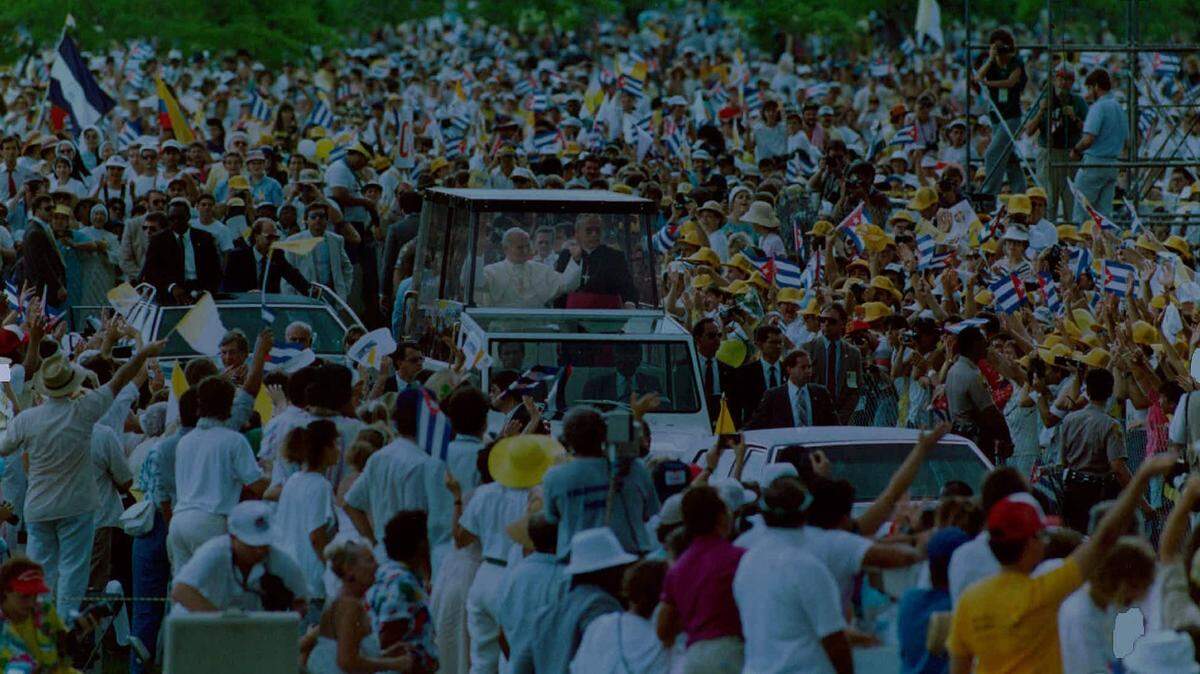
And Miami is due. The last papal visit happened nearly four decades ago, when Pope John Paul II visited in 1987.
He drove around Miami in a popemobile as thousands lined the streets, Catholics and non-Catholics. He then celebrated mass in Tamiami Park before a crowd of 230,000 — but as he spoke the skies opened with thunder and a torrential thunderstorm interrupted his homily. Many viewed the sudden rains as a sign from above.
That visit included a historic meeting with President Ronald Reagan, who flew to Miami.
Leo XIV could also meet with current President Donald Trump, whose Mar-a-Lago residence is down the road in Palm Beach. Such a moment would command global attention and reflection.
Is it too soon to be planning international visits for the new pope? Not really; these take time.
After being elected in 2013, the late Francis made his first international trip just four months later, starting his visit in Brazil. Leo XIV can keep the same time schedule and embark on his first international trip before the end of 2025.
No American city reflects the Catholic mission — migration, struggle, resilience, faith — more vividly than Miami.
Let this new papacy begin in Little Haiti, Liberty City or Little Havana — places where people are still struggling, but still believing.
After his stop here, the pope can then head to Chicago or Peru, where he is now a favorite son.
Miami is a perfect city to share this moment with the new pope. And the message would be unmistakable because Miami isn’t just an immigrant city that mirrors the hopes and struggles of millions across this hemisphere. A visit to Miami would make global sense.
Click here to send the letter.
BEHIND THE STORY
MOREWhat's an editorial?
Editorials are opinion pieces that reflect the views of the Miami Herald Editorial Board, a group of opinion journalists that operates separately from the Miami Herald newsroom. Miami Herald Editorial Board members are: opinion editor Amy Driscoll and editorial writers Isadora Rangel and Mary Anna Mancuso. Read more by clicking the arrow in the upper right.
What's the difference between an op-ed and a column?
How does the Miami Herald Editorial Board decide what to write about?
The Editorial Board, made up of experienced opinion journalists, primarily addresses local and state issues that affect South Florida residents. Each board member has an area of focus, such as education, COVID or local government policy. Board members meet daily and bring up an array of topics for discussion. Once a topic is fully discussed, board members will further report the issue, interviewing stakeholders and others involved and affected, so that the board can present the most informed opinion possible. We strive to provide our community with thought leadership that advocates for policies and priorities that strengthen our communities. Our editorials promote social justice, fairness in economic, educational and social opportunities and an end to systemic racism and inequality. The Editorial Board is separate from the reporters and editors of the Miami Herald newsroom.
How can I contribute to the Miami Herald Opinion section?
The Editorial Board accepts op-ed submissions of 650-700 words from community members who want to argue a specific viewpoint or idea that is relevant to our area. You can email an op-ed submission to oped@miamiherald.com. We also accept 150-word letters to the editor from readers who want to offer their points of view on current issues. For more information on how to submit a letter, go here.