
With blood streaking across Trump’s face, America learned the price of toxic politics | Opinion
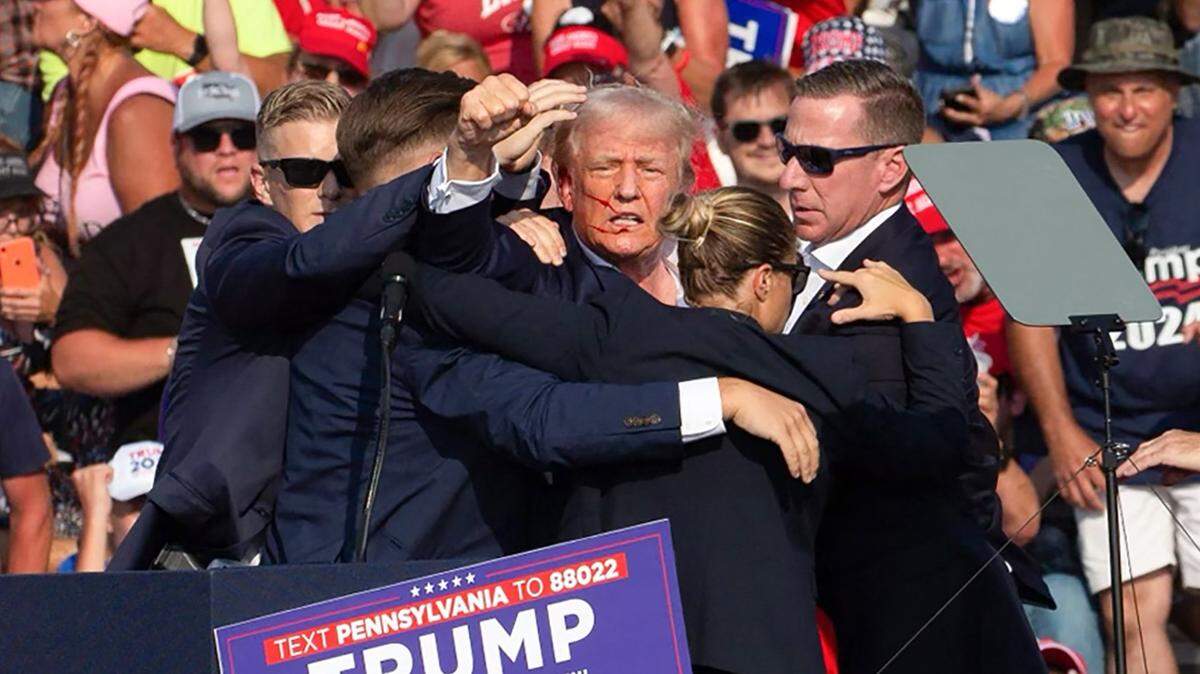
We are glad former President Donald Trump survived what the FBI said was an assassination attempt during a rally in Pennsylvania on Saturday. His fiercest rivals and those who are fighting against a second Trump term should be as well.
There is no place for political violence in America. Luckily, many of Trump’s political opponents, including President Biden, condemned the attack.
“It’s sick… It cannot be like this. We cannot condone this,” Biden said Saturday evening.
The suspected shooter has been identified as a 20-year-old from a small Pennsylvania town who used an AR-15, the same style of rifle used in many mass shootings in the U.S. Authorities say they are still trying to understand what motivated him to commit such senseless violence. Meanwhile, Homeland Security Secretary Alejandro Mayorkas said on Monday the shooting was a security failure and the Secret Service faces scrutiny by members of Congress from both parties.
While we wait for answers, this should be a moment of reflection for Americans, not of finger pointing.
Not since 1981, when President Ronald Reagan was shot outside the Washington Hilton Hotel by John Hinckley Jr., have we seen a president or former president under a gunman’s attack.
It’s a frightening moment, one that, unfortunately, isn’t surprising given the current state of polarization and how toxic American politics has turned — and how Americans have turned against each other. Polarization only exists because it is accepted by a large portion of the American public. Although we still have to learn the motives for the shooting, we’re all in different ways complicit for the political environment that might have led somebody to open fire on a presidential candidate.
Violence is the worst-case scenario when a country is torn apart by ideological differences and Americans retreat into their echo chambers. Less notable consequences are seen everyday with the normalization of inflammatory rhetoric and disinformation. The more Americans demonize each other and their political affiliation, the more likely violence becomes.
Trump posted on Truth Social he was hit in the upper right ear. He is fine. The suspected shooter was killed, and so was a rally attendee, 50-year-old volunteer fire chief Corey Comperatore, who died trying to protect his family by shielding them from bullets. How tragic to have lost one’s life for attending a political rally. Two others were seriously injured.
The shooting has revived conversations about the easy availability of semi-automatic weapons like the AR-15. Roughly 16 million people in the U.S. own an AR-15 — one in every 20 adults, the Washington Post reported. The weapon was used in 10 of the 17 deadliest mass shootings in America between 2012 and 2022, including the school massacre in Parkland that killed 17 people.
If the murder of school children didn’t bring both parties together on gun control, it’s unlikely that the assassination attempt against Trump will do it.
The events of Saturday could have been much worse had Trump been more seriously injured or tragically killed. Americans of all political inclinations should be thankful he survived.
In the end, the best photographs of Trump’s political career came from the tragedy and the chaos that followed the shooting. When Trump was lifted from the ground on the stage by Secret Service agents who rushed to the podium to protect him, at first he looked dazed, but then quickly defiant.
As he was led off the stage, photographs show him pumping his fists up in the air, streaks of blood across his face. The American flag flying in the air behind him.
Trump said to the crowd: “Fight! Fight! Fight!”
Is Trump our next president? Maybe.
Regardless of the outcome of the November elections, Americans must accept the ebbs and flows of electoral politics and its results.
The shocking events of Saturday prove that democracy only works when we all subscribe to its principles. We cannot change electoral outcomes by invading the U.S. Capitol or trying to take the life of a politician we dislike or even hate, if that’s what motivated the suspected shooter.
Political violence is the opposite of democracy.
Click here to send the letter.
BEHIND THE STORY
MOREWhat's an editorial?
Editorials are opinion pieces that reflect the views of the Miami Herald Editorial Board, a group of opinion journalists that operates separately from the Miami Herald newsroom. Miami Herald Editorial Board members are: opinion editor Amy Driscoll and editorial writers Isadora Rangel and Mary Anna Mancuso. Read more by clicking the arrow in the upper right.
What's the difference between an op-ed and a column?
How does the Miami Herald Editorial Board decide what to write about?
The Editorial Board, made up of experienced opinion journalists, primarily addresses local and state issues that affect South Florida residents. Each board member has an area of focus, such as education, COVID or local government policy. Board members meet daily and bring up an array of topics for discussion. Once a topic is fully discussed, board members will further report the issue, interviewing stakeholders and others involved and affected, so that the board can present the most informed opinion possible. We strive to provide our community with thought leadership that advocates for policies and priorities that strengthen our communities. Our editorials promote social justice, fairness in economic, educational and social opportunities and an end to systemic racism and inequality. The Editorial Board is separate from the reporters and editors of the Miami Herald newsroom.
How can I contribute to the Miami Herald Opinion section?
The Editorial Board accepts op-ed submissions of 650-700 words from community members who want to argue a specific viewpoint or idea that is relevant to our area. You can email an op-ed submission to oped@miamiherald.com. We also accept 150-word letters to the editor from readers who want to offer their points of view on current issues. For more information on how to submit a letter, go here.
This story was originally published July 14, 2024 at 12:30 AM.