
Another Miami-Dade politician charged with a crime runs for office. Call it the Trump Effect | Opinion
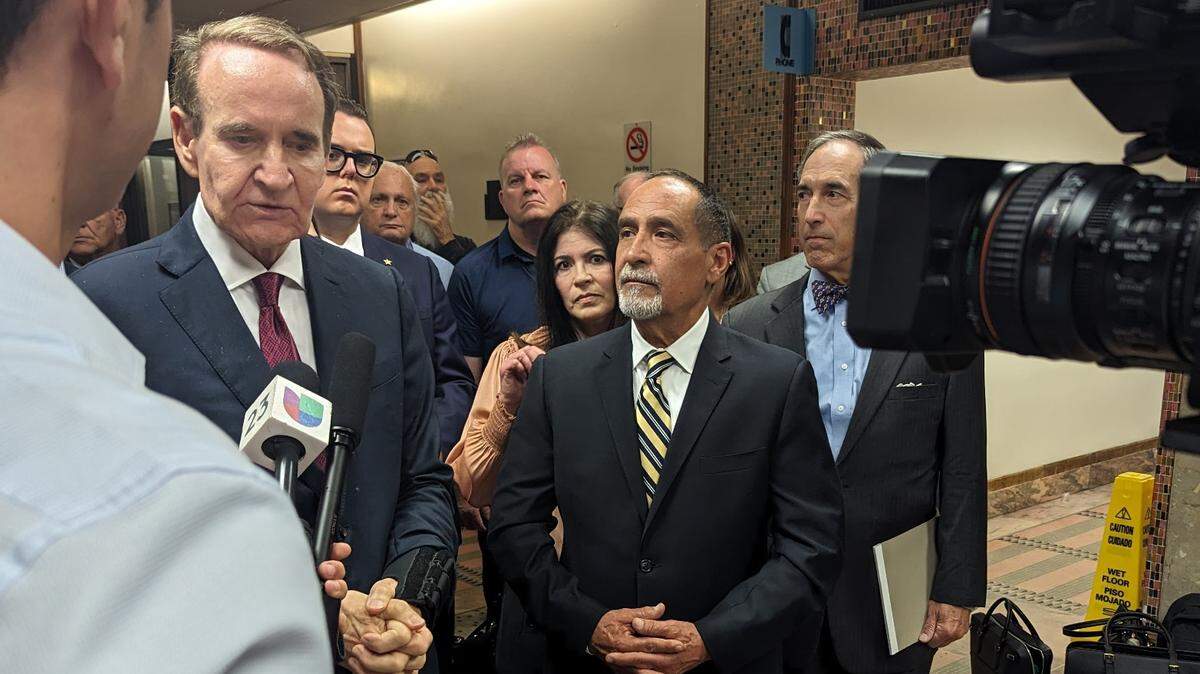
Suspended Miami-Dade Commissioner Joe Martinez announced this week he plans to run for the coveted, brand new, powerful post of Miami-Dade sheriff.
Nevermind that Martinez was arrested in 2022 and charged with unlawful compensation for accepting money from a grocery store owner. He is awaiting trial.
Martinez maintains he is innocent and the money he received was for work done while he was not a commissioner. He claims the criminal case against him was politically motivated.
Heard that one before?
Martinez, a Republican and a former police officer, is riding on the Trump Effect — a new political reality in which candidates no longer believe that a run-in with the law precludes them from seeking public office, not even the county’s top law enforcement job.
If it’s working for the former president, who’s fundraising off of his conviction on 34 felony charges in New York, why won’t others then try to ride his shameless coattails?
“This community deserves to have a law enforcement person who not only has an exemplary record as police officer but who also has command of government,” Martinez told reporters Tuesday.
Martinez is not alone in thinking a criminal record doesn’t endanger political aspirations. In September, former Miami City Commissioner Alex Diaz de la Portilla was also charged with public corruption and suspended. He decided to double down and run for his seat again in November. He lost. Kudos for old-fashioned voters.
Diaz de la Portilla also claimed his arrest had been politically motivated, a weaponizing of the judicial system led by a renegade Broward County prosecutor.
This week, the Herald reported Diaz de la Portilla is under investigation for possible witness tampering related to his case. Diaz de la Portilla told the Herald the “only tampering is the State’s tampering.”
Sound familiar?
And also this week, a consultant once deemed a “possible subject” in a criminal investigation by the office of Miami-Dade State Attorney Katherine Fernandez Rundle was identified as being behind a political committee attacking the longtime Democratic prosecutor.
Alex Alvarado, a Tallahassee consultant tied to a 2020 plot to hurt Democrats by promoting “ghost” candidates, is said to be the one coordinating political ads criticizing Fernandez Rundle for raising money for a reelection campaign she ultimately didn’t have to run because she didn’t face any opponents, the Miami Herald reported. Alvarado was never charged with a crime.
“Not again… ‘Disgraced’ Katherine Fernandez Rundle was re-elected without opposition,” but she “raised over $600k for her ‘ghost’ campaign,” the ads say. He accuses her of being “in the pockets of big developers, healthcare executives and lobbyists.”
For decades, having a criminal record or coming under investigation was seen as a major black mark. Voters generally wanted their elected leaders to be people of high moral character without any scandals.
However, it seems those norms have gone, thanks to Trump.
From settling lawsuits over housing discrimination to accusations of tax fraud, Trump managed to convince voters that his questionable past was a conspiracy against him. Trump’s greatest trick now is likely that despite being convicted in New York, he will likely be the Republican presidential candidate and face President Joe Biden in November.
Trump has seemingly given other politicians with problematic histories a new confidence.
Martinez and Diaz de la Portilla are, in the eyes of the law, innocent until proven guilty. But, in the past, their legal troubles would have been political suicide — and it might have been for Diaz de la Portilla. Martinez is still betting he can win over voters in our current environment. He might be right.
But this lowering of standards threatens the very foundations of our democratic system. How can we expect our leaders to faithfully serve the public interest if they themselves face active criminal prosecutions?
Voting people under indictment into office removes any incentive for politicians to avoid corruption or legal gray areas.
More worryingly, it could even help normalize corruption as just another part of the political game. Let’s hope Miami-Dade voters can see clearly when voting this election season.

Click here to send the letter.
BEHIND THE STORY
MOREWhat's an editorial?
Editorials are opinion pieces that reflect the views of the Miami Herald Editorial Board, a group of opinion journalists that operates separately from the Miami Herald newsroom. Miami Herald Editorial Board members are: opinion editor Amy Driscoll and editorial writers Isadora Rangel and Mary Anna Mancuso. Read more by clicking the arrow in the upper right.
What's the difference between an op-ed and a column?
How does the Miami Herald Editorial Board decide what to write about?
The Editorial Board, made up of experienced opinion journalists, primarily addresses local and state issues that affect South Florida residents. Each board member has an area of focus, such as education, COVID or local government policy. Board members meet daily and bring up an array of topics for discussion. Once a topic is fully discussed, board members will further report the issue, interviewing stakeholders and others involved and affected, so that the board can present the most informed opinion possible. We strive to provide our community with thought leadership that advocates for policies and priorities that strengthen our communities. Our editorials promote social justice, fairness in economic, educational and social opportunities and an end to systemic racism and inequality. The Editorial Board is separate from the reporters and editors of the Miami Herald newsroom.
How can I contribute to the Miami Herald Opinion section?
The Editorial Board accepts op-ed submissions of 650-700 words from community members who want to argue a specific viewpoint or idea that is relevant to our area. You can email an op-ed submission to oped@miamiherald.com. We also accept 150-word letters to the editor from readers who want to offer their points of view on current issues. For more information on how to submit a letter, go here.
This story was originally published June 7, 2024 at 6:00 AM.