
The Trump documents scandal isn’t a ‘storage’ issue. It’s a national-security issue | Editorial
The more we hear about the Donald Trump documents scandal, the worse it sounds.
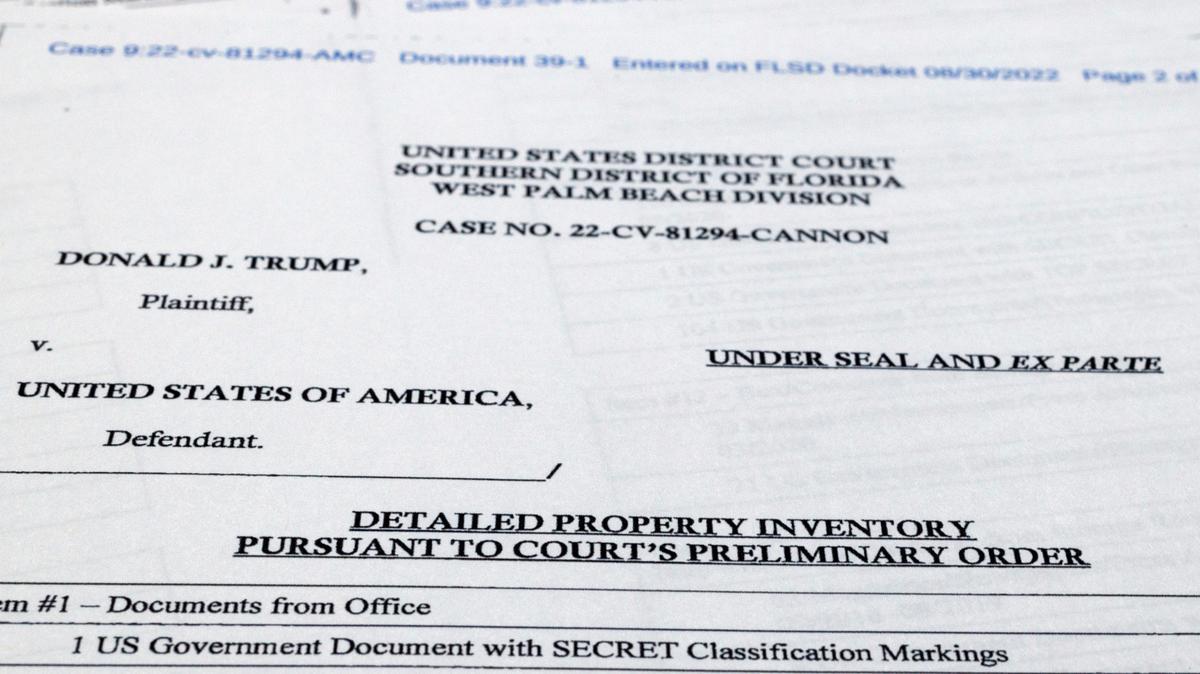
The list of items the FBI removed from the former president’s Mar-a-Lago home Aug. 8 includes more than two dozen documents marked “CONFIDENTIAL” and “TOP SECRET,” according to information released in federal court Friday. There were also 43 folders marked “CLASSIFIED” that were empty, raising a critical question of what happened to those secret government documents.
That created a whole new level of worry, especially since Trump’s Palm Beach residence and club has been proven to be far from secure.
One box alone, marked #13, contained a mishmash of presidential stuff: 62 magazines and press clippings, two documents marked “CONFIDENTIAL,” one marked “TOP SECRET,” an article of clothing that may have been a gift — and 708 additional documents and photos that lacked a classification. Would Trump even have known if something important was missing?
It’s no wonder the National Archives, and subsequently the Department of Justice, became alarmed enough to launch criminal and national security investigations.
And though a Trump-appointed judge on Monday handed the former reality TV star at least a temporary legal win — by requiring a special master to examine all the seized documents — it has become clear that Trump’s method of storage for some of the most closely held documents in the U.S. government was one step below the average suburban garage.
Florida Sen. Marco Rubio, in a Sunday interview in the midst of his reelection campaign, seized on that, brushing off this unprecedented and dangerous behavior by an ex-president as solely a “fight over storage of documents.”
“I don’t think a fight over storage of documents is worthy of what they’ve done, which is full scale raid and then these constant leaks,” he said — failing to note that it was Trump who told the world about the seizure of the documents.
But, of course, it is far worse than a problem with storage, and Rubio, vice chair of the Senate Intelligence Committee, knows that better than most.
He even said it out loud, back in 2016, when he was still competing with Trump for the Republican presidential nomination. He called Trump a “con artist” who was “reckless and dangerous” and he said it would be dangerous to give Trump the nuclear codes.
Sometimes, it’s cold comfort to be right.
And with each new revelation about the documents and Trump’s stonewalling of any investigation, the more we see how reckless and dangerous his behavior has been.
He had plenty of time to correct course, if he’d had any desire to do so. The raid on his Palm Beach residence and club came after long discussions with the Archives about documents he wasn’t supposed to take with him when he left the White House. Eventually, after months of talks, Trump and his legal team turned over 15 boxes. He later sent another batch of documents to the DOJ, in June, after a grand jury subpoena.
But even after Trump’s attorneys said they’d turned over everything, DOJ officials said the former president kept documents that belonged to the federal government — to the people of this country, really — including some related to national security.
Some Republicans have concluded, rightly, that there is no defending this behavior. Bill Barr, Trump’s former attorney general, said on Fox News that the government was more than patient.
“People say this was unprecedented, but it’s also unprecedented for a president to take all this classified information and put them in a country club, OK? And how long is the government going to try to get that back?,” he asked. “They jaw-boned for a year. They were deceived on the voluntary actions taken. They then went and got a subpoena. They were deceived on that, they feel. And the facts are starting to show that they were being jerked around. And so how long do they wait?”
Now a Trump-appointed federal judge has taken the unheard-of step of intervening in the investigation by ordering a special master to review the seized documents. It was a ruling requested by Trump, and it effectively paused the FBI’s investigation. The DOJ may appeal, and that could create delays as well, but probably nowhere near as long as the delay created by finding a special master with sufficient security clearances to review these highly sensitive documents.
And moving the investigation forward with all due speed is important here. This was no mere mishandling of documents, like some corporate employee who took a confidential reorg plan out the door along with their potted plant. Based on the markings on those folders and documents, this was some of the most serious information our government has, the kind of information that can endanger individuals or our troops.
No president who actually cares about the country would put us in that position. It doesn’t take a genius — even a “stable” one — to know that you shouldn’t be mixing secret documents that could pose a risk to U.S. national security with articles of clothing or your favorite magazine clippings.
The DOJ had no choice. Trump has created a security nightmare for this country. No amount of pretending it’s about politics changes that.
Editor’s note: This editorial has been updated to reflect a federal judge’s ruling Monday to appoint a special master and Sen. Marco Rubio’s comments.
BEHIND THE STORY
MOREWhat's an editorial?
Editorials are opinion pieces that reflect the views of the Miami Herald Editorial Board, a group of opinion journalists that operates separately from the Miami Herald newsroom. Miami Herald Editorial Board members are: opinion editor Amy Driscoll and editorial writers Isadora Rangel and Mary Anna Mancuso. Read more by clicking the arrow in the upper right.
What's the difference between an op-ed and a column?
How does the Miami Herald Editorial Board decide what to write about?
The Editorial Board, made up of experienced opinion journalists, primarily addresses local and state issues that affect South Florida residents. Each board member has an area of focus, such as education, COVID or local government policy. Board members meet daily and bring up an array of topics for discussion. Once a topic is fully discussed, board members will further report the issue, interviewing stakeholders and others involved and affected, so that the board can present the most informed opinion possible. We strive to provide our community with thought leadership that advocates for policies and priorities that strengthen our communities. Our editorials promote social justice, fairness in economic, educational and social opportunities and an end to systemic racism and inequality. The Editorial Board is separate from the reporters and editors of the Miami Herald newsroom.
How can I contribute to the Miami Herald Opinion section?
The Editorial Board accepts op-ed submissions of 650-700 words from community members who want to argue a specific viewpoint or idea that is relevant to our area. You can email an op-ed submission to oped@miamiherald.com. We also accept 150-word letters to the editor from readers who want to offer their points of view on current issues. For more information on how to submit a letter, go here.
This story was originally published September 2, 2022 at 4:26 PM.