
Florida told them they could vote, then arrested them for it. Could DeSantis care any less? | Editorial
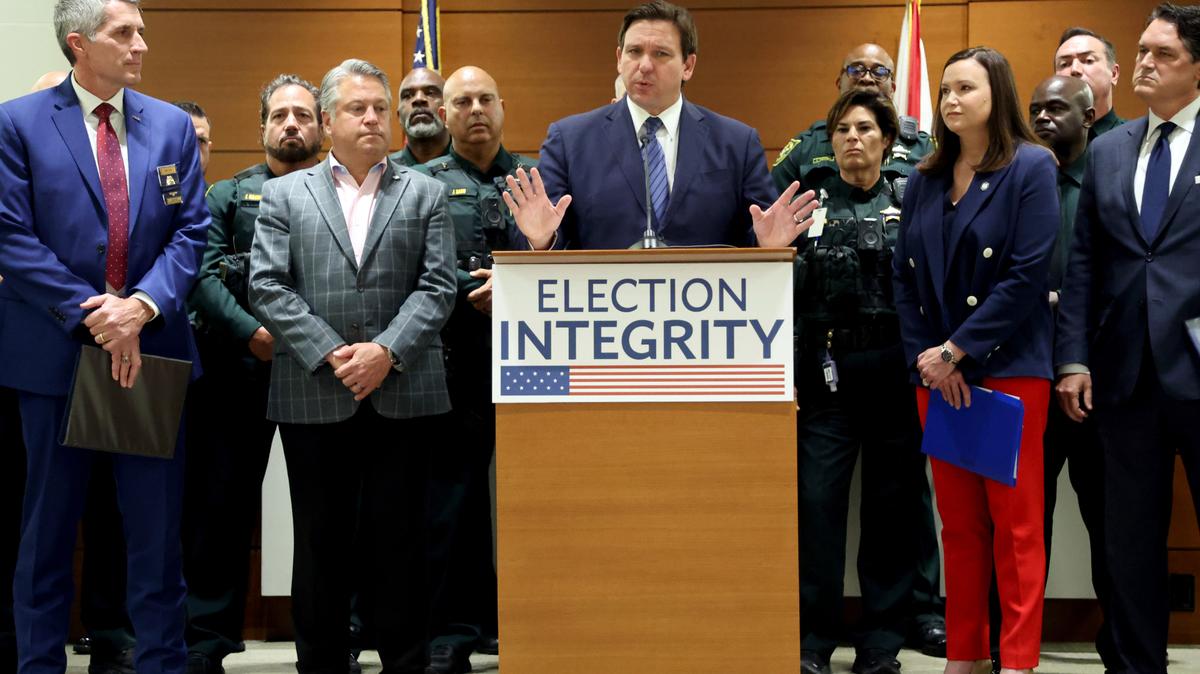
Gov. Ron DeSantis’ big reveal of voter fraud in Florida is turning into a big embarrassment.
His triumphant mid-August press conference in the Democratic stronghold of Broward County was clearly supposed to be a two-fer: justifying his unnecessary new Office of Election Crimes and Security while also striking fear — the GOP’s favorite emotion — in the hearts of a purportedly vast sea of wrong-doers. He struck a typical strongman pose at the event, surrounding himself with uniformed officers as he announced the arrests of 20 people and vowed to make them “pay the price.”
In reality, it was a naked attempt to fuel paranoia about election fraud by someone who wants to make sure he can call into question the result of any close contest if it goes the wrong way for him, a lesson from Donald Trump that DeSantis has embraced as his own.
But now the voter-fraud claims are backfiring, as the details emerge in the days after DeSantis’ splashy press conference. Fully 18 of the 20 people arrested told state investigators that they received voter registration cards from their county elections supervisors office. In other words, the government told them they could vote.
What’s more, four of those people actually got their voter registration cards in Broward County during the years when Pete Antonacci was the supervisor of elections there. That’s the same Pete Antonacci, a lawyer, who is now the head of DeSantis’ elections police force, the one who is now, essentially, putting those people in handcuffs.
To recap, the government told them they could vote. And then the government arrested them for voting.
Even more problems
There’s another legal complication. For DeSantis and Antonacci to convict anyone as an “unqualified elector” under state law, prosecutors have to prove that the voters actually intended to break the law. That’ll require some mighty creative lawyering — to prove intent — considering that elections offices, an arm of the government, issued voter registration cards to so many of these folks. Some of those who were arrested were reportedly told by more than one government agency that they could vote.
Reminder: Both DeSantis and Antonacci are lawyers and presumably are familiar with the requirements of prosecution.
And for anyone who might say, well, ignorance is no excuse for registering when you’re not eligible: How do you propose that voters determine whether they can vote, if not by asking their county elections office? Should they call the governor?
Or maybe they should check with the Florida Department of State. In 2020, then-Secretary of State Laurel Lee, a DeSantis appointee, told the Herald/Times and ProPublica that it was the state’s responsibility to screen ineligible voters and inform county supervisors to remove those people from the rolls.
But that’s problematic, too, because of the mess Florida lawmakers created when they undermined the intent of Amendment 4, the ex-felon voting-rights constitutional amendment approved by about 65% of voters in 2018. The law ended Florida’s lifetime ban on voting for felons, except for those convicted of murder, sexual assault and criminal sexual behavior.
Amendment 4
Legislators, after the vote, interpreted a phrase in the amendment — which said ex-felons had to complete “all terms” of their sentence — to extend to any financial obligations, such as fines or restitution, rather than just probation or parole. (Most of the Republican legislative leadership had been against the amendment. No surprise there.) That left the state scrambling to remove ineligible people from the voter rolls.
And in case there’s any doubt about the true intent of this vaunted crackdown on voter fraud, Antonacci sent a letter to elections supervisors that sounds a lot like an advance pardon. It assured them — on the day of the arrests, Aug. 18 — that it was “through no fault of your own” that people who may have been ineligible to vote had nonetheless “registered to vote and voted in your county.” Supervisors are required by law to pass along completed voter registration forms to the state for its approval, as the Miami Herald reported.
So who is to blame here? The Department of State? The local supervisors of elections office? The Legislature and governor for failing to create an easy way to determine voter eligibility? Or is it, as the governor would have you believe, the fault of the individual who, apparently without any help from the state, must determine for themselves whether they can vote?
Let’s also consider the cases of a handful of people from The Villages, a far-right Republican retirement community, who were charged with voter fraud in the 2020 election — cases in which they clearly were deliberately trying to game the system by voting in Florida, while also trying to cast absentee ballots in other states. They got caught, but then mostly ended up in pre-trial diversion, avoiding prison in exchange for such things as attending civics classes or doing community service.
Will the 20 people recently arrested be granted the same soft landing — assuming their cases aren’t thrown out of court by any judge with a brain?
Florida’s new Office of Election Crimes and Security is, as we have said before, a solution in search of a problem. Even Republican lawmakers, securely in DeSantis’ pocket, had their doubts, agreeing only to a smaller version of the office the govenors proposed last fall, when he was trying to blunt attempts by Trump supporters to hold an election audit to satisfy their baseless claims of voter fraud.
Election fraud paranoia
But now the danger has become even clearer. DeSantis is using this office — which is supposed to “investigate all election crimes in Florida” — to pump up election-fraud paranoia rather than to go after big problems. Where is this office when it comes to going after ghost candidates being used to subvert entire elections, such as in the Frank Artiles case? The former Miami-Dade state senator is still accused of recruiting and paying a no-party candidate, Alexis Pedro Rodriguez, to sway the outcome of a Miami-Dade state Senate race. And it worked like a charm, unfortunately.
There was also the case of those Republican Party canvassers who illegally switched the party affiliations of more than 100 elderly Miami-Dade residents last year without their consent. If the Office of Election Crimes and Security needs something to do, perhaps they could look there.
Sen. Jeff Brandes, a St. Peterburg Republican who was the Senate sponsor for the law that implemented the felons voting law, was among the first to raise questions about the latest arrests. Earlier this week, Brandes — who is not running for reelection — tweeted: “The more that comes out on the arrests the more I believe the individuals involved had no knowledge or intent to violate the law.”
He said he believes the process broke down “in the Secretary of State’s office” but he also pointed out that DeSantis has likely achieved his goal, no matter the outcome, because “the impact for him both at the state level and the presidential level is probably going to be positive — which is what he wants.”
Maybe so, but there’s power in showing the hypocrisy at play, especially in an election year. DeSantis’ efforts have become an example of the government overreach that the governor of our “free state” professes to hate so much. Laughable, yes, but his hubris might actually ruin a lot of people’s lives, people who are trying to put their lives back together.
And he’s using our money, and the power we as voters invest in his office, to do it.
BEHIND THE STORY
MOREWhat's an editorial?
Editorials are opinion pieces that reflect the views of the Miami Herald Editorial Board, a group of opinion journalists that operates separately from the Miami Herald newsroom. Miami Herald Editorial Board members are: opinion editor Amy Driscoll and editorial writers Isadora Rangel and Mary Anna Mancuso. Read more by clicking the arrow in the upper right.
What's the difference between an op-ed and a column?
How does the Miami Herald Editorial Board decide what to write about?
The Editorial Board, made up of experienced opinion journalists, primarily addresses local and state issues that affect South Florida residents. Each board member has an area of focus, such as education, COVID or local government policy. Board members meet daily and bring up an array of topics for discussion. Once a topic is fully discussed, board members will further report the issue, interviewing stakeholders and others involved and affected, so that the board can present the most informed opinion possible. We strive to provide our community with thought leadership that advocates for policies and priorities that strengthen our communities. Our editorials promote social justice, fairness in economic, educational and social opportunities and an end to systemic racism and inequality. The Editorial Board is separate from the reporters and editors of the Miami Herald newsroom.
How can I contribute to the Miami Herald Opinion section?
The Editorial Board accepts op-ed submissions of 650-700 words from community members who want to argue a specific viewpoint or idea that is relevant to our area. You can email an op-ed submission to oped@miamiherald.com. We also accept 150-word letters to the editor from readers who want to offer their points of view on current issues. For more information on how to submit a letter, go here.
This story was originally published September 1, 2022 at 2:28 PM.