
IRS isn’t hiring 87,000 agents willing ‘to kill’ fellow Americans. Sen. Scott, stop trying to scare people | Editorial
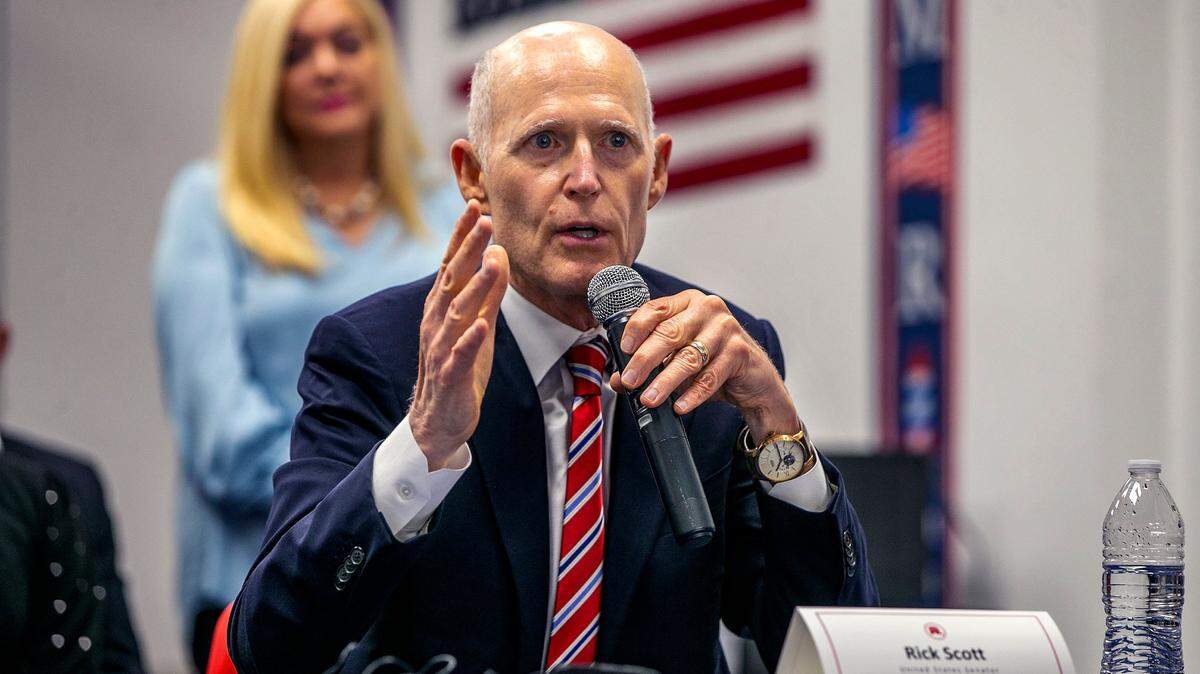
Florida’s junior U.S. senator — know for his “Let’s get to work” slogan and for depicting unemployed Americans on welfare as living off the backs of hard-working people — now is urging Americans to not apply for thousands for jobs at the Internal Revenue Service.
The irony is not lost on us that the wealthy, anti-IRS Sen. Rick Scott recently released a plan to “rescue America” in which he lamented that too many Americans are exempt from paying the same federal income taxes the IRS is in charge of collecting.
The former Florida governor posted a manifesto-like “open letter” on LinkedIn brimming with inflammatory misrepresentations and half-truths about recent IRS job postings.
“The Democrats’ plans to defund the actual police and create an IRS super-police force will not be tolerated by the American people,” Scott wrote.
In the wake of Congress passing the Democratic “Inflation Reduction Act,” Republicans have zeroed in on $80 billion allocated to the IRS. They claim the money will be used to audit middle-class and working-class Americans. They cite a 2021 Treasury analysis that found the agency could hire nearly 87,000 employees over a decade — not overnight — some to replace retiring employees and not all in auditing or tax enforcement.
It’s unclear how many hires actually will occur, but it’s clear that the IRS has been dealing with shortages, ranging from pens and paper to employees to answer customer-service calls. Its Trump-appointed commissioner has told Congress agency staffing is close to 1974 levels, and the number of full-time employees has dropped by 30% since 2010, even though the tax-filing population has increased by 14%.
Treasury Secretary Janet Yellen has issued a memo directing the IRS to use the cash infusion to go after “high-net-worth individuals, large corporations and complex partnerships who today pay far less than they owe,” and not “households earning $400,000 per year or less or small businesses.”
But some Republicans wouldn’t let the facts get in the way. They have resorted to fear-mongering to attack the Inflation Reduction Act, which includes popular provisions on climate change and prescription-drug costs for seniors.
Fear mongering
No one has peddled fear about this issue better than Scott, who wrote that new IRS employees would have to be willing “to kill” their neighbors and friends.
We’re not making this up.
A false claim has been circulating on social media that the IRS is looking for 87,000 new armed agents. It was based on a job posting for special agents for the Criminal Investigation department, a law-enforcement agency within the IRS that investigates criminal tax violations and other financial crimes, such as money laundering. Reuters reported last week the ad said new hires must “Carry a firearm and be willing to use deadly force, if necessary” under “major duties” of the role, though that part was since been taken out.
Only 2,100 IRS special agents carry firearms, according to Reuters, which labeled the social-media claim “false.” Unarmed civilians perform most of the agency’s duties.
In comes Scott, driving a truck full of gasoline into the fire. He doesn’t go as far as saying all of those 87,000 positions would require the use of firearms. But he conveniently leaves out important context, writing that the “IRS made it very clear that one of the ‘major duties’ of these new positions is to “be willing to use deadly force.”
“The IRS is making it very clear that you not only need to be ready to audit and investigate your fellow hardworking Americans, your neighbors and friends, you need to be ready and, to use the IRS’s words, willing, to kill them,” he wrote.
Earlier this year, Scott proposed an 11-point Plan to Rescue America that indicated his support for requiring that millions of Americans who currently don’t pay federal income taxes — because they don’t work, earn too little or for other reasons — to start paying them.
“All Americans should pay some income tax to have skin in the game, even if a small amount. Currently over half of Americans pay no income tax,” Scott’s plan read.
Scott’s plan drew GOP opposition and got dressed down by Senate Minority Leader Mitch McConnell. Scott has vehemently denied he wanted to raise taxes — “Senator Scott has not proposed any new taxes or tax increases. Period,” his office told the Herald Editorial Board. But the senator’s own plan, even in its vagueness, contradicts that.
After the backlash, Scott removed the reference to taxes from his revised 11-point plan and replaced it with a call that “able-bodied Americans under 60” should be “pulling the wagon and paying taxes.”
This time, Scott’s words on the IRS are crystal clear and based on egregious misrepresentations that instill fear and animosity among Americans.
Don’t be fooled.
BEHIND THE STORY
MOREWhat's an editorial?
Editorials are opinion pieces that reflect the views of the Miami Herald Editorial Board, a group of opinion journalists that operates separately from the Miami Herald newsroom. Miami Herald Editorial Board members are: opinion editor Amy Driscoll and editorial writers Isadora Rangel and Mary Anna Mancuso. Read more by clicking the arrow in the upper right.
What's the difference between an op-ed and a column?
How does the Miami Herald Editorial Board decide what to write about?
The Editorial Board, made up of experienced opinion journalists, primarily addresses local and state issues that affect South Florida residents. Each board member has an area of focus, such as education, COVID or local government policy. Board members meet daily and bring up an array of topics for discussion. Once a topic is fully discussed, board members will further report the issue, interviewing stakeholders and others involved and affected, so that the board can present the most informed opinion possible. We strive to provide our community with thought leadership that advocates for policies and priorities that strengthen our communities. Our editorials promote social justice, fairness in economic, educational and social opportunities and an end to systemic racism and inequality. The Editorial Board is separate from the reporters and editors of the Miami Herald newsroom.
How can I contribute to the Miami Herald Opinion section?
The Editorial Board accepts op-ed submissions of 650-700 words from community members who want to argue a specific viewpoint or idea that is relevant to our area. You can email an op-ed submission to oped@miamiherald.com. We also accept 150-word letters to the editor from readers who want to offer their points of view on current issues. For more information on how to submit a letter, go here.
This story was originally published August 25, 2022 at 9:42 AM.