
Caring people behind a Miami mental-health initiative want to change a tragic narrative | Editorial
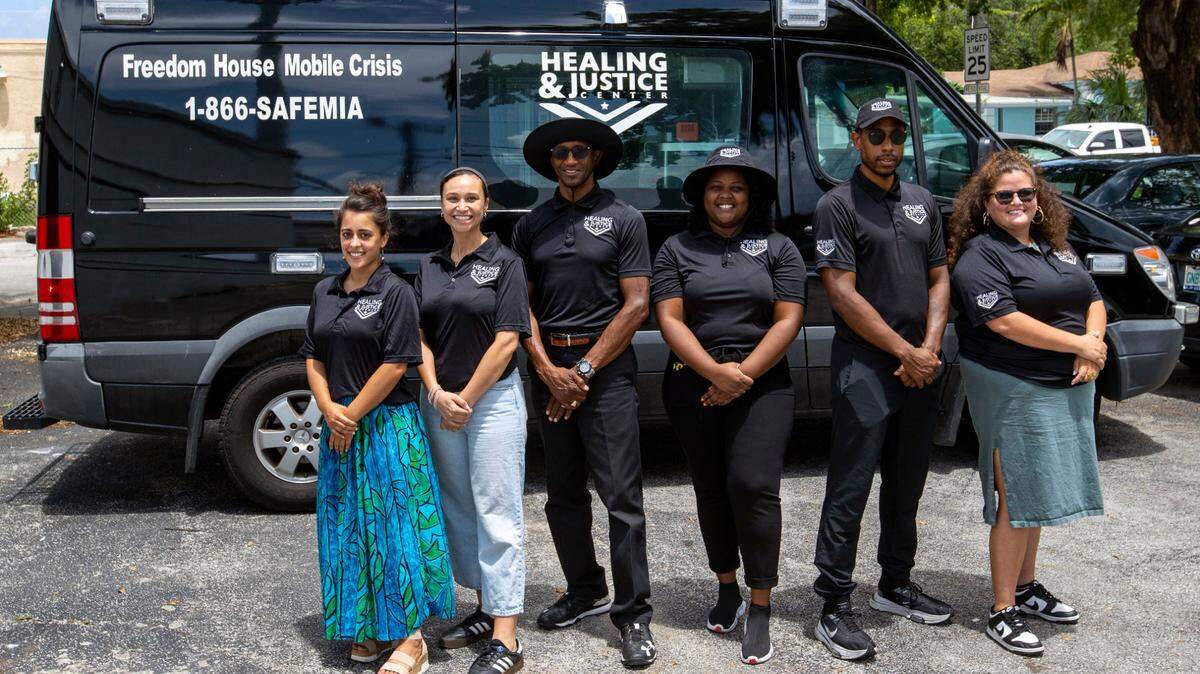
Sometimes, calling the police to deal with a mentally ill person in Miami-Dade ends not with the person getting desperately needed help, but with a tragic use of deadly force.
We’ve seen the news stories. The arriving officer is met by a person having a psychotic episode, maybe threatening themselves, those around them and the officer. Sometimes, they are armed. As the incident escalates, the officer will often see no recourse, but to follow the manual and take the person down.
It’s a disturbing reality when policing and mental illness collide, especially in Black and Hispanic neighborhoods.
And it remains a problem even though local police departments, after the murder of George Floyd by Minneapolis police, have put great emphasis on learning to de-escalate emotionally charged incidents with residents.
We applaud a game-changing grassroots pilot project being introduced in Liberty City, created by a coalition of Miami groups that have a big and admirable goal to change how low-income Black and brown communities — and the addicted and mentally ill — are encountered by police.
Why Liberty City first? “That community is over-policed, and we saw it as a great place to launch our pilot program,” Dr. Armen Henderson, who practices internal medicine in the University of Miami Health System, told the Editorial Board. Henderson first made headlines in 2020 when he led a medical team in testing homeless people for COVID-19. It was a commendable effort. He was in the news again when a Miami police sergeant investigating illegal dumping handcuffed the doctor outside his home. Months later, Miami’s Civilian Investigative Panel determined the law-enforcement officer violated procedure.
Henderson says statistics from the Treatment Advocacy Center show that if police are called to deal with someone having a mental-health crisis, that person is 16 times more likely to be shot and killed. That figure, although seven years old, is not difficult to believe.
Put simply, police officers are not “licensed health professionals,” Alexis Piquero, a criminologist and chair of sociology at the University of Miami, told the Miami Herald. He’s right.
One way to reduce such deadly conflicts is to minimize the interactions between police and residents in Liberty City. This is the kind of valuable project we hope catches on and is duplicated across the county.
The idea is to divert calls from Liberty City residents from 911 to the Freedom House Mobile Crisis Team van — 1-866-SAFE MIA — when they encounter someone in the midst of a mental-health emergency. Freedom House will send a therapist, a conflict resolution specialist and a medic to the scene. As the program grows, they may add a social worker.
This changes the equation to helping, not punishing.
”It’s a way not to have every public-health issue handled by police,” Rachel Gilmer, co-executive director of Dream Defenders, told the Board. “It’s a new way to look at what public safety can really mean.”
The program is a relatively novel idea in Miami, although it’s been tried in other cities, including Dallas, Texas, and Eugene, Oregon.
The program is funded by a $900,000 grant from the Open Society Foundation to the Dream Defenders’ Healing and Justice Center, a coalition of organizations, including Dade County Street Response, Beyond the Bars and Circle of Brotherhood, that provide an array of services from free health clinics to youth programs.
In Miami, organizers are trying to spread the word about the alternative call to 911 by going to shopping centers and parks and introducing the concept to residents.
The coalition says it is purposely remaining independent of local police. ”We don’t want them to have a say in what we do, but we do want them to see us as an asset,” Henderson said.
Indeed, they are an asset. We would also urge police and Freedom House to at least get to know each other, to cooperatively work together when necessary, and learn from and enhance each other.
Neither side can operate in a vacuum. And they definitely are not in contention. We think that, ultimately, they are on the same side.
BEHIND THE STORY
MOREWhat's an editorial?
Editorials are opinion pieces that reflect the views of the Miami Herald Editorial Board, a group of opinion journalists that operates separately from the Miami Herald newsroom. Miami Herald Editorial Board members are: opinion editor Amy Driscoll and editorial writers Isadora Rangel and Mary Anna Mancuso. Read more by clicking the arrow in the upper right.
What's the difference between an op-ed and a column?
How does the Miami Herald Editorial Board decide what to write about?
The Editorial Board, made up of experienced opinion journalists, primarily addresses local and state issues that affect South Florida residents. Each board member has an area of focus, such as education, COVID or local government policy. Board members meet daily and bring up an array of topics for discussion. Once a topic is fully discussed, board members will further report the issue, interviewing stakeholders and others involved and affected, so that the board can present the most informed opinion possible. We strive to provide our community with thought leadership that advocates for policies and priorities that strengthen our communities. Our editorials promote social justice, fairness in economic, educational and social opportunities and an end to systemic racism and inequality. The Editorial Board is separate from the reporters and editors of the Miami Herald newsroom.
How can I contribute to the Miami Herald Opinion section?
The Editorial Board accepts op-ed submissions of 650-700 words from community members who want to argue a specific viewpoint or idea that is relevant to our area. You can email an op-ed submission to oped@miamiherald.com. We also accept 150-word letters to the editor from readers who want to offer their points of view on current issues. For more information on how to submit a letter, go here.
This story was originally published June 15, 2022 at 6:00 AM.