
Florida’s DeSantis is a politically savvy power player. And he’s beating Trump at his own game | Editorial
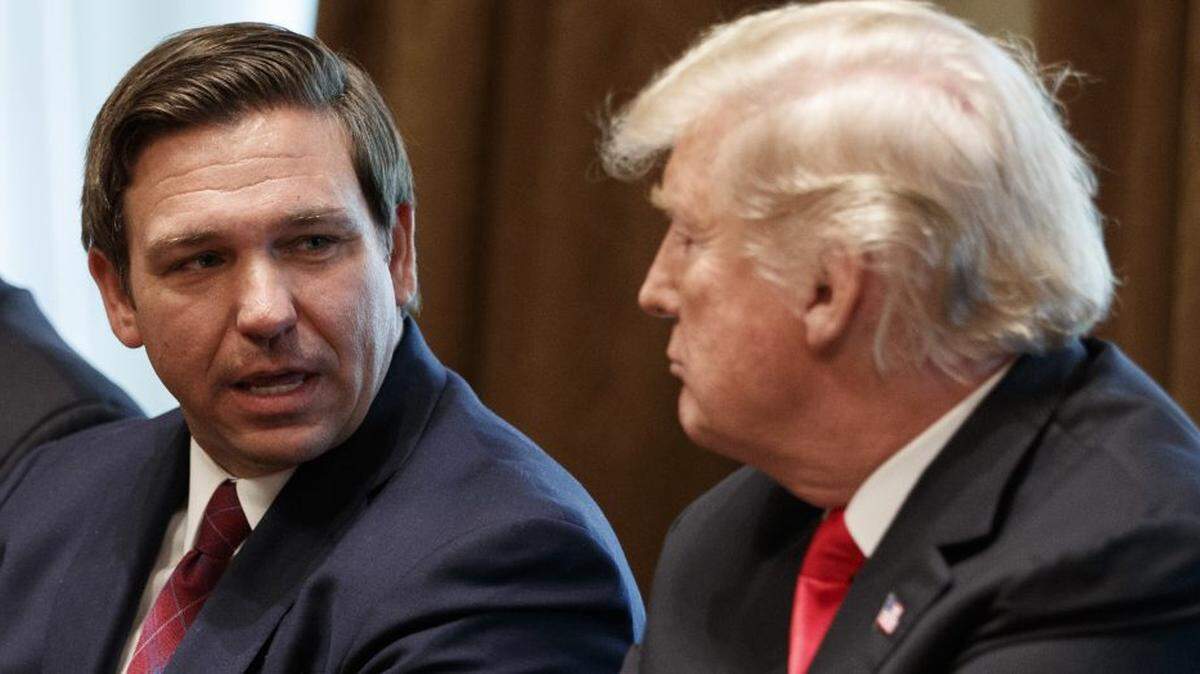
He’s younger, prettier and speaks in complete, comprehensible sentences. And he speaks directly to former President Donald Trump’s rock-solid base — which is showing a few cracks.
As reported by Politico, Florida Gov. Ron DeSantis beat out Trump in a straw poll of attendees at last weekend’s Western Conservative Summit in Denver, Colorado. Among the participants, 71% want our governor to run for president in 2024; Trump came in at an irritating 67% — irritating to Trump, at least. And Texas Sen. Ted “Have one door into and out of the school” Cruz? He lagged at 28% — somewhat of a relief to many, we guess.
Florida’s governor bested Trump at last year’s conference, too. Although straw polls are far from being a scientific or accurate measure of the overall electorate, they show that DeSantis’ support among core voters is growing.
DeSantis is Trump’s creation. The mentor remains a force in the Republican Party — hell, he is the Republican Party — anointing candidates for Congress and still bloviating, untruthfully, about his election loss in 2020. But DeSantis, the mentee, is doing in Florida what Trump could not, except through reversible executive orders. He is wielding direct power over policy, enshrining conservative values in the law.
With singular ambition — and a malleable Republican Legislature — he has intimidated, handcuffed or struck down anything or anyone who doesn’t sit right with him or the voters he needs to win in the 2024 Republican primary: Disney’s support for gay rights; Black representation in Congress; the truth of Black history and the present-day experiences of Blacks and other minorities; LGBTQ+ existence; women’s continued fight for reproductive rights. Gun-control advocates. Some immigrants are OK in his book; others, not so much. And in excoriating Democrats’ alleged socialist leanings and supposed indoctrination, he is employing the same autocratic methods he decries.
According to the investigative and corporate-accountability newsletter Seeking Rents, DeSantis is hellbent on tightening his grip on public universities; strengthening his authority to remove independently elected school board members and state’s attorneys; clamping down on citizen campaigns to amend the state Constitution; and stripping oversight authority from the state’s independently elected Cabinet members.
Americans who fled dictatorships of all ideologies should see where this is headed. Yet many of them are among his — and Trump’s — most ardent supporters, and eating it up.
DeSantis’ poll numbers clearly are the result of his carefully cultivated moves to gain the national stage. He deployed law enforcement from Florida to Texas to help stem the tide of migrants trying to cross the U.S.-Mexico border, then paid agents a photo-oppable visit. He reopened the state during the coronavirus pandemic earlier than blue states. And though his COVID policies put so many people in danger, he still looked like a boss. He didn’t pitch bleach as a possible cure to COVID-19, he pitched personal freedoms and economic strength.
The competition
Of course, DeSantis is not the only Floridian with his eye on this particular prize. U.S. Sen. Rick Scott, the state’s former governor, clearly is itching to run for the White House in 2024. It’s also clear that he lacks the popularity that DeSantis has among the base. Even Sen. Minority Leader Mitch McConnell rebuked the senator’s 11-point plan to, allegedly, “Rescue America.”
“We will not have as part of our agenda a bill that raises taxes on half the American people, and sunsets Social Security and Medicare within five years,” McConnell vowed. “That will not be part of a Republican Senate majority agenda.”
However, Scott has something DeSantis lacks: boatloads of personal money and the ability to easily raise tons more. DeSantis has already been crisscrossing the country raising money for his gubernatorial reelection, but he’s simultaneously locking up support for 2024.
As governor, Scott was effective at wielding the powers of the executive office, but DeSantis has taken that art and elevated it to a science. Scott had to negotiate with legislative leaders. DeSantis has the leaders doing his bidding and waiting on him hand and foot.
Scott’s ongoing cold war with DeSantis might turn white-hot in the coming year.
And Florida’s other senator, Marco Rubio, once dubbed the “savior” of the Republican Party, is still in the mix, likely looking for a pathway to victory in 2024.
Last weekend’s straw poll results, according to Politico, follow the results of a University of Nevada, Reno, survey finding Florida’s governor neck-and-neck with Trump there. Nevada voters were asked to rate potential 2024 candidates. DeSantis received the highest favorability score of any Republican with all voters — 48% compared to Trump’s 42% — but Trump beat DeSantis when just Republicans were counted.
That’s telling: DeSantis is catching the eye of independents and Democrats, too, boding better for him than for Trump in a general election.
DeSantis clearly is a player for a residence far grander than the Governor’s Mansion. Trump, indeed, has some competition. As a politician, Florida’s governor is more skilled, more experienced, more palatable and, possibly, more dangerous.
BEHIND THE STORY
MOREWhat's an editorial?
Editorials are opinion pieces that reflect the views of the Miami Herald Editorial Board, a group of opinion journalists that operates separately from the Miami Herald newsroom. Miami Herald Editorial Board members are: opinion editor Amy Driscoll and editorial writers Isadora Rangel and Mary Anna Mancuso. Read more by clicking the arrow in the upper right.
What's the difference between an op-ed and a column?
How does the Miami Herald Editorial Board decide what to write about?
The Editorial Board, made up of experienced opinion journalists, primarily addresses local and state issues that affect South Florida residents. Each board member has an area of focus, such as education, COVID or local government policy. Board members meet daily and bring up an array of topics for discussion. Once a topic is fully discussed, board members will further report the issue, interviewing stakeholders and others involved and affected, so that the board can present the most informed opinion possible. We strive to provide our community with thought leadership that advocates for policies and priorities that strengthen our communities. Our editorials promote social justice, fairness in economic, educational and social opportunities and an end to systemic racism and inequality. The Editorial Board is separate from the reporters and editors of the Miami Herald newsroom.
How can I contribute to the Miami Herald Opinion section?
The Editorial Board accepts op-ed submissions of 650-700 words from community members who want to argue a specific viewpoint or idea that is relevant to our area. You can email an op-ed submission to oped@miamiherald.com. We also accept 150-word letters to the editor from readers who want to offer their points of view on current issues. For more information on how to submit a letter, go here.