
With no assault-weapons ban in sight, Rubio and Scott must do bare minimum on gun control | Editorial
There won’t be a ban on so-called assault weapons coming from Congress, and don’t hold your breath for limits on high-capacity magazines.
The fate of federal gun control legislation rests in the hands of 10 Republicans needed to overcome a Senate filibuster — and Democrats keeping a united front. If a bipartisan group negotiating a compromise comes up with anything, it will be lackluster. On the flip side, it will be harder to argue it’s an attack on the Second Amendment.
Florida — home of the Parkland and Pulse nightclub mass shootings — will be looking to its senators, Rick Scott and Marco Rubio, to do their job. But neither have said they will support any form of gun legislation beyond encouraging states to pass “red flag” laws. Lawmakers should, at a minimum, strengthen background checks and gun-storage requirements.
If they can’t show a backbone and compromise after the murders of 10 people in Buffalo, New York, and 19 elementary school children and two teachers in Uvalde, Texas, then when will they?
It will be hard to justify inaction after the heart-wrenching U.S. House testimony of the 11-year-old who survived the Texas shooting by playing dead and covering herself in a classmate’s blood. Or the pediatrician who saw the unrecognizable bodies of children mangled by bullets from an AR-15-style rifle.
Dr. Roy Guerrero told lawmakers he saw “two children whose bodies had been pulverized by bullets fired at them, decapitated, whose flesh had been [so] ripped apart, that the only clue as to their identities was the blood-spattered cartoon clothes still clinging to them.”
Gory, but necessary, details that lawmakers — in theory — can’t brush aside.
‘Political theater’
The U.S. House’s passage of a package of gun reforms on Wednesday was a partisan showdown. The “Protecting our Kids Act” got only five Republican votes and has no chance in the Senate. The bill raises the minimum age to buy a semi-automatic rifle to 21 and prohibits the sale of ammunition magazines with a capacity of more than 15 rounds.
Miami Republicans Maria Elvira Salazar, Carlos Gimenez and Mario Diaz-Balart opposed the legislation. Salazar voted in favor of a stand-alone provision on the age restriction.
Gimenez and Diaz-Balart issued statements that called the House vote “political theater” and “radical.” Yes, it was a partisan tactic to put Republicans on the record opposing gun control. But radical? No, considering polls show many Americans support these measures.
Both congressmen have tried to switch the focus to strengthening school security and addressing mental health — a deflection tactic we’ve seen before. Gimenez said that as Miami-Dade County mayor he oversaw the spending of $20 million to ensure that every school had a law enforcement officer and the creation of an active shooter response team in the county Police Department. Diaz-Balart highlighted his co-sponsoring a bipartisan bill to help states enforce existing laws to keep guns from people not legally allowed to own one.
These are good measures, but they don’t go far enough.
Rubio and Scott
In the Senate, the clock is ticking for an agreement before lawmakers leave D.C. on June 24 for a two-week recess.
Among the very modest proposals on the table is allowing the inspection of criminal records of juvenile gun buyers under the age of 21, more funding to address mental health and school security, and federal incentives for states to pass red flag laws, ABC News reported.
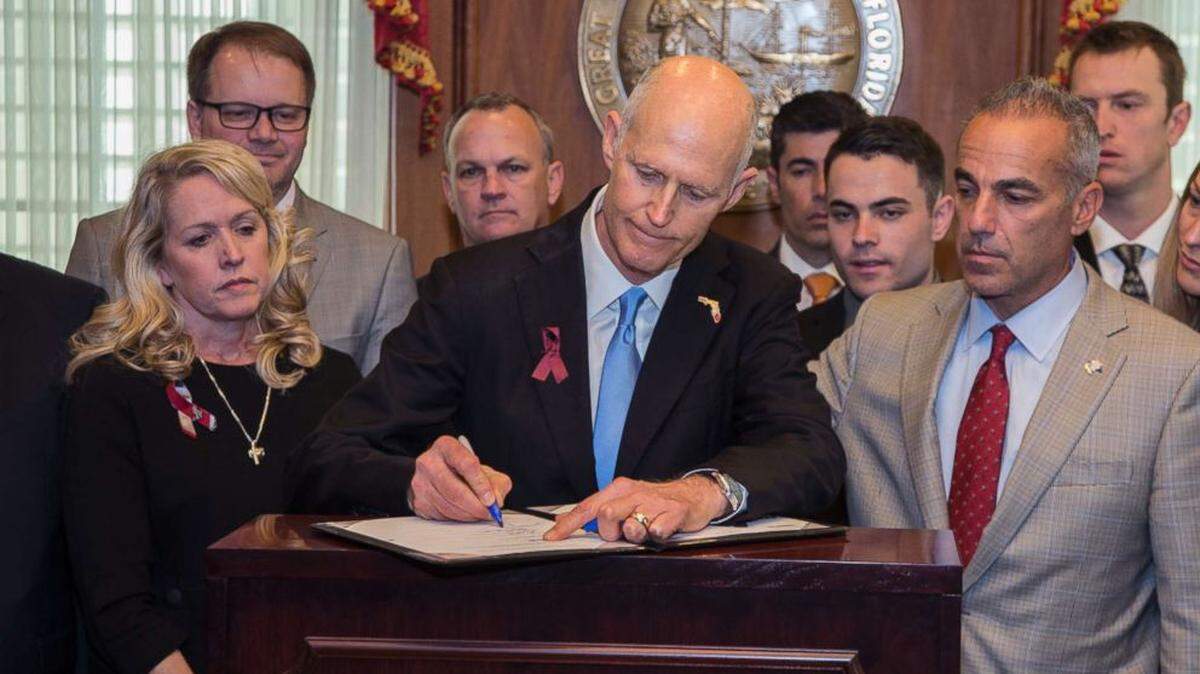
Conspicuously absent is raising the age requirement for rifle purchases. That was part of a package of reforms Florida Republicans championed after Parkland. Scott, then governor, signed it into law in 2018.
Although Scott “encourages every state to look at the targeted action he took” as governor, his office told the Herald Editorial Board he’s against age restrictions at the federal level.
“Senator Scott is not working on federal gun legislation,” his office said via email.
That’s unconscionable, but not surprising given extreme partisanship in Congress.
Rubio’s office didn’t say whether he would support raising the age restriction or more background checks. Instead, his spokesman highlighted other legislation that he’s backed, such as a bill to improve threat assessments at schools and the 2018 STOP School Violence Act, which provided violence-prevention grants to states and school districts.
Given this answer, it doesn’t look like Rubio will be on board with anything that curbs access to weapons. That’s disappointing.
There’s a glimmer of hope in that Rubio and Scott are co-sponsors of a bill that would use funding and other mechanisms to encourage states to enact red flag laws. Those allow law enforcement or family members to ask for a court order to prevent firearm purchases and possession by people who pose a significant threat to themselves or others.
The two senators also are behind the Luke and Alex School Safety Act, named after two Parkland victims, which codifies a federal school safety clearinghouse. Senate Majority Leader Chuck Schumer blocked the bill.
School security is a part of the equation Democrats cannot ignore. But the issue is becoming a cover for Republicans unwilling to act on gun control much like blaming every mass shooting on mental health. If preventing mass shootings is even possible, it won’t happen without a comprehensive approach.
It would be foolish to expect any significant reforms from Senate Republicans. But they owe the nation more than what they have offered so far.
BEHIND THE STORY
MOREWhat's an editorial?
Editorials are opinion pieces that reflect the views of the Miami Herald Editorial Board, a group of opinion journalists that operates separately from the Miami Herald newsroom. Miami Herald Editorial Board members are: opinion editor Amy Driscoll and editorial writers Isadora Rangel and Mary Anna Mancuso. Read more by clicking the arrow in the upper right.
What's the difference between an op-ed and a column?
How does the Miami Herald Editorial Board decide what to write about?
The Editorial Board, made up of experienced opinion journalists, primarily addresses local and state issues that affect South Florida residents. Each board member has an area of focus, such as education, COVID or local government policy. Board members meet daily and bring up an array of topics for discussion. Once a topic is fully discussed, board members will further report the issue, interviewing stakeholders and others involved and affected, so that the board can present the most informed opinion possible. We strive to provide our community with thought leadership that advocates for policies and priorities that strengthen our communities. Our editorials promote social justice, fairness in economic, educational and social opportunities and an end to systemic racism and inequality. The Editorial Board is separate from the reporters and editors of the Miami Herald newsroom.
How can I contribute to the Miami Herald Opinion section?
The Editorial Board accepts op-ed submissions of 650-700 words from community members who want to argue a specific viewpoint or idea that is relevant to our area. You can email an op-ed submission to oped@miamiherald.com. We also accept 150-word letters to the editor from readers who want to offer their points of view on current issues. For more information on how to submit a letter, go here.