
Florida Republicans aren’t done targeting trans youth. Denying them care might be next | Editorial
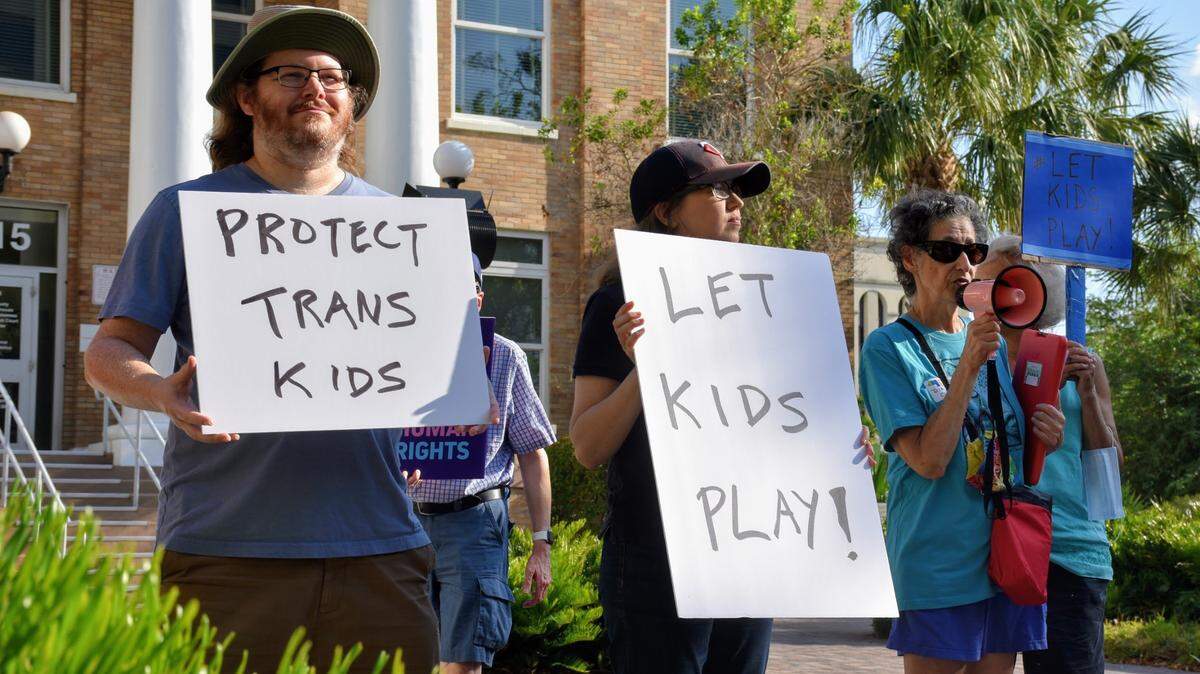
They should not be seen, heard or discussed in classrooms.
Florida is returning to a time when only the voices of a few mattered. Especially irrelevant — or, worse, threatening — to Republicans state leaders are transgender youth. The plan appears to be to shove them back into the closet where they won’t cause discomfort to conservative policymakers.
As Gov. Ron DeSantis scapegoats the LGBTQ community on his possible path to the White House, the infamous Florida parental rights law known as “Don’t say gay” and a transgender athlete ban were likely just the beginning.
Florida is among GOP-led states that have proposed or enacted a raft of measures to deny rights to LGBTQ people. There’s realistic fear that even same-sex marriage, guaranteed by a 2015 U.S. Supreme Court ruling, might be the next target of these states if the court overturns abortion rights under Roe v. Wade.
The Florida Department of Health last month issued recommendations against providing transition treatment to transgender teenagers, such as hormones and gender-affirming surgery, which is more typically done on adults. The guidance even advises against social transition, such as name, pronoun and clothing changes — the stuff that really irks conservatives.
The document seems more like a political stance than an attempt to protect youth. Withholding care can “prolong gender dysphoria and contribute to an appearance that could provoke abuse and stigmatization,” the World Professional Association for Transgender Health warns.
Doctors oppose
A group of 300 health care providers signed an open letter in the Tampa Bay Times opposing the DOH’s position. Among them was former Florida Surgeon General and DOH head Scott Rivkees. Rivkees was apparently sidelined by DeSantis when he spoke in favor of masks and social distancing in the early stages of the COVID-19 pandemic. His successor, Dr. Joseph Ladapo, has toed DeSantis’ anti-mask, vaccine-skeptic line.
The letter accused the DOH of cherry-picking studies on transgender care. For example, the agency states its guidance is in line with the recommendations by Sweden, Finland, the United Kingdom and France. But “none of these countries recommends against social gender transition, and all provide a path forward for patients in need of medical intervention,” the letter states.
Sweden this year published new recommendations that advise “restraint when it comes to hormone treatment,” citing lack of evidence on effects and safety. But it also says that treatment should be used “in cases where they are deemed justified” and that teens with gender dysphoria must be taken seriously and “offered adequate care measures.”
The decision to undergo treatment has life-changing impacts that young people cannot make alone. Parents, with medical advice, should have the ultimate say after knowing the risks and benefits. But the DOH leaves no room for such nuance and instead suggests an outright ban that smacks of grandstanding.
Outlawing care
Luckily, Florida’s misguided guidelines aren’t enforceable. But that might change with a bill Central Florida GOP Rep. Randy Fine said he will file next year to outlaw gender-affirming medications and surgery for minors.
Similar legislation has been filed in the past but didn’t advance. But times have changed. The Legislature has embraced a hard-right agenda in its past two sessions. For example, lawmakers fast-tracked the “Don’t say gay” law, which bans K-3 instructions on gender identity and sexual orientation, and limits on classroom discussions and workplace training on racism and sexism.
More than a dozen states are considering proposals to penalize healthcare providers for providing gender-affirming care, POLITICO reported. In a display of even greater cruelty, Texas Gov. Greg Abbott ordered child abuse investigations into parents who allow their children to obtain these potentially life-saving treatments.
It would be a waste of time to hope Republican leaders understand that being LGBTQ isn’t a “trend” or a “phase.” These adults would rather spend their political capital making children and teens feel inadequate in the hopes of drumming up votes.
They also appear to be ensuring the state remains in ignorance when it comes to the lives of the teens affected by their policies.
Florida has withdrawn its three-decade-long participation in the federal Youth Risk Behavior Survey. The confidential survey asks high-school students things like their sexual orientation, gender identity, sexual behavior, whether they use drugs, drink alcohol and milk, eat fast food and think about suicide. That data is used to learn what kind of physical and emotional problems threaten teenagers.
The Department of Education told the Herald Editorial Board it “withdrew from a federal grant we did not view as necessary to collect this information,” and “we will not stop collecting data.” The agency didn’t specify how it will do that. Our guess is that it will cater to the sensitivities of the adults in state leadership who don’t want to feel uneasy.
Lawmakers should quit legislating their discomfort. Transgender people aren’t a threat. The real threat comes from lawmakers with an ax to grind.
BEHIND THE STORY
MOREWhat's an editorial?
Editorials are opinion pieces that reflect the views of the Miami Herald Editorial Board, a group of opinion journalists that operates separately from the Miami Herald newsroom. Miami Herald Editorial Board members are: opinion editor Amy Driscoll and editorial writers Isadora Rangel and Mary Anna Mancuso. Read more by clicking the arrow in the upper right.
What's the difference between an op-ed and a column?
How does the Miami Herald Editorial Board decide what to write about?
The Editorial Board, made up of experienced opinion journalists, primarily addresses local and state issues that affect South Florida residents. Each board member has an area of focus, such as education, COVID or local government policy. Board members meet daily and bring up an array of topics for discussion. Once a topic is fully discussed, board members will further report the issue, interviewing stakeholders and others involved and affected, so that the board can present the most informed opinion possible. We strive to provide our community with thought leadership that advocates for policies and priorities that strengthen our communities. Our editorials promote social justice, fairness in economic, educational and social opportunities and an end to systemic racism and inequality. The Editorial Board is separate from the reporters and editors of the Miami Herald newsroom.
How can I contribute to the Miami Herald Opinion section?
The Editorial Board accepts op-ed submissions of 650-700 words from community members who want to argue a specific viewpoint or idea that is relevant to our area. You can email an op-ed submission to oped@miamiherald.com. We also accept 150-word letters to the editor from readers who want to offer their points of view on current issues. For more information on how to submit a letter, go here.