
Florida legislators handed DeSantis more power on redistricting. That’s dangerous | Editorial
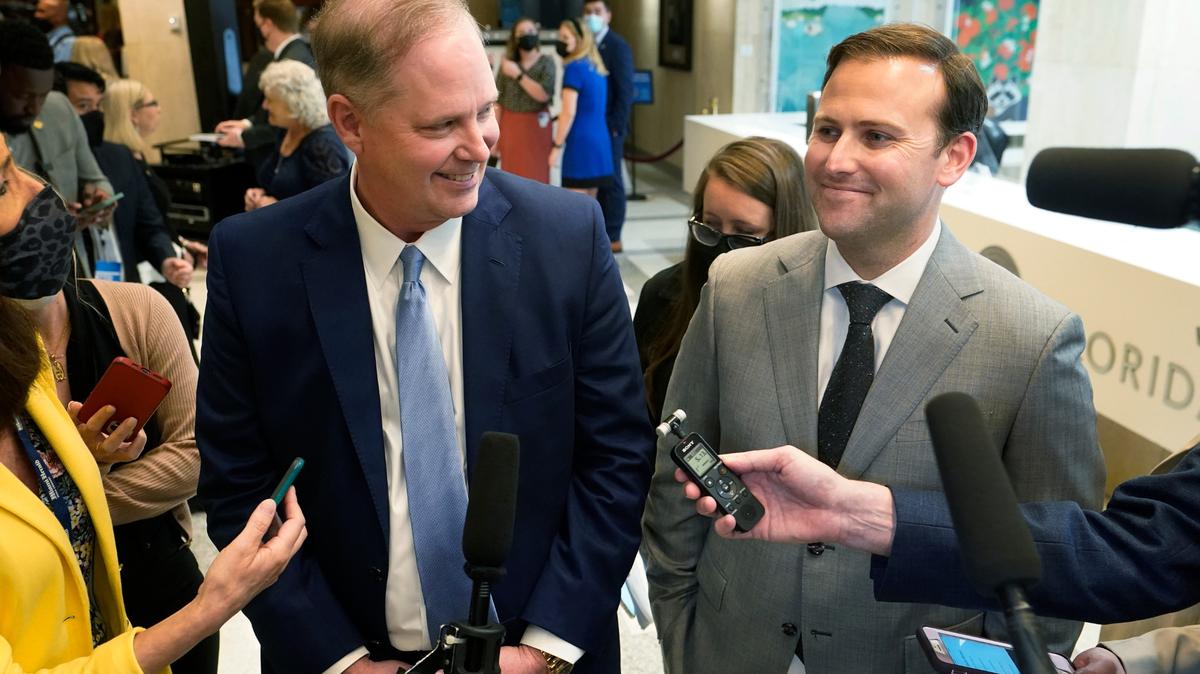
The Legislature, which has been locked in a protracted standoff with the governor over the redrawing of congressional district maps, just handed the mapping process over to Gov. Ron DeSantis.
What happened to check-and-balance government, designed to stop any one branch from seizing too much control? What happened to separation of powers? Florida has already mostly been one-party rule, with the governor and Legislature in Republican hands. Are we now turning into a state of one-man rule?
Announced Monday by Senate President Wilton Simpson, R-Trilby, and House Speaker Chris Sprowls, R-Palm Harbor, the decision to let the governor come up with the maps is an unprecedented move that seems to run directly counter to the role of the Legislature. That role is spelled out on nothing less than the Florida redistricting website, created by the same Legislature that just abandoned its responsibilities: “The Florida Constitution directs the Legislature to redraw district boundaries at its Regular Session in the second year following each decennial census.”
It does not say the Florida Legislature should abdicate its responsibilities when there might be political consequences to arguing with a powerful governor. It doesn’t say lawmakers should let the governor decide how to reapportion the state’s 28 congressional districts for the next decade. It says: Draw the boundaries.
At the heart of the dispute is the governor’s insistence that congressional districts in North Florida be carved up in a way that would dilute Black voting strength. Critics have said the map he had pushed for violates the state Fair Districts constitutional amendment, which is supposed to ensure that minority communities can elect representatives of their choice.
The House and Senate had been pushing back, a least a little. But now, it appears, they have caved.
Redistricting is the job of the Legislature every 10 years. Lawmakers draw up legislative maps and congressional maps. The governor gets his say through the power of his veto on congressional maps. That’s already happened this year, when lawmakers agreed on maps for congressional districts and the governor vetoed them. But the next part of the process is to try to work it out — in a special session already set to start April 19 — and if that fails, which seems likely, go to court.
Ultimately, we have no doubt that’s where this will land. That’s not without additional risks. We worry that the Fair Districts amendment, approved by Floridians in 2010, may wind up under attack.
The pressure to get this done is growing. Florida got a new seat in Congress after the U.S. Census, which means the state can’t simply fall back on its old district lines while legal wrangling goes on for years, as has happened in the past. (The number of seats is based on population.) The last day for candidates to qualify to run for a congressional seat in 2022 is June 17, and the primary is Aug. 23.
In this case, it looks like it’ll come down to the courts to function as a check on the power of the executive branch. That’s a critically important role of a functioning democracy. And it’s a role Florida lawmakers just discarded and walked away from.
BEHIND THE STORY
MOREWhat's an editorial?
Editorials are opinion pieces that reflect the views of the Miami Herald Editorial Board, a group of opinion journalists that operates separately from the Miami Herald newsroom. Miami Herald Editorial Board members are: opinion editor Amy Driscoll and editorial writers Isadora Rangel and Mary Anna Mancuso. Read more by clicking the arrow in the upper right.
What's the difference between an op-ed and a column?
How does the Miami Herald Editorial Board decide what to write about?
The Editorial Board, made up of experienced opinion journalists, primarily addresses local and state issues that affect South Florida residents. Each board member has an area of focus, such as education, COVID or local government policy. Board members meet daily and bring up an array of topics for discussion. Once a topic is fully discussed, board members will further report the issue, interviewing stakeholders and others involved and affected, so that the board can present the most informed opinion possible. We strive to provide our community with thought leadership that advocates for policies and priorities that strengthen our communities. Our editorials promote social justice, fairness in economic, educational and social opportunities and an end to systemic racism and inequality. The Editorial Board is separate from the reporters and editors of the Miami Herald newsroom.
How can I contribute to the Miami Herald Opinion section?
The Editorial Board accepts op-ed submissions of 650-700 words from community members who want to argue a specific viewpoint or idea that is relevant to our area. You can email an op-ed submission to oped@miamiherald.com. We also accept 150-word letters to the editor from readers who want to offer their points of view on current issues. For more information on how to submit a letter, go here.
This story was originally published April 11, 2022 at 6:14 PM.