
Housing costs are so high, only out-of-state transplants think Miami’s a bargain | Editorial
Miamians have known for a long time that their city is expensive, so it’s ironic that transplants from other states look at our soaring housing prices and see a bargain.
The influx of people moving to South Florida from places with higher incomes and living costs during the pandemic has created a perfect storm, the Herald reported Tuesday. The Miami metro area, already one of the most unaffordable in the nation, has gotten worse.
The average monthly rent for an apartment in Miami was $3,020 in December, a 34% annual increase, according to estate brokerage firm Redfin. In the tri-county area of Miami-Dade, Broward and Palm Beach, the average was $2,564 in December, according to Zillow.
For the transplant from New England or New York, that might seem like a great deal, but not for Miami couples earning the area’s median income of $76,831; the large portion of local residents working service-sector and hospitality jobs; or even professionals with a college degree who make less than their counterparts in other parts of the country.
People from the Northeast and Midwest “consider $2,200 for an apartment a great deal compared to where they are coming from,” Jack McCabe, owner of McCabe Research & Consulting, told the Herald. “They also have more cash in the bank than people in Miami do.
“People in Miami can’t afford this, because their salaries are not going up as high.”
Cash is king
Buying a home is just as hard nowadays, with out-of-state buyers offering cash for homes they haven’t even seen. The median house sales price has reached $525,000.
Let’s just say it: Miami is becoming less of a place for the majority of Miamians.
Mayor Francis Suarez, who has worked to attract tech companies to the city, recently touted in an interview with CBS4 that the city is using money from a voter-approved bond referendum to help build more housing and that 14 new high-rises will be built over the next couple of years to alleviate the city’s supply-and-demand problem. At one of those new buildings breaking ground, the Okan Tower in downtown, units prices are expected to start at $387,000 for 445 square feet. Wow.
We hope Suarez is right, but the area needs 40,000 affordable-housing units, thousands more than what’s in the pipeline in Miami-Dade and the city of Miami, the Herald reported. It also seems that Suarez doesn’t appear to get the struggle of residents who cannot afford to wait until prices drop.
“One option is to try to find another apartment that’s equivalent or less expensive,” he told CBS4. “. . . The other option is for a job to pay more, your employer to pay more, because they are probably making more money, they’re also benefiting from inflation. Or, B, find a job that pays better and we’re creating those high-paying jobs.”
Talk about being out of touch. Suarez receives a city salary and other cash benefits totaling $130,600 while also working for a national law firm. We need more from our leaders than simply telling people to get better jobs, especially when it appears that high-paying tech jobs have yet to materialize in large numbers, and it’s unclear how many of those are going to locals versus people relocating here. Of course, we should all agree with Suarez that companies should raise wages to compete in a tight labor market in an expensive city.
Florida expensive
The options outside the Miami area don’t necessarily mean greener pastures. Housing costs across the state and the nation are up, in particular for those who need — or want — to stay in a large metropolitan area. A 2021 rent report by Zumper found that five of the top 10 cities with the highest rent increases were in Florida. Miami was in the No. 1 spot, followed by Tampa and Orlando in the top three, then Jacksonville in sixth place and St. Petersburg in 10th. Fort Lauderdale saw rents for two-bedroom apartments jump to a median $2,810, according to Zumper. That’s better than Miami, but not by much.
The conversation about affordable housing normally has revolved around low-income renters, people who qualify for housing vouchers and other assistance. But long forgotten have been people who, at least on paper, should be able to afford a middle-class life. Even those who earn the coveted six-figure household income aren’t necessarily splurging. To pay $3,020 a month with the recommended 30% of your salary, you’d have to make way — way — more than $100,000 annually. A couple earning the median income of $76,831 shouldn’t spend much more than $1,500 on rent. Good luck finding something for that price.
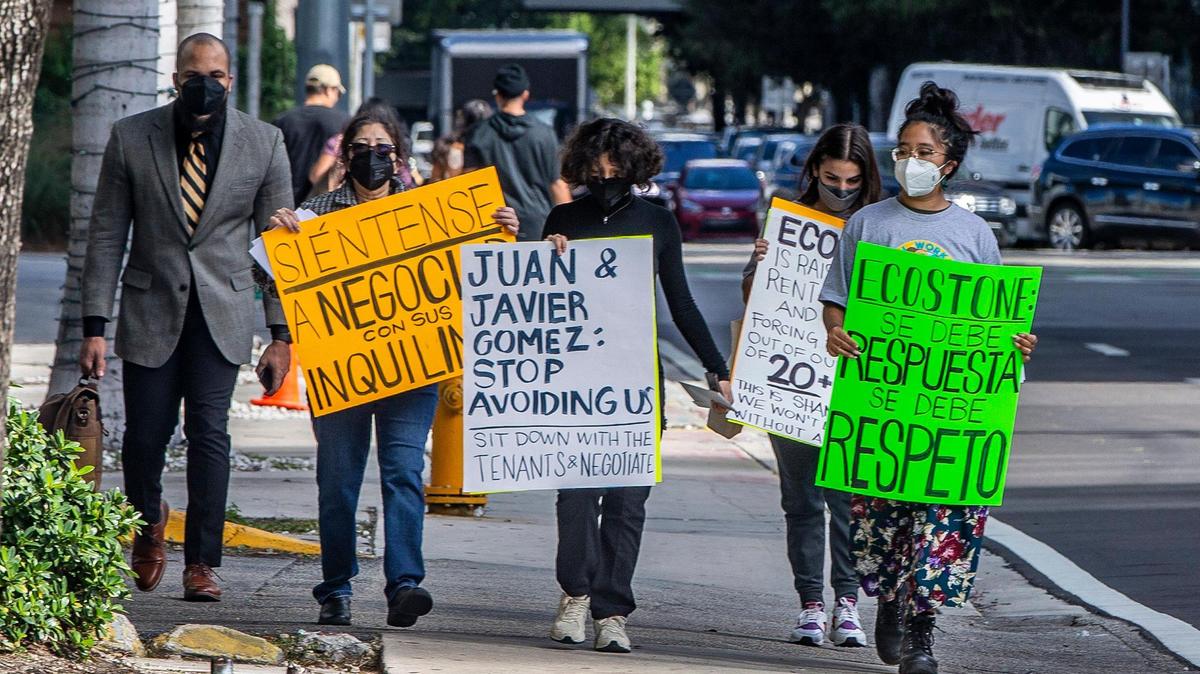
Even areas known for their affordability are seeing residents displaced by jaw-dropping rent increases: $200, $300 and a whopping $650 at a Hialeah apartment complex that was purchased by an investment firm.
Other states have used rent-control laws with mixed results and lots of controversy, but that’s not even a possibility in Florida. The state preempts local governments from imposing such regulations. Legislation to lift that preemption has never gone anywhere. In fact, that’s normally the fate of bills to give renters more rights — such allowing them more time to make good on back rent or to investigate landlords who retaliate against tenants who complain about lack of repairs. Both landlords and tenants deserve protections, but state statute leans heavily in favor of the former.
With very few rights and at the mercy of market forces, it seems that the only option Miami renters have is to ride out the storm like they always have. But it seems they won’t be able to do that for much longer.
BEHIND THE STORY
MOREWhat's an editorial?
Editorials are opinion pieces that reflect the views of the Miami Herald Editorial Board, a group of opinion journalists that operates separately from the Miami Herald newsroom. Miami Herald Editorial Board members are: opinion editor Amy Driscoll and editorial writers Isadora Rangel and Mary Anna Mancuso. Read more by clicking the arrow in the upper right.
What's the difference between an op-ed and a column?
How does the Miami Herald Editorial Board decide what to write about?
The Editorial Board, made up of experienced opinion journalists, primarily addresses local and state issues that affect South Florida residents. Each board member has an area of focus, such as education, COVID or local government policy. Board members meet daily and bring up an array of topics for discussion. Once a topic is fully discussed, board members will further report the issue, interviewing stakeholders and others involved and affected, so that the board can present the most informed opinion possible. We strive to provide our community with thought leadership that advocates for policies and priorities that strengthen our communities. Our editorials promote social justice, fairness in economic, educational and social opportunities and an end to systemic racism and inequality. The Editorial Board is separate from the reporters and editors of the Miami Herald newsroom.
How can I contribute to the Miami Herald Opinion section?
The Editorial Board accepts op-ed submissions of 650-700 words from community members who want to argue a specific viewpoint or idea that is relevant to our area. You can email an op-ed submission to oped@miamiherald.com. We also accept 150-word letters to the editor from readers who want to offer their points of view on current issues. For more information on how to submit a letter, go here.
This story was originally published February 3, 2022 at 1:00 AM.