
Potential interference is already clouding the 2026 midterms | Opinion
It’s not too early to start worrying about efforts to undermine the fairness of the 2026 midterm elections.
President Donald Trump, who famously asked Georgia election officials to “find” 11,780 votes after he lost the state in 2020, is already moving to interfere with state-run elections over which he has no direct authority. His Justice Department has asked for access to election and voting data in a dozen states. It’s not clear what may come next, but fair-election advocates worry that the Trump administration may seek to purge voter rolls or set up post-election challenges.
In Colorado, a consultant who says he is connected to the White House has asked to examine election equipment.
“Whatever the Trump administration tries to pull is very unlikely to be successful,” Colorado Secretary of State Jena Griswold, a Democrat, told Stateline this month. “With that said, do I think they are trying to undermine our elections at large in this country? Absolutely.”
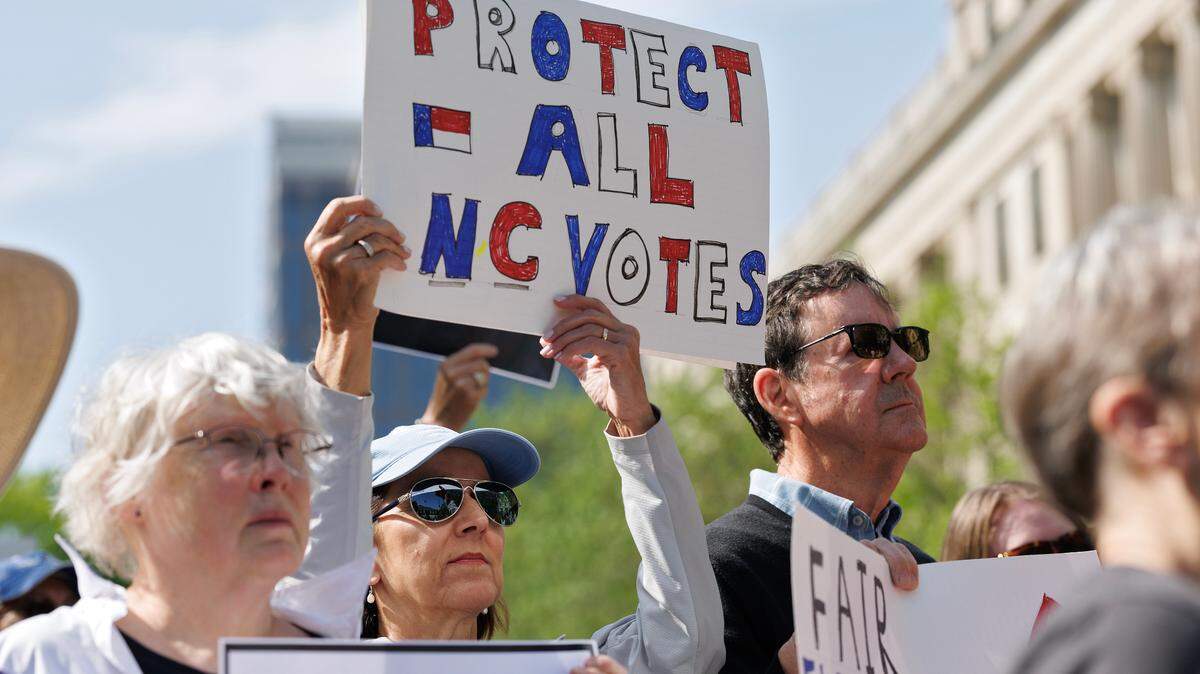
In North Carolina, the Republican effort to exert greater control over elections is already well underway.
In April, Republicans took control of the State Board of Elections from Democratic Gov. Josh Stein based on a law that a panel of N.C. Superior Court judges found to be unconstitutional “beyond reasonable doubt.” But a Court of Appeals panel said, without explanation, that the law should take effect until Stein’s challenge to it is resolved. The Republican majority on the state Supreme Court agreed.
Justice Anita Earls, a Democrat, said in her dissent to the decision, “The General Assembly may not grab power over enforcement of election laws by shuttling the Board between statewide elected officials until it finds one willing to do its bidding.”
It’s a dereliction of duty that the state Supreme Court’s Republican majority allowed the State Board of Elections transformation to go forward before the legality of the change is resolved.
But here we are. Under the new law, the Republican state auditor now has power over appointments to the board — an arrangement found nowhere else in the nation. The five-member board has been appointed with a Republican majority and the board’s new executive director is the former counsel to the Republican state House speaker. County boards of elections have flipped to Republican control. Meanwhile, there’s a proposal in the Republican-controlled legislature to replace some nonpartisan State Board of Elections employees with politically appointed staff.
The changes in the State Board of Elections have not produced anything egregious yet, but the new arrangement is itself an affront to fair elections.
It’s not hard to foresee where the changes could lead. There may be fewer days for early voting; an end of Sunday voting that is favored by many Black voters as part of the “Souls to the Polls” voter drive, fewer polling places on campuses; longer lines at urban polls, and more disputed registrations and provisional ballots.
Bob Hall, a longtime voting rights advocate, isn’t quite ready to sound an alarm about what is shaping up for 2026. “I’m not there yet,” he told me. It’s not that he isn’t concerned. It’s that he doesn’t want to discourage voting.
Hall doesn’t blame the newly appointed State Board of Elections for potentially skewing elections. He said the fault lies with partisan judges who are effectively making new election laws from the bench.
But there’s a reason Republican lawmakers have pushed for years to wrest oversight of elections from the governor. These are the lawmakers who rendered North Carolina among the most extremely gerrymandered states in the nation, the group that has been rebuffed by federal courts for voter suppression. Now they have greater influence over the State Board of Elections and local boards of elections in all 100 North Carolina counties.
It’s further worrying that any challenges to the new board’s actions will face a state Supreme Court and U.S. Supreme Court with narrow views on voting rights and a U.S. Justice Department subservient to a president who is willing to bend election results in his favor.
The 2026 election is still a ways off, but the threat to its fairness is already here.
Ned Barnett is an opinion editor and write for McClatchy and the News & Observer of Raleigh.
This story was originally published July 28, 2025 at 11:35 AM with the headline "Potential interference is already clouding the 2026 midterms | Opinion."