
Haiti is becoming a failed state. The Trump Administration can save it | Opinion
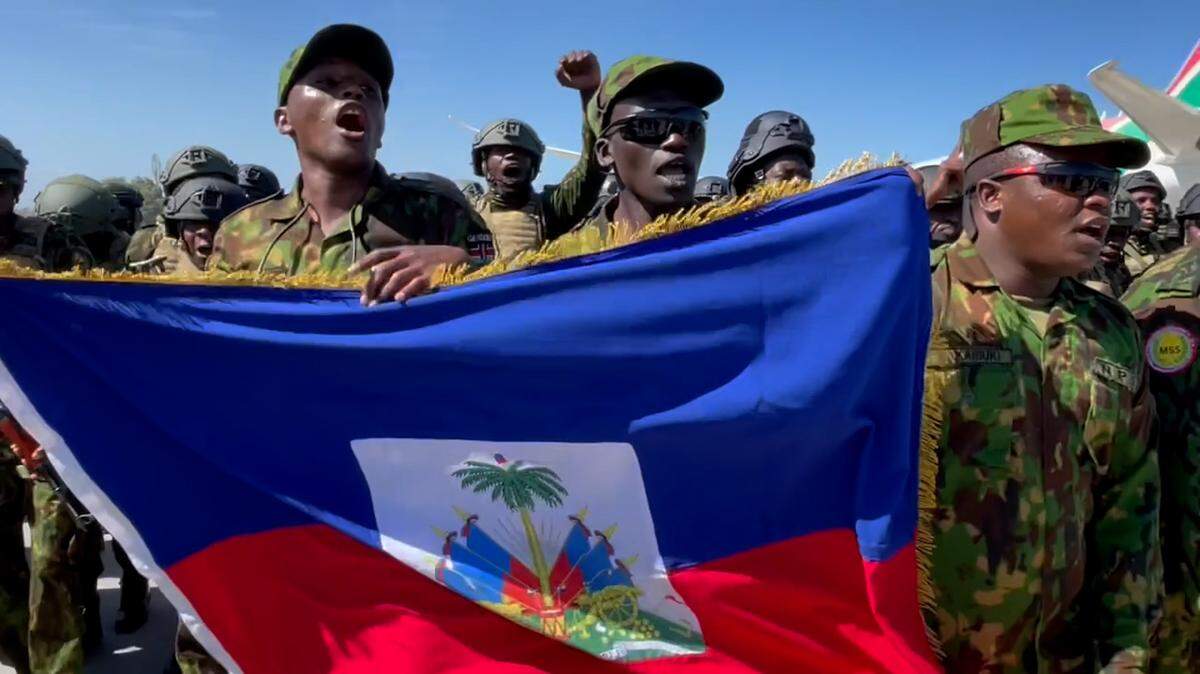
Only a few hours from Florida, Haiti is descending into a failed state. This alarming situation poses significant risks to United States national security, but also presents an opportunity for the Trump administration to pioneer a pragmatic model of cooperation rooted in core American values and business sense.
The streets of Haiti are dominated by violent gangs and the people are sinking into despair. Like the countless Europeans who came to America in earlier times, Haitians are being forced to flee their homes in search of a better life while their country falls into chaos. This crisis calls for an expeditious, vigorous plan to establish security and provide the people with hope.
Realistically, the incoming administration cannot send displaced Haitians back to a country under gang rule with over one million Internally Displaced Persons (IDP), a closed international airport, damaged hospitals, precarious sanitary conditions and rampant hunger. One gang leader had even filmed himself using a drone to direct an attack against the national palace.
Haiti’s security forces are woefully under-equipped to counter these threats, in large measure due to the Leahy Law, which prevents the Haitian security forces from buying armaments from the U.S. or other countries. This effectively ties the hands of the security forces while the flow of guns, munitions and related equipment, mainly from American manufacturers, continues to the bandits.
The Trump administration should waive the Leahy law and allow Haiti to adequately equip and arm its security forces. A training mission led by U.S. Special Forces or private contractors could provide Haitian law enforcement with training in urban counterinsurgency, advanced technological capacity and kinetic weaponry needed to level the playing field and bring the battle to the gangs. Securing the country to stem the flow of drugs, weapons and other illicit traffic would capture the estimated $1 billion lost to smuggling yearly.
If the U.S. fails to dismantle these corrupt networks, the violence in Haiti will continue as will the flow of drugs out of the country. That is why the new administration should formally charge all individuals and entities who have previously been sanctioned by the U.S.
The innocent will have the opportunity to clear their names and regain access to their property. Those found guilty should have their assets forfeited and placed into a trust to compensate their victims.
American administrations have tried to assist Haiti in the past with mixed results. Franklin D. Roosevelt used the Marines to restore internal order after a president was lynched. The U.S. occupation (1915-1934) established a national police force, built hospitals, roadways, airports and an effective national administration – at a high human cost.
President Jimmy Carter’s human rights campaign helped end the kleptocracy and murderous Jean-Claude Duvalier dynasty.
President Bill Clinton, who honeymooned in Haiti, used the U.S. military to reinstate President Jean-Bertrand Aristide to power after a military coup and was involved in reconstruction after the 2012 earthquake.
These efforts, limited in scope and time, have not resulted in stability.
President Trump can succeed because he has assets that other administrations lacked. He has a Haitian-American diaspora, largely in South Florida, that is already supporting Haiti with more than $4 billion a year in remittances, and he is ready to help stabilize and bring hope to Haiti.
The Trump administration can also initiate a 10-year, $50 billion sovereign fund to bring security and stability.
Meanwhile, Congress can pass an enhanced HOPE Law to protect and accelerate Haiti’s fledgling manufacturing capacity and prepare the country for American investments once security is established. Practically, these steps will be a strategic investment as we seek to counter China’s growing influence in our hemisphere.
Previous administrations have failed in Haiti because they have sought quick fixes. The Trump administration can be the first to succeed by fulfilling the president’s promises from 2016, to be a champion for Haiti while offering a different model of international cooperation to the rest of the world.
Lt. Russel L. Honoré (Ret.) is a former U.S. First Army commanding officer. He is an expert in disaster management and recovery. Honoré oversaw New Orleans’ recovery after Hurricane Katrina.