
It’s time to term limit the Supreme Court justices | Opinion
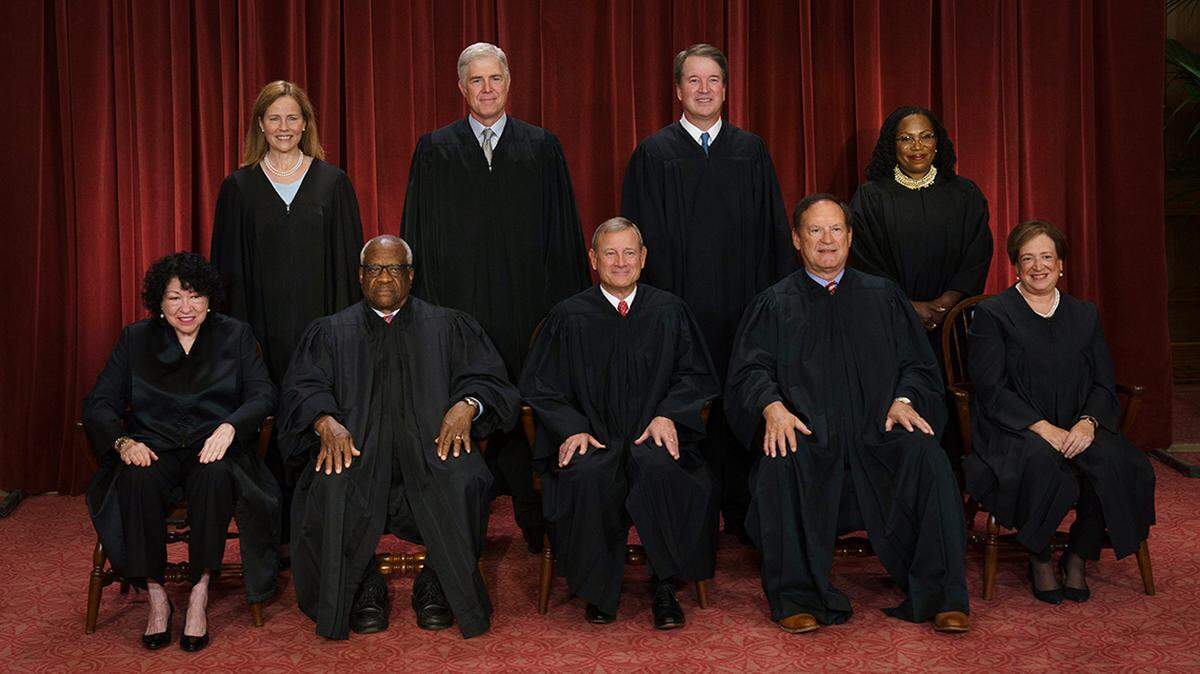
Let’s not kid ourselves: the Supreme Court isn’t more political now than at any other time in our nation’s history.
Just ask John Adams and Thomas Jefferson about their epic battle over federalism, the Judiciary Act of 1801 (a/k/a/ the “Midnight Judges Act”), which reorganized the courts to create 16 new judgeships, allowing Adams to pack the federal judiciary with Federalists in the final weeks of his presidency.
Two hundred twenty-three years later, the Supreme Court has made itself ground zero in the political battleground over conflicting views about life, liberty and the pursuit of happiness.
As Justice Samuel Alito recently said while caught on a secret recording, “One side or the other is going to win,” In other words reversing Carl Von Clausewitz’s famous quote, “Politics is the continuation of war by other means.”
We believe our nation is in mortal danger, in no small part due to the majority on the Supreme Court, and that’s why a fundamental change in how vacancies on the Supreme Court are filled is imperative.
President Joe Biden and Vice President Kamala Harris are signing to the movement to reform the Supreme Court and enact 18-year term limits on justices.
Our organization, Term Limit the Court, launched its effort last September. When the TERM Act was introduced in the House last fall there were eight co-sponsors. Now there are 37 in the House and eight in the Senate. It’s easy to see why support is exploding.
The Supreme Court has become the most powerful tool in Republican presidential candidate Donald Trump’s effort to return to the White House.
Justice Sonya Sotomayor recognizes it. She seethed with disdain while reading her dissent after the majority, in an apparent move to insulate Trump, ruled he’s immune from prosecution for his official acts connected to the Jan. 6th insurrection.
“The president is now a king above the law,” Sotomayor wrote in a scathing 29-page dissent that was joined by Justices Elena Kagan and Ketanji Brown Jackson. The ruling, Sotomayor wrote, makes a “mockery of the principle” that no one is above the law.
Approval of how the Supreme Court is doing its job continues to hover below 50 percent. Continuing questions about ethics have rocked the court.
Clarence Thomas had no concerns about taking millions from his billionaire friends like Harlan Crow to fund his luxury lifestyle. Justice Samuel Alito flew the American flag upside down outside his home in an apparent nod to the “Stop the Steal” movement. The justice said his wife had placed the flag.
The Supreme Court doesn’t have an enforcement mechanism. Its power doesn’t derive from an army or a police force.
Confidence in the Supreme Court is a pillar of our democracy. If that pillar cracks, we fear, the entire house could crumble under the weight of growing distrust in the court and the government as a whole. It could serve as further evidence to a growing number of Americans the traditions that bind us together are deteriorating to the point fidelity to a civil society is no longer a given.
We believe one way to restore faith in the court is to end the life tenure of justices who today are so seemingly secure in their belief they are beyond accountability. They take liberties when it comes to principle and favor.
The TERM ACT in the House, introduced last fall by Rep. Hank Johnson (D-GA), now has 37 co-sponsors, including Dan Goldman and Adam Schiff (D-CA). Its Senate companion bill, filed by Senator Sheldon Whitehouse (D-RI), now has eight co-sponsors. Interestingly, there are no Republican co-sponsors despite the fact they file bills every year to term limit members of Congress.
We’re under no illusion term limits for SCOTUS will happen this term or even the next. But great movements often take time, and it’s time we look at term limits as one way to restore confidence in the essential institution on which our democracy balances.
Alan Cohn is executive director of Term Limit the Court.
This story was originally published July 30, 2024 at 12:00 AM.