
‘Sickness in our society.’ DeSantis stokes division with immigration and Hamas comment | Opinion
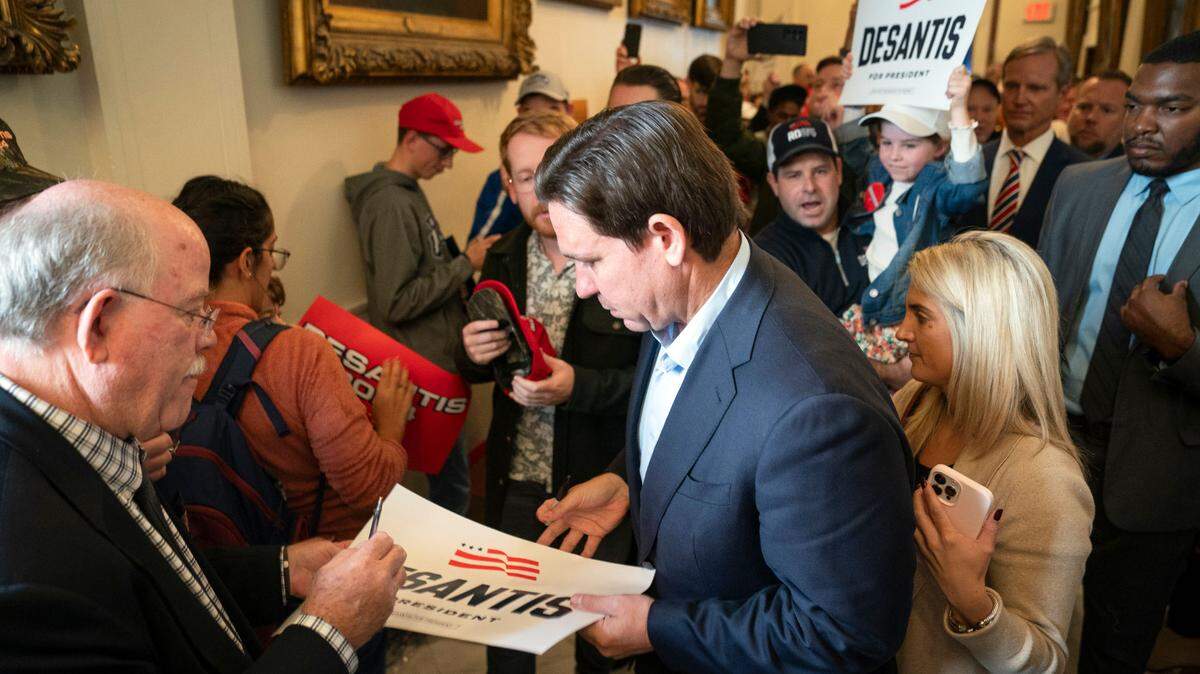
Speaking in New Hampshire recently, Gov. Ron DeSantis tied the country’s immigration problems to a letter signed by a coalition of Harvard students blaming Israel for the heinous Hamas attacks.
“I see Harvard students signing letters supporting Hamas terrorists who are decapitating infants and raping women,” DeSantis said, during a stop on the campaign trail as he runs for president. “That’s a sickness in our society. Part of it, I think, you know, our immigration system is a joke. We’ve brought in people who don’t like this country. I’m sorry, like, nobody has a right to come here. And I believe a lot of people that have emigrated have done great things for our country. But if you do not like this country, then stay where you are.”
It’s disturbing and appalling that the letter penned by Harvard Palestine Solidarity Groups ignored the carnage Hamas inflicted against families, innocent children, the elderly and music festival-goers. By writing that Israel’s “apartheid regime is the only one to blame,” the letter essentially excused and justified those terrorist attacks.
But blaming our immigration system, as broken as it is, for a “a sickness in our society” is ludicrous — how many immigrants broke into the U.S. Capitol on Jan. 6, for example? It is ignorant and insulting to immigrants who believe what happened in Israel was pure evil, even if they are also perplexed by the suffering of Palestinians who are desperately trying to flee Gaza. It’s unclear how many, or if any, of the students who drafted the letter were immigrants.
After signing an Oct. 12 executive order to charter flights to return Florida residents stranded in Israel, DeSantis should have let his deed speak for itself. But outrage is DeSantis’ political brand. He also has said the U.S. should not accept displaced Palestinians because they are “all antisemitic.” He’s stoking the same Islamophobia that authorities say drove a landlord in the Chicago area to stab a 6-year-old Palestinian-American boy — 26 times — to death last Saturday.
Perhaps fanning the flames of a heated debate is the pathway to snatching the GOP presidential nomination from the man who perfected that political strategy.
Donald Trump wrote on Truth Social on Oct. 9: “The same people that raided Israel are pouring into our once beautiful USA, through our TOTALLY OPEN SOUTHERN BORDER, at Record Numbers.” Trump’s campaign didn’t provide any evidence to back that up, according to Politifact, which rated the claim “pants on fire” for its misinformation.
Although the federal government has reported a larger number of border crossings involving people on the terrorism watch list, many of the people on the list aren’t terrorists or affiliated with groups that are a threat to Americans, Politifact reported.
DeSantis’ speech in New Hampshire seemed to go deeper than Trump’s attempt to link the Southern border to terrorism. DeSantis appears to blame immigration for what he often paints as the corrupt liberal intellectual elites that Harvard represents. That’s laughable given that most immigrants, and Americans, will never set foot in an Ivy League school — unlike DeSantis, who attended Yale and Harvard.
Just like Trump once wished the U.S. had more immigrants from Norway and and fewer from ”s---hole countries,” DeSantis’ words are an attempt to define what a desirable immigrant is — and what it means to love this country. The immigrants who voted for him don’t seem to be the problem.
Gauging expressions of patriotism is a complicated matter but the type of conservatism that DeSantis and Trump represent draws a line in the sand. If you believe in concepts like systemic racism or that there’s any flaw in the country’s history, you’re anti-American. You must “go back to your country,” no matter where you were actually born. The four progressive congresswomen whom Trump told in 2019 to “go back and help fix the totally broken and crime infested places from which they came” are all U.S. citizens. Three were born in the U.S.
The “good” versus “bad” — or the “grateful” versus “ungrateful” — immigrant binary is part of a larger attempt to control the narrative of this country. Good immigrants and Americans are only allowed to view the country as that city on a shining hill.
A simple measure of love for country should be that we try to unite during tension, rather than drawing false parallels that serve no purpose other than political expedience.
Click here to send the letter.
BEHIND THE STORY
MOREWhat's an editorial?
Editorials are opinion pieces that reflect the views of the Miami Herald Editorial Board, a group of opinion journalists that operates separately from the Miami Herald newsroom. Miami Herald Editorial Board members are: opinion editor Amy Driscoll and editorial writers Isadora Rangel and Mary Anna Mancuso. Read more by clicking the arrow in the upper right.
What's the difference between an op-ed and a column?
How does the Miami Herald Editorial Board decide what to write about?
The Editorial Board, made up of experienced opinion journalists, primarily addresses local and state issues that affect South Florida residents. Each board member has an area of focus, such as education, COVID or local government policy. Board members meet daily and bring up an array of topics for discussion. Once a topic is fully discussed, board members will further report the issue, interviewing stakeholders and others involved and affected, so that the board can present the most informed opinion possible. We strive to provide our community with thought leadership that advocates for policies and priorities that strengthen our communities. Our editorials promote social justice, fairness in economic, educational and social opportunities and an end to systemic racism and inequality. The Editorial Board is separate from the reporters and editors of the Miami Herald newsroom.
How can I contribute to the Miami Herald Opinion section?
The Editorial Board accepts op-ed submissions of 650-700 words from community members who want to argue a specific viewpoint or idea that is relevant to our area. You can email an op-ed submission to oped@miamiherald.com. We also accept 150-word letters to the editor from readers who want to offer their points of view on current issues. For more information on how to submit a letter, go here.
This story was originally published October 24, 2023 at 1:32 PM.