
Trump’s unpredictability didn’t work out too well for Suleimani
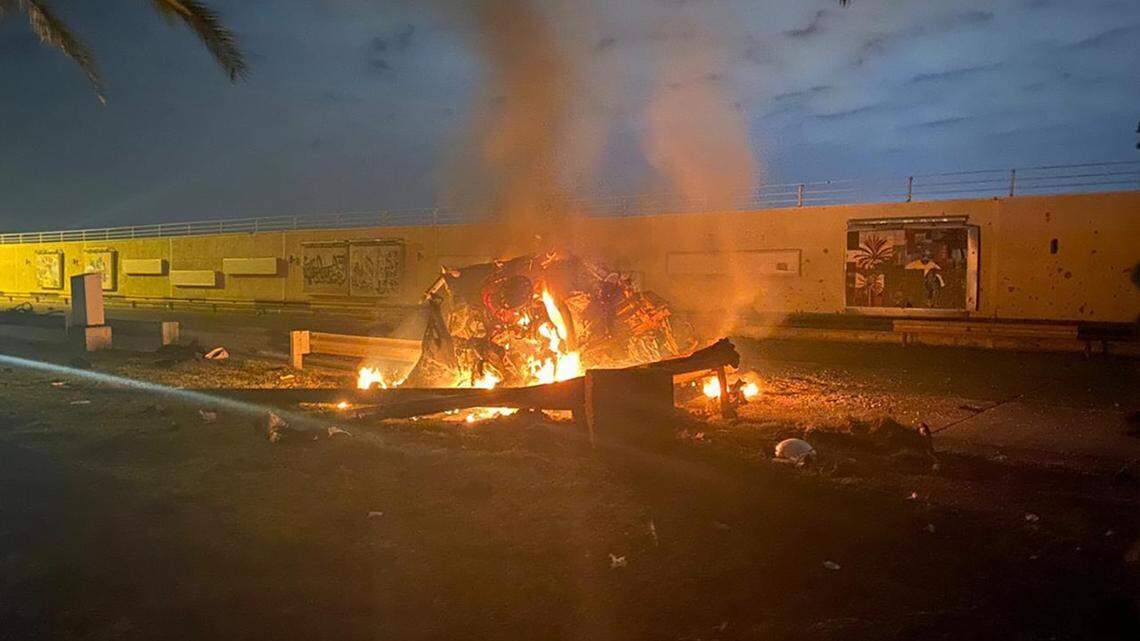
The successful termination of the world’s most notorious terrorist chieftain on the orders of President Donald Trump ignited all kinds of feigned outrage and bluster from political opponents and their media messengers.
Tehran, of course, responded with automatic anger and predictable vows of revenge. They’re no doubt genuine and may result in violent retaliation. However, as powerful head of the murderous Quds Force of Iran’s Revolutionary Guards, Maj. Gen. Qassem Soleimani had his own internal Iranian opponents who might not miss the ruthless architect of the world’s most active sponsor of international terror.
No one has explained how Iran’s terror leader, prominent on an international travel ban list, could so easily fly from Syria into Baghdad, the capitol of an alleged ally, and simply drive away with fellow terrorists to plan more attacks against nearby Americans.
Nor has anyone explained, understandably, how the electronic and human intelligence apparatus of a restored American military could track this man so well that the electronic eye of a lethal Reaper drone above could pick his car out of airport traffic and follow it to a more secluded section of road.
The bold, decisive move by Trump — one that his two predecessors chose to avoid, despite the target’s responsibility for hundreds of U.S. military deaths — was the president’s second mandated slaying of an international terror leader in recent months.
In October, U.S. special operators cornered the leader of ISIS, Abu Bakr al Baghdadi, in a Syrian tunnel where he blew himself up with two of his children.
Surviving terror leaders must be looking at each other these days with suspicious eyes seeking a traitorous mole in their midst.
In May 2011, despite the objections of Vice President Joe Biden, then-President Barack Obama authorized the SEAL team visit to Osama bin Laden’s home in Pakistan.
Five months later, Obama approved a Reaper drone strike to kill Anwar al-Awlaki, an American from New Mexico who became a radical imam in Yemen. Neither of the killings ordered by a Democratic commander in chief caused the selective outrage of the Soleimani hit.
These recent orders reveal some of Trump’s style and could provide instructive lessons for other potential adversaries taunting or mocking the American leader, such as North Korea’s Kim Jung-un. One lesson: Do not misread Trump’s military restraint as a weakness, as Iran’s leaders, including Soleimani, may have done after an incident last June.
Proclaiming Trump could do nothing, Iran has undertaken numerous recent provocations, including seizing ships, mining their hulls and attacking Saudi refineries with a flight of drones.
After Iran downed an American drone in June, Trump did order a retaliatory attack. That turned out to be destruction of some Iranian radar sites. It was widely reported at the time that the attack was canceled at the last minute.
Not widely reported was the real reason for the cancellation. Fifteen minutes before the attack, while planes were en route, Trump asked military leaders for a casualty estimate on the ground, a figure not included in the plans he approved. He was told about 150. Trump immediately canceled the attack, deciding that it was disproportionate to the loss of an unmanned drone.
Such a judicious approach is not often associated with Trump, whose public persona at rallies and on Twitter is the opposite of restrained and disciplined.
Democrats vying to oust the Republican this year risk, in the language of his GOP predecessor, “mis-underestimating” the national security appeal of a strong, decisive commander in chief for voters, even those perhaps doubtful of his other actions.
“If we get word of attacks,” said Trump’s Defense Secretary, Mark Esper, “we will take preemptive action as well to protect American forces, protect American lives. The game has changed.”
As much as opponents want to portray Trump as a one-dimensional, boorish usurper, he isn’t. One-dimensional is for caricatures, which are easier to demonize. But no one is one-dimensional, no matter how exaggerated the public presentations. Opponents who see everything about Trump through the prism of “He shouldn’t be president in the first place” do so at their peril.
The problem with that line of thought is that Trump is president, fair and square. Unexpectedly, for sure. Unfortunately, perhaps. But legitimately. Fair-minded people see that. It wasn’t the first time in our nation’s 58 presidential elections that the winner of the Electoral College lost the popular vote. It was the fifth. So what?
To continue to cling bitterly to the belief that Trump does not belong in the White House violates the social compact of this country’s politics. George Washington was twice elected president unopposed. But in all our other presidential elections, there were losers. Unhappy, maybe angry. But in time, they and their supporters got over it and prepared for the next Leap Year contest. Until 2016.
This stubborn bitterness has the very real potential to mislead its adherents and actually assist the reelection of the man they dislike, as much as Soleimani did.
In a speech last year, the Quds leader arrogantly warned Trump, “We are near you, where you can’t even imagine. We are ready.” Well, Soleimani was correct about the “near” part. But he wasn’t ready for two, 108-pound Hellfire missiles that were suddenly nearer than the Iranian general had time to imagine.
This story was originally published January 7, 2020 at 6:00 AM with the headline "Trump’s unpredictability didn’t work out too well for Suleimani."