Dueling tropical systems could see ‘Fujiwhara effect.’ What does that mean for Florida?
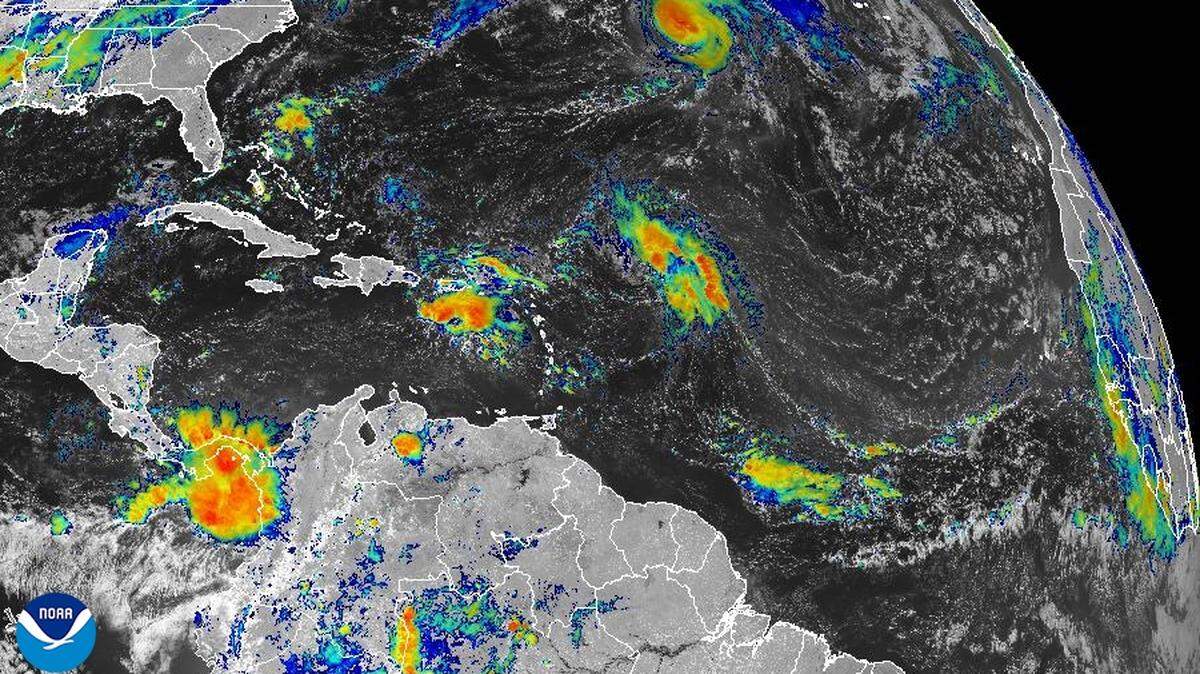
After an unseasonably long pause, the Atlantic hurricane season is alive again with twin tropical systems that some models show heading in parallel tracks off the coast of Florida and the Southeast.
Or, it could be a setup for the “Fujiwhara effect” — an atmospheric phenomenon where two nearby storms interact with each other.
Phil Klotzbach, senior research scientist at Colorado State University, said the effect — also called binary interaction by the scientists who study such things — occurs when two systems are within 800 miles of each other.
“Sometimes if you have a strong storm and a weak storm, one will basically swallow the other up,” he said. “Other times, because each of these has a counterclockwise spin, they can push each other and dance around each other.”
It’s too early to know for sure if that could happen with the two systems the National Hurricane Center is watching in the Atlantic this week — Tropical Storm Humberto and a tropical wave to its west. Humberto formed on Wednesday evening, while the western wave was moving over Puerto Rico as a weaker collection of thunderstorms. It’s that system that Florida and coastal communities to the north should be most closely watching.
Michael Brennan, director of the National Hurricane Center, said in a video update Wednesday afternoon that the two systems were within 750 to 800 miles of each other.
“The complexity here is that these systems are likely to interact with each other,” he said.
.png "two_atl_7d0 (42).png")
Some models show the systems following a parallel track along the Southeast coast, with some versions scraping the western storm along the Bahamas, Florida or even the Carolinas, and others keeping both of them offshore.
Whether or not the two systems get close enough to even interact depends on what shape the wave is in after it crosses over the mountains of Haiti and the Dominican Republic, an island called Hispaniola, over the next few days.
“The question is what emerges over the north side of Hispaniola,” Klotzbach said. “Maybe the systems will be far enough apart that it won’t be much of an interaction.”
Still other long-range models suggest that Humberto could eat the weaker wave, which Klotzbach said would likely be “good news for Florida and the Carolinas.” The resulting storm would probably stay out to sea on a similar track to Hurricane Gabrielle, which zoomed past Bermuda this week on a path toward the Azores in Portugal.
READ MORE: Two Atlantic storms may soon collide. Rare ‘Fujiwhara effect’ shapes what happens next
While the hurricane center named Tropical Storm Humberto Wednesday at 5 p.m., the eastern one could take a few more days to form.
“We don’t know if the storm is going to form in three days, six days or never,” he said. “There’s just a lot of uncertainty and not a lot we can say right now.”
The most recent example of the Fujiwhara effect was in 2023, when Tropical Storm Philippe absorbed the nearby Tropical Storm Rina. According to the hurricane center’s storm report, there were no deaths associated with Philippe, but it did cause flooding and mudslides in some eastern Caribbean islands, including Antigua.
This story was originally published September 24, 2025 at 3:19 PM.