Curiously quiet Atlantic has hurricane scientists scratching their heads. ‘A mystery.’
The Atlantic hasn’t been this quiet in 50 years, and hurricane scientists are trying to figure out why.
The last time a storm didn’t form between August 12 and September 3 — historically among the most active stretches of the hurricane season — was in 1968, said Phil Klotzbach, senior research scientist at Colorado State University and head of the leading academic seasonal forecast.
The quiet in the Atlantic is even weirder considering nearly every forecast this year trumpeted an alarming hurricane season ahead. Federal forecasters and other experts called for the most active season on record, including Klotzbach’s team, which also foresaw a record-breaking year ahead.
Instead, after an early burst of intense and record-setting storms, including two U.S. landfalls, the Atlantic Ocean has fallen nearly silent at a time when every homeowner in Florida is typically watching which way the cone of concern is pointing on one or more tropical tempests.
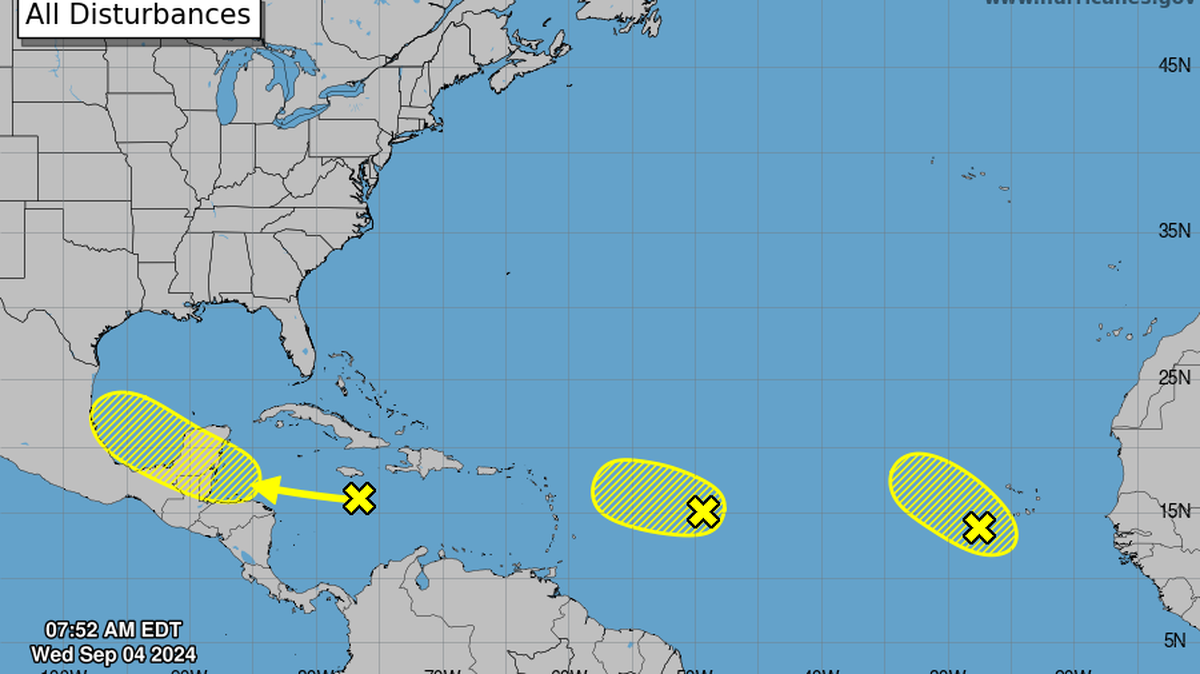
The National Hurricane Center is currently tracking a few disturbances but even those have been languishing. As of Wednesday morning, they all had a low chance of developing anytime soon.
Even forecasters with the hurricane center are puzzled.
“Still haven’t seen a good explanation of why the Atlantic was able to produce the strongest hurricane on record in the early season (Beryl), then shut off in mid-August! Not easy to understand folks,” tweeted forecaster Eric Blake. “A scientific curiosity.”
Some meteorologists have started calling the season a dud, but experts warn that’s not a call for people in hurricane territory to stop paying attention to the forecast. Or that we won’t see any more hurricanes through the end of the season.
“To say ‘all clear, everybody act like it’s December,’ I think it’s too early to do that,” Klotzbach said. “It would be extremely impressive to get nothing the rest of the season.”
The last time there was such a mismatch between a pre-season forecast and the actual count of storms was 2013, when forecasters predicted an above-average season but instead saw the lowest activity in 30 years.
However, Klotzbach, who co-published an analysis of the mid-season slowdown on Tuesday evening, doesn’t buy it.
“To me, this doesn’t look like 2013. At some point, if you have extremely warm water and low shear, something will happen,” he said. “I can’t imagine all these things that have worked so well for 60 years will suddenly give up. Maybe they will, but I doubt it.”
Why the tropics have cooled is “a mystery” with many possible suspects, perhaps working in concert. His team’s analysis identified four factors for the suspiciously slow season, but they caution that they’re only educated guesses at this point. It will take some more time, and likely the end of the season, for researchers to refine their thinking on where all the storms went.
“None of these arguments in themselves are the answer,” he said. “It’s a hybrid of those causes.”
Struggling storms
There are a number of working theories.
For weeks, scientists have been pointing to the mysteriously intense rain levels in the Saharan desert as a clue to the slowed-down traffic across the Atlantic.
Instead of rolling across the Atlantic and forming storms like they usually do, for some reason, most of the African easterly waves have been exiting the continent too far north. They’re dropping tremendous amounts of rain in the Saharan desert instead, or, if they do emerge over the ocean, they’re getting battered by dry and dusty air instead of the welcoming moisture to the south that helps feed baby hurricanes.
“You’re getting rain in places that almost never get rain, like southern Egypt,” Klotzbach said. “If I had to say one thing that really caused this season to be squelched it would be that.”
However, in a normal season, the train of African easterly waves does shift south around this time of the year. So scientists say that this issue could likely resolve in the next few weeks, leading to friendlier conditions for storm formation.
The next factor CSU pointed to was the abnormally stable atmosphere.
Sea surface temperatures are exceedingly hot in the Atlantic, which is part of the reason forecasters called for such a ramped-up season. But it’s not just the sea surface that’s toasty. The lower and upper levels of the atmosphere are also pretty warm. That may sound like an ideal situation for wannabe storms, but hurricanes actually need a little bit of variety in their atmospheric layers to generate that friction or spark to start spinning.
The reason the upper atmosphere is so warm could be climate change, which is warming the ocean and the atmosphere more every year it’s left unchecked.
“This long-term, increasingly stable trend in the tropical troposphere is also consistent w/ what’s expected from climate change,” wrote Eric Webb, a federal meteorologist, on Twitter.
For now, it seems like the atmosphere is just too stable for storms to really get going. Again, that’s something that usually changes later in the season, as the upper levels of the atmosphere cool faster than the lower levels.
Unfriendly skies
A third factor at play is a common one: shear. That’s when higher-level winds and lower-level winds are moving in different directions, which makes it hard for hurricanes to line up a column of air to grow big and strong.
CSU noted that there’s more shear than usual in the eastern Atlantic, making it tough for the systems that do manage to form to strengthen. That shear does seem on track to lighten up later this month, potentially creating a window for storm formation.
And for the rare disturbance that manages to launch in the right place, dodge the dry air, skirt the shear and find a little pocket of atmospheric instability — like the three the hurricane center is tracking — there’s another enemy to vanquish: the tradewinds.
They’re slower than usual this year, leaving baby storms to limp along through the Atlantic rather than getting shoved forward by powerful wind currents.
It won’t be clear what exactly caused the slowdown this season until at least December, when the season is officially wrapped up. And scientists may well be debating it for years to come. But after several years of spot-on pre-season forecasts from CSU and NOAA, the potential for a miss is still surprising the scientists who put them together.
Last year, Klotzbach said, forecasters thought trying to balance the impacts of record-breaking sea surface temperatures with the cooling effect of an El Niño was going to be difficult. They were pleasantly surprised when they nailed it, and when this season came along with all green flags ahead for a busy season, it seemed like an even easier forecast.
“We got the tough forecast right, this year’s the shooting fish in a barrel forecast. We said confidence above normal,” he said.
“Maybe we should never be confident.”