Category 1 Hurricane Ida hits west Cuba, expected to strengthen to Category 4 in Gulf
Hurricane Ida entered the Gulf of Mexico Friday night and is forecast to rapidly intensify before reaching the Northern Gulf Coast.
South Florida, particularly the Keys, could feel the rainy outskirts of the powerful storm as it moves through the Gulf this weekend.
Forecasters are also monitoring two other disturbances in the Atlantic that could turn into tropical depressions over the weekend and a third with a low chance of developing anytime soon.
Here’s what to know:
Hurricane Ida forecast to be a Cat 4 before U.S. landfall
Ida hit Category 1 hurricane status just before making landfall on Cuba’s Isle of Youth around 2 p.m. Friday.
At 5 a.m. Saturday, it had 80 mph maximum sustained winds, which extended 25 miles from the center, and tropical-storm-force winds that extended 115 miles from the center.
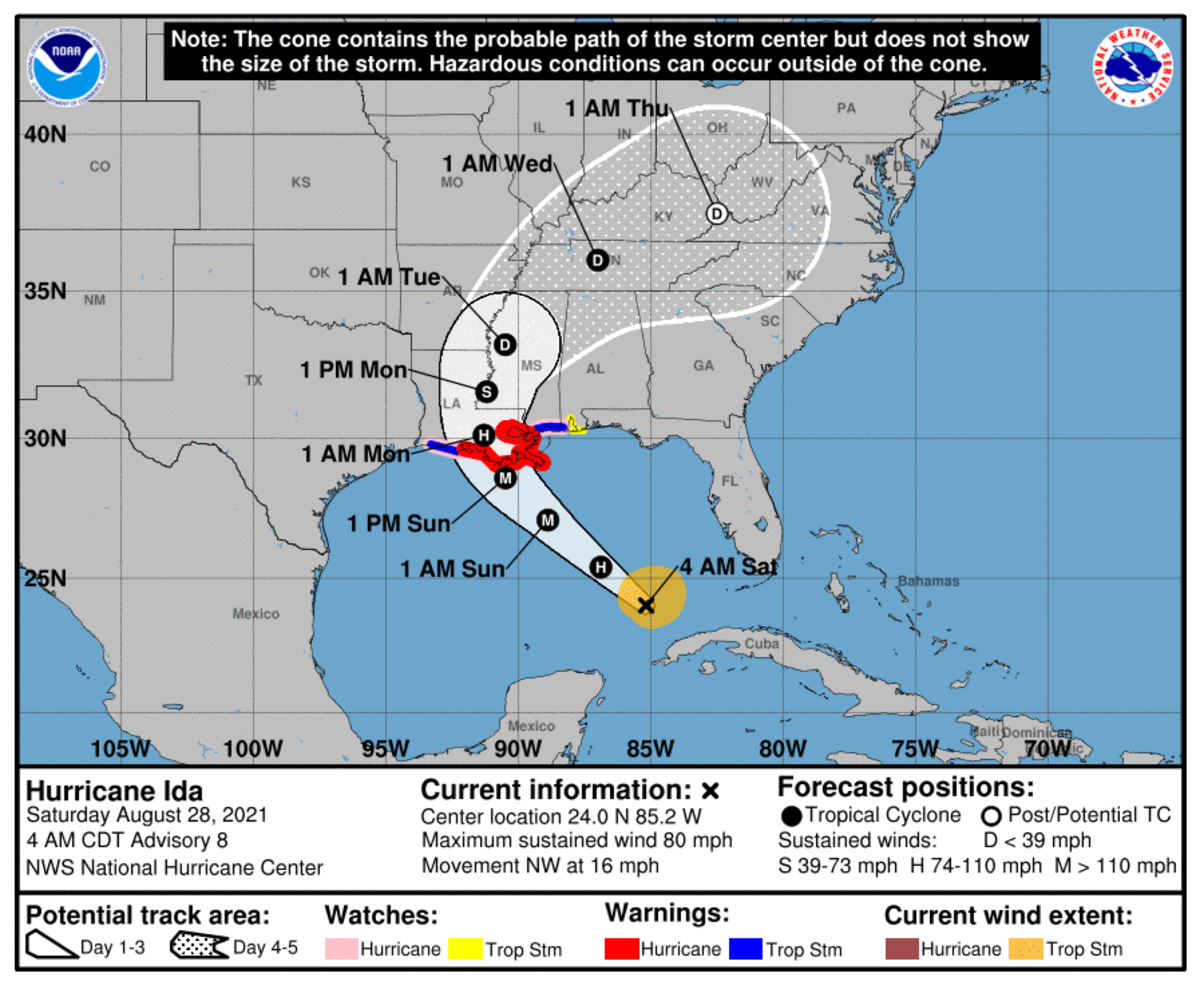
The system was briskly moving northwest at 16 mph and was about 185 miles west-northwest of Havana, Cuba. It’s about 510 miles southeast of New Orleans.
On Friday afternoon, Cubans were reporting flooding and high winds on social media.
“The winds of Ida are already felt in Nueva Gerona,” wrote writer Liudys Carmona Calaña about the capital city of Isla de la Juventud, an island off the western coast of Cuba with a population of over 80,000. In one video, she showed a local river flooding.
“This is Río Las Casas,” she narrated as she showed muddy water, “It already entered the entire garden.”
In a 3 p.m. advisory, Cuba’s Institute of Meteorology said that a weather station had recorded maximum winds of 75 miles per hour and sustained winds of 67 miles per hour. The storm was slated to make landfall in mainland Cuba by nightfall, and storm surges will likely span the provinces of Artemisa and Cienfuegos, added the agency.
On the forecast track, the center of Ida will move over the southeastern and central Gulf of Mexico during the next day or two and make landfall along the U.S. northern Gulf coast within the hurricane warning area by late Sunday.
Forecasts shows Ida becoming an extremely dangerous category 4 hurricane before reaching the coast. After landfall, rapid weakening is expected due to land interaction, drier air, and an increase in shear.
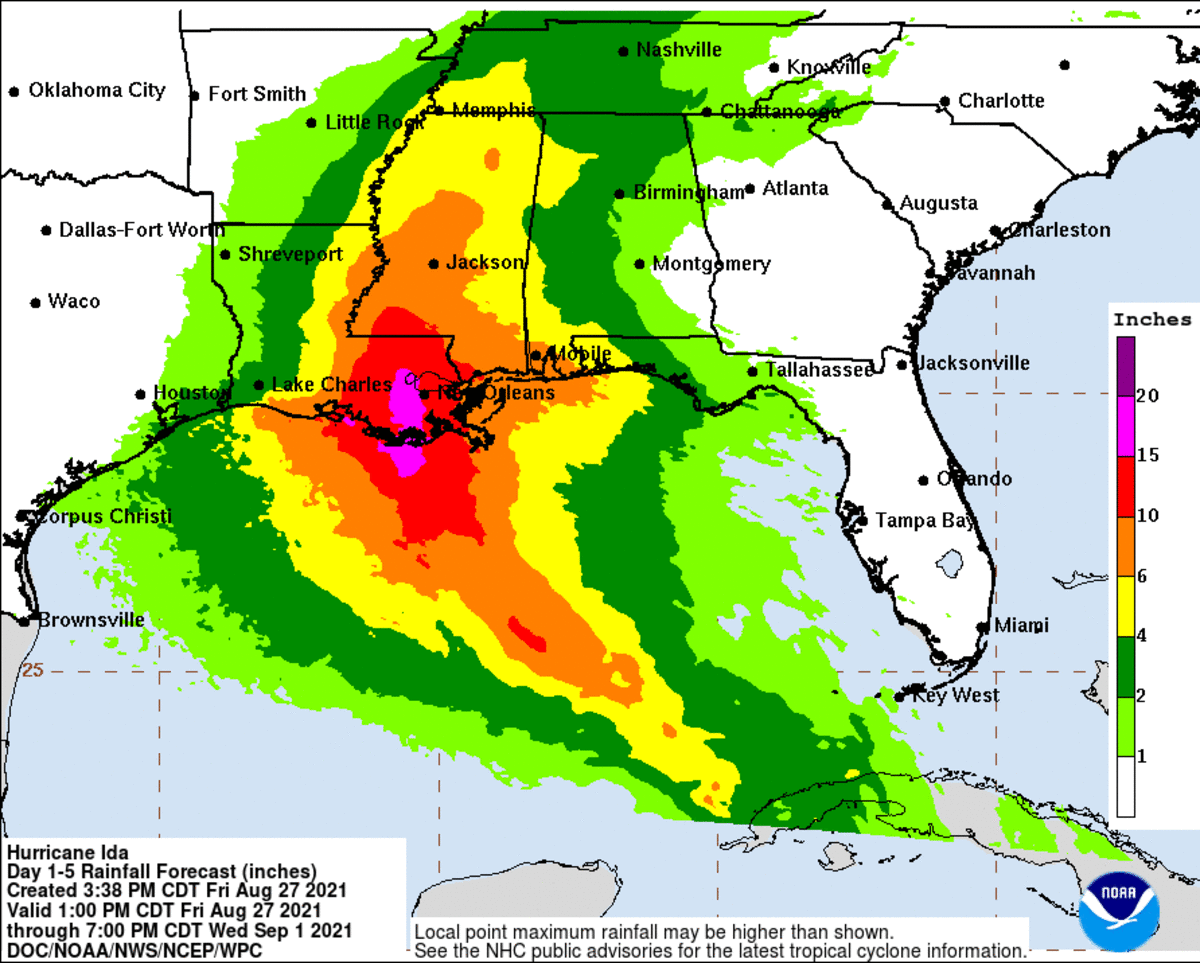
Morgan City, Louisiana, to the mouth of the Mississippi River, could see storm surge of 10 to 15 feet at highest, which could overtop local levees. And then there’s the rain. The hurricane center said Ida could bring 8 to 16 inches to the Gulf Coast, with some spots seeing up to 20 inches.
Models also suggest Ida’s wind field could grow larger, affecting even more of the coast.
“In summary, there is a higher-than-normal confidence that a significant hurricane will impact a large portion of the northern Gulf coast by late this weekend and early next week,” forecasters said in the 11 a.m. update.
After landfall, Ida is expected to weaken as it moves through the lower Mississippi and Tennessee River valleys.
A hurricane warning has been issued for the coast of Louisiana from Intracoastal City to the Mouth of the Pearl River, including Lake Pontchartrain, Lake Maurepas, and Metropolitan New Orleans. A warning is already in effect for Cuban provinces of Artemisa, Pinar del Rio and the Isle of Youth.
A hurricane watch is in effect from Cameron, Louisiana, to the Mississippi-Alabama border. A hurricane watch is also in effect for Lake Pontchartrain, Lake Maurepas and metropolitan New Orleans. A tropical storm warning remained in place for the Cuban provinces of Matanzas, Mayabeque and Havana and one was issued for the northern Gulf coast from the Mouth of the Pearl River to the Mississippi/Alabama border and the coast of Louisiana from west of Intracoastal City to Cameron.
A tropical storm watch is in effect for the Mississippi-Alabama border to the Alabama-Florida border. A storm surge watch is also in effect from the Sabine Pass to the Alabama-Florida border, including at Vermilion Bay, Lake Borgne, Lake Pontchartrain, Lake Maurepas and Mobile Bay.
A Storm Surge Warning has been issued from east of Rockefeller Wildlife Refuge, Louisiana, to the Mississippi/Alabama border including Vermilion Bay, Lake Borgne, Lake Pontchartrain, and Lake Maurepas.
Three Atlantic disturbances to keep an eye on
As Ida continues toward the Gulf of Mexico and the northern U.S. Gulf Coast, forecasters are also monitoring two disturbances in the Atlantic that have a high chance of turning into tropical depressions this weekend and a third new disturbance.
None of them pose a threat to land at the moment.
One of the disturbances was producing a large area of disorganized showers and thunderstorms in the Atlantic between the Cabo Verde Islands and the Lesser Antilles early Friday, according to the hurricane center.
“Gradual development of the system is expected and a tropical depression is likely to form during the next couple of days before it moves into an environment of stronger upper-level winds and slightly cooler waters,” forecasters wrote.
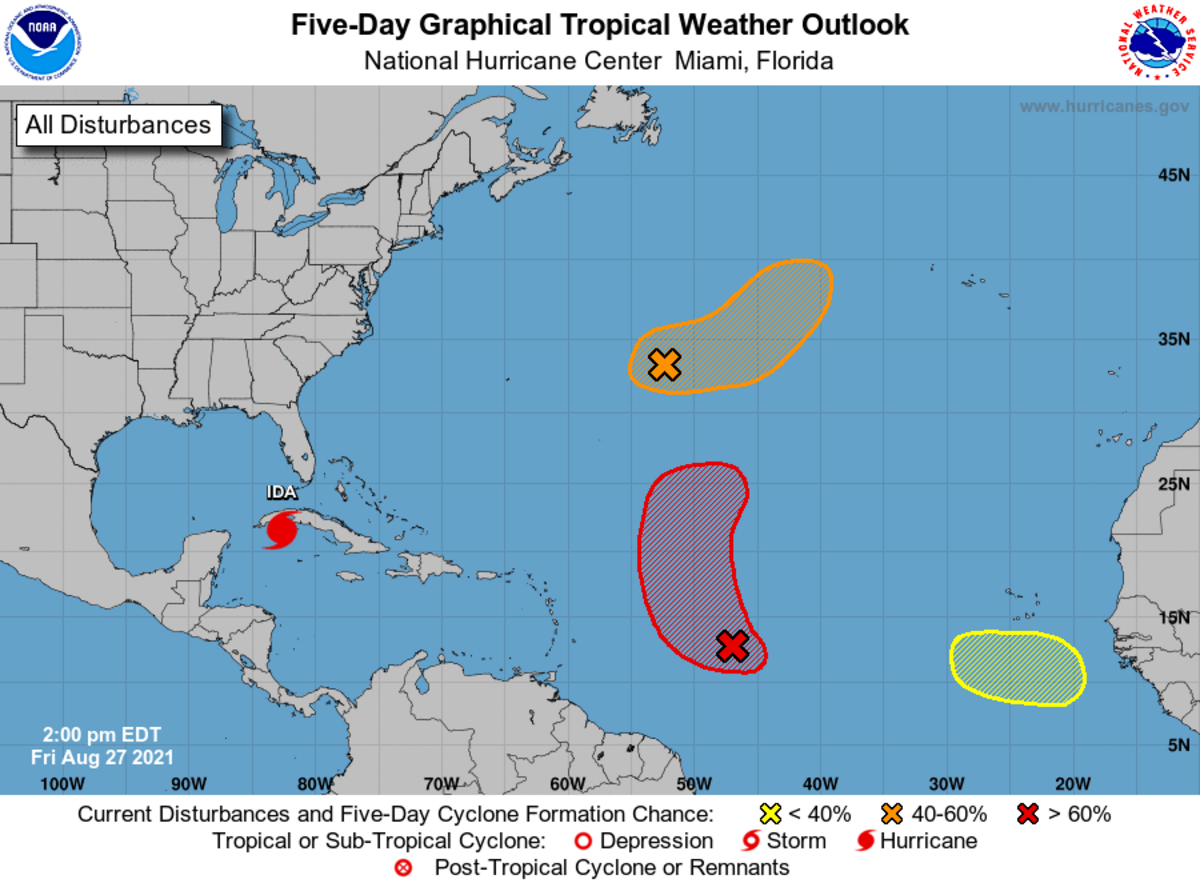
On the forecast track, the system is expected to move west-northwest before turning toward the north during the weekend.
It had an 80% of formation in the next 48 hours or next five days, as of the 2 p.m. Friday update.
Another disturbance forecasters are watching was producing disorganized showers and thunderstorms several hundred miles east of Bermuda Friday morning. While environmental conditions are “marginally conducive” for development, forecasters think the system could still turn into a tropical depression during the weekend.
It’s expected to move slowly east during the next day or two before picking up its pace and heading northeast Sunday, away from the United States. As of the 2 p.m. update, it had a 40% chance of formation in the next 48 hours and a 60% chance of formation through the next five days.
The third disturbance, a tropical wave expected to roll off Africa’s coast by the middle of next week, first appeared in the hurricane center’s 2 p.m. update. It had no chance of developing in the next two days and a 20% chance of strengthening in the next five.
The next storm names on the list are Julian and Kate.
Miami Herald reporter Syra Ortiz-Blanes contributed to this report.
This story was originally published August 27, 2021 at 7:29 AM.