Cat 4 Hurricane Delta expected to approach the Gulf Coast as large Cat 3 storm
Delta has exploded from a tropical storm to a Category 4 hurricane in the last two days, and the latest predictions show it could be nearly a Cat 5 by the time it crashes into the Yucatán Peninsula on Wednesday and remain a powerful Cat 3 by the time it reaches the northern Gulf Coast later this week.
Despite the prediction of slightly weaker winds for its Gulf Coast landfall, the National Hurricane Center warned that the big and powerful storm will bring life-threatening storm surge and hurricane winds, as well as up to a foot of rain in some spots.
The powerful storm could bring up to 13 feet of storm surge and 10 inches of rain to parts of the Yucatán Peninsula, where at least six died over the weekend in Tropical Storm Gamma.
The hurricane center said the storm, which had 130 mph sustained winds as of the 11 p.m Tuesday update, could cross the peninsula with 155 mph winds, just 2 mph away from Cat 5 status.
Forecasters expect Delta to continue to strengthen as it reaches the Yucatán Peninsula and western Cuba early Wednesday, but even landfall isn’t expected to slow it down for long.
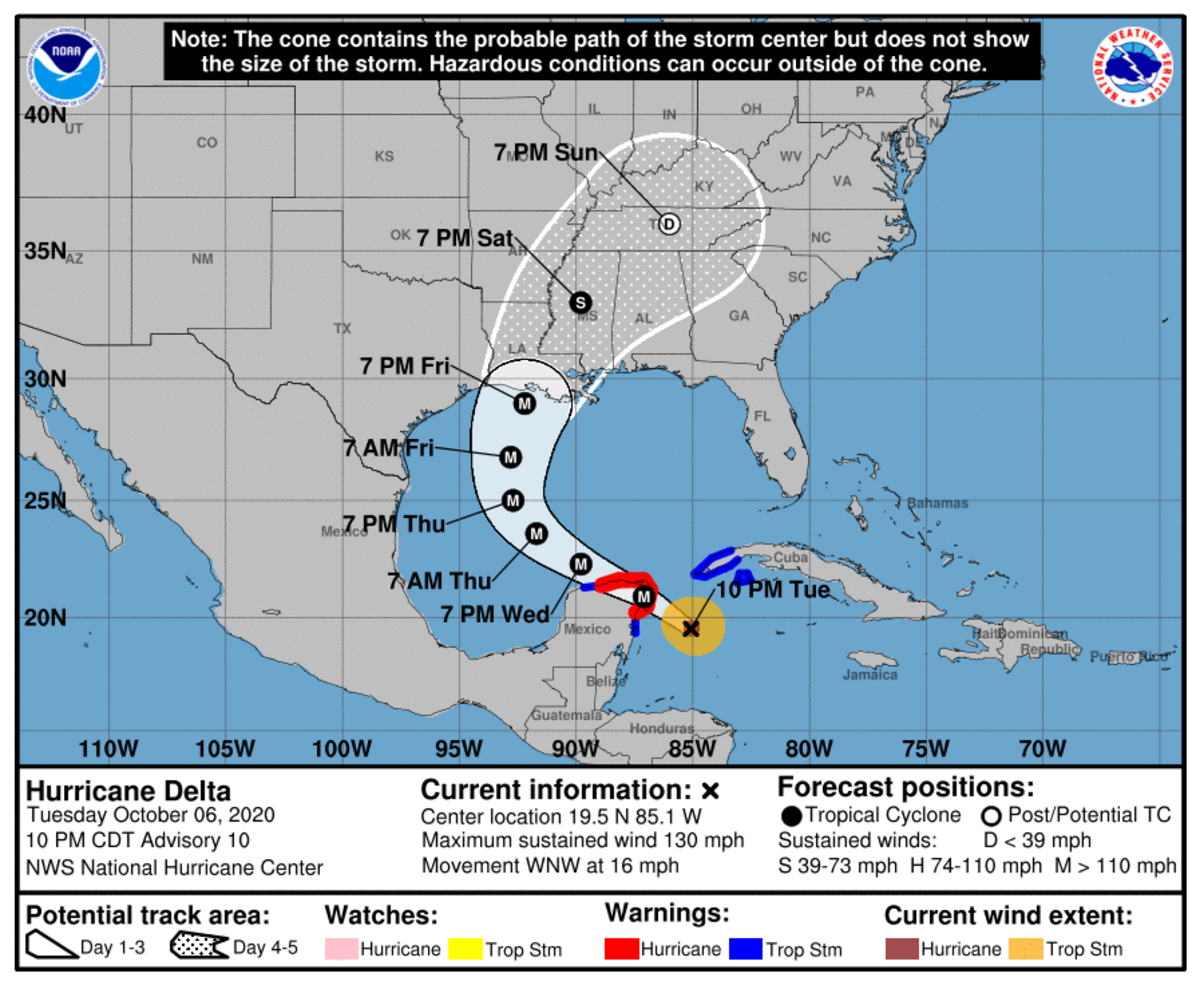
“Although some weakening is likely when Delta moves over the Yucatan Peninsula, re-strengthening is forecast when the hurricane moves over the southern Gulf of Mexico Wednesday night and Thursday,” forecasters wrote in the 11 p.m. advisory.
Delta could strengthen into a Category 4 hurricane briefly in the open waters as it continues on track toward the U.S. Gulf Coast, possibly Louisiana. The storm is expected to weaken to a Cat 3 hurricane in the slightly cooler waters before making landfall somewhere along the northern U.S. Gulf Coast. But forecasters warn there is still a “large uncertainty” in its track and forecast.
What forecasters say they do know is that Delta could bring a dangerous storm surge, wind and hazardous rainfall anywhere from Louisiana to the western Florida Panhandle beginning Thursday night or Friday. The potential for heavy rain and flash flooding will also increase across portions of the central Gulf Coast, Tennessee Valley, and southeastern United States as Delta moves inland later this week.
“Residents in these areas should ensure they have their hurricane plan in place and monitor updates to the forecast of Delta.”
Where is Hurricane Delta now?
Delta was quickly moving toward the west-northwest at 16 mph and was about 135 miles east-southeast of Cozumel, Mexico, late Tuesday, according to the hurricane center.
The northern Yucatán Peninsula of Mexico and extreme western Cuba will likely see a dangerous storm surge and hurricane conditions beginning Tuesday night.
Delta’s rapid intensification — from 40 mph winds to 110 mph in 24 hours — is the most an October Atlantic named storm has intensified since Hurricane Wilma in 2005, Colorado State University meteorologist Philip Klotzbach tweeted.
Research has shown that climate change may have an effect on how fast hurricanes intensify.
“On average, Atlantic hurricanes are intensifying from a storm to Cat 3 now 20 hours faster than 25 years ago,” tweeted Katharine Hayhoe, a climate scientist with Texas Tech University’s Climate Center. She was referencing a 2012 study published in the American Geophysical Union.
Hurricane Delta Watches/Warnings
▪ The government of Mexico has extended the hurricane warning westward along the northern coast of the Yucatán Peninsula to Dzilam.
▪ A tropical storm warning is in effect for the Cuban province of Pinar del Rio, the Cuban island Isle of Youth, and in Mexico, Punta Herrero to Tulum, Dzilam to Progreso.
This story was originally published October 6, 2020 at 7:29 AM.