Tropical Storm Beta approaches Texas coast; Hurricane Teddy nears Bermuda
The breakneck pace of the 2020 Atlantic hurricane season claimed another record on Friday after three tropical storms formed within a 24-hour period, hitting fast-forward on the National Hurricane Center’s adoption of the Greek alphabet for storm names.
By Saturday morning, there were five systems to monitor in the Atlantic waters. On Sunday, one of those systems, a tropical wave off the coast of Africa, was no longer being monitored, but another low-pressure system had formed just off the coast of central Florida and moved inland Sunday afternoon.
First came Tropical Storm Wilfred in the Atlantic around 11 a.m. Friday, which had weakened to a depression by Sunday. Then came Subtropical Storm Alpha near Portugal at 12:30 p.m., which dissipated by Saturday night. Tropical Storm Beta, in the Gulf of Mexico, broke the record around 5 p.m. Friday.
For just the second time, tropical storms and hurricanes are now being named after Greek letters, a backup list that the National Hurricane Center first turned to when it exhausted its alphabetical list in 2005.
NOAA’s midseason prediction called for 19 to 25 named storms this season, and Beta is number 23. The record for most storms in one season, 27, is held by 2005.
Elsewhere in the Atlantic, Hurricane Teddy, a Category 2 storm by Sunday after previously achieving Category 4 strength, continued to move toward Bermuda and was expected to approach the island on Sunday night before passing it to the east.
Also on forecasters’ radar: Post-tropical cyclone Paulette might reform in the faraway Atlantic, and a “small and weak” system off the central Florida coast that produced thunderstorms Sunday as it moved across the state but had only a 10% chance of cyclone formation in the coming days.
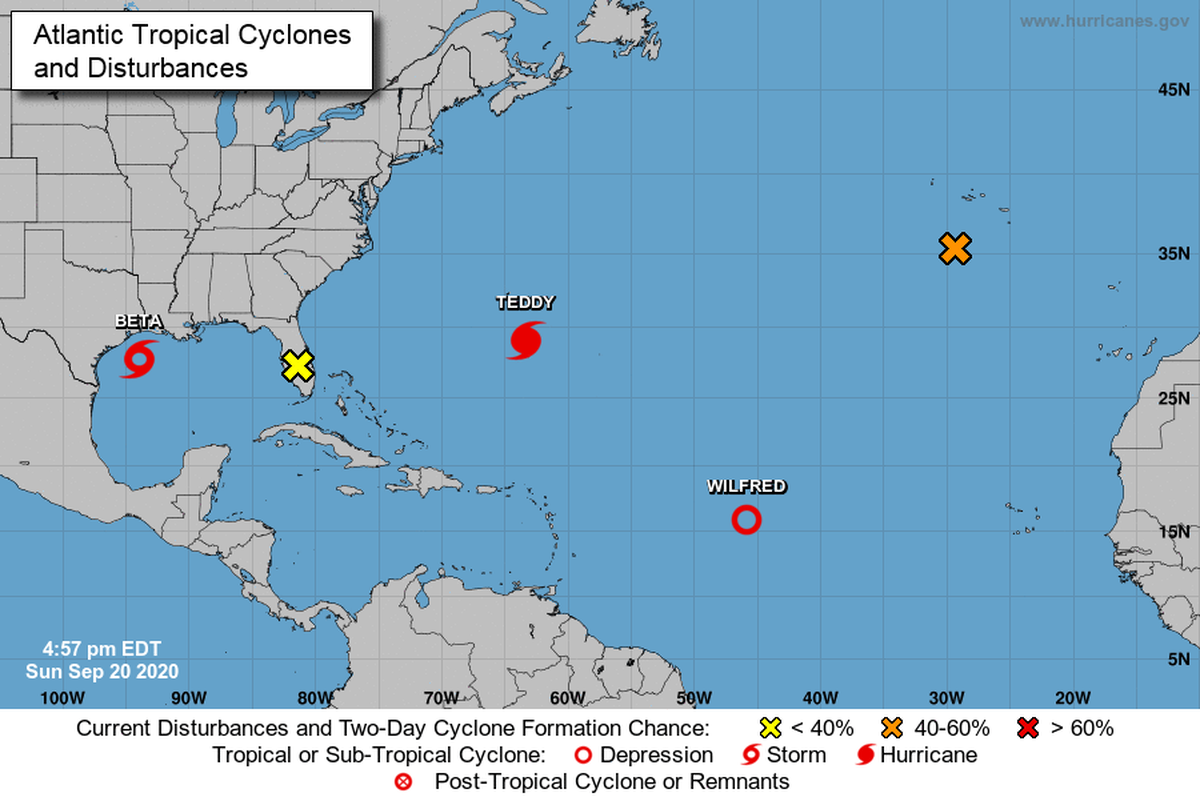
Wilfred weakens to a depression, Alpha a low
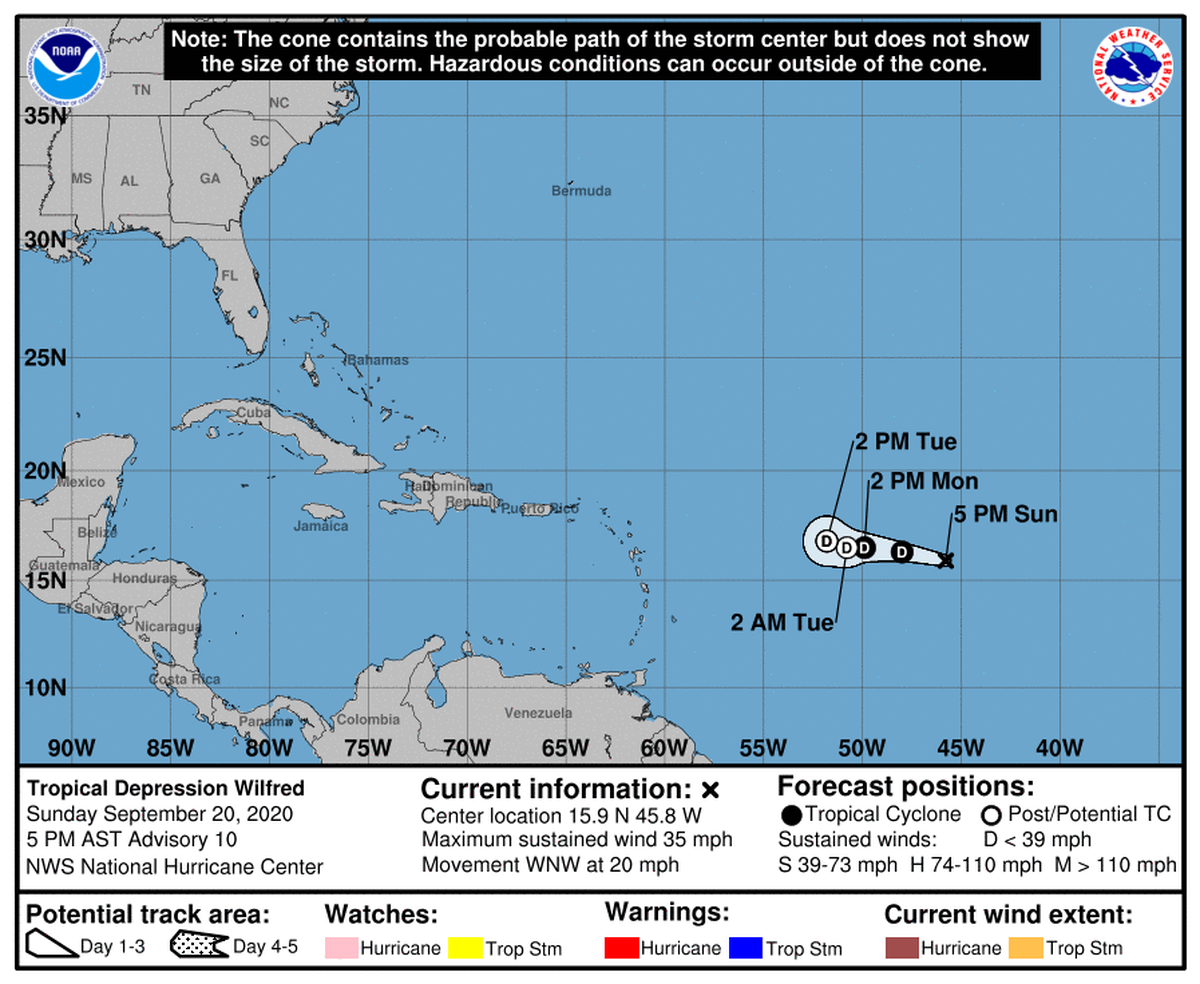
At the 11 a.m. Sunday update, Wilfred had weakened to a tropical depression over the Atlantic Ocean. By 5 p.m., the system was about 1,445 miles west of the Cabo Verde islands and 1,030 miles east of the Lesser Antilles. Forecasters dubbed it “woeful” on Saturday because the prediction was that it would diminish to a depression and then dissipate.
The depression was moving west-northwestward at around 20 mph with sustained winds near 35 mph. The hurricane center said the depression would likely slow down over the next couple days and weaken to a remnant low “within a day or two.”
Subtropical Storm Alpha formed just after noon Friday, but by the 11 p.m. Saturday update had become a remnant low over the District Of Viseu, Portugal. The hurricane center is no longer issuing advisories for Alpha.
Tropical Storm Beta breaks record
Tropical Storm Beta formed Friday afternoon hours after Wilfred and Alpha, marking the first time three named storms formed within a 24-hour period. The previous record was three storms forming within a 30-hour period, in August 1993, when Humberto, Iris and Jerry formed, tweeted Tomer Burg, an atmospheric science Ph.D. student at the University of Oklahoma.
As of 5 p.m. Sunday, Beta had held on to 60 mph winds with higher gusts while moving at 6 mph west-northeast over the Gulf. Forecasters say little change in strength is expected in the next couple days as Beta approaches the central Texas coast.
Beta is about 120 miles south-southeast of Galveston and 155 miles east-southeast of Port O’Connor, Texas. Data from Hurricane Hunter flights show that Beta is moving slowly west-northwest and is likely to continue in that direction for the next day or so, followed by a slowdown and turn to the north and northeast Monday night and Tuesday.
A storm surge warning is in effect for Port Aransas, Texas, to Rockefeller Wildlife Refuge, Louisiana. There’s a tropical storm warning in effect for Port Aransas to Morgan City, Louisiana, and a Tropical Storm Watch is in effect for Baffin Bay to Port Aransas. A tropical storm watch was discontinued for areas south of Baffin Bay, Texas.
Beta is expected to move inland Monday after reaching the Texas coast and remain close to the southeastern coast of Texas on Tuesday. Forecasters said the storm will likely weaken as it moves inland.
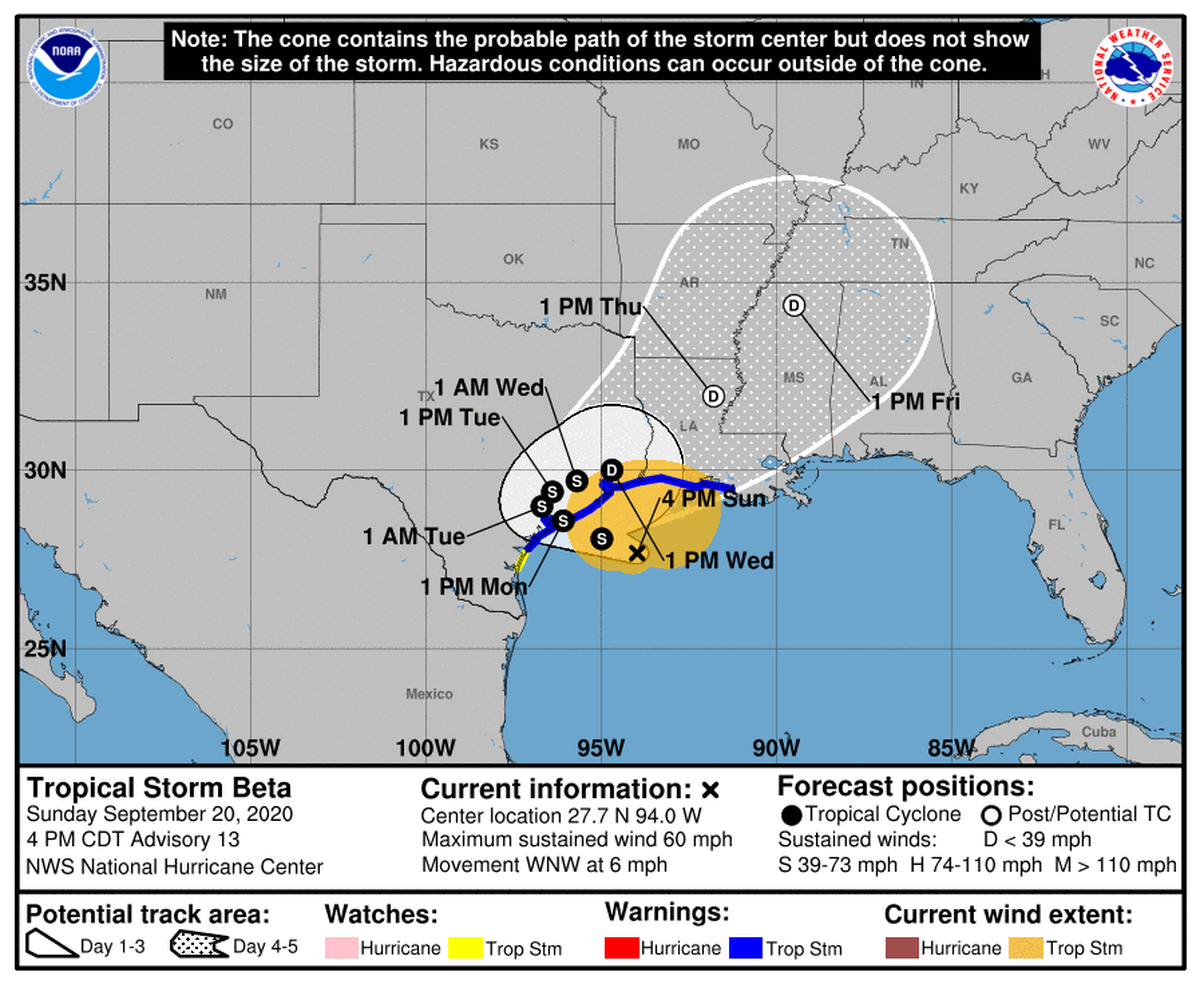
Tropical storm conditions were felt Sunday in the tropical storm warning area along the southwestern Louisiana coast, forecasters said, and will spread westward to the warning areas in Texas late Sunday through early Monday.
Beta is expected to produce 6 to 12 inches of rain and up to 15 inches in some areas of the middle Texas coast to southern Louisiana through Thursday, the hurricane center said. The region where the states of Arkansas, Louisiana and Texas come together to the lower Mississippi River Valley could see 3 to 5 inches of rainfall.
Forecasters also warned that “a tornado or two” could occur Monday near the middle-to-upper Texas coast or the southwestern Louisiana coast.
How strong will Hurricane Teddy be when it passes Bermuda?
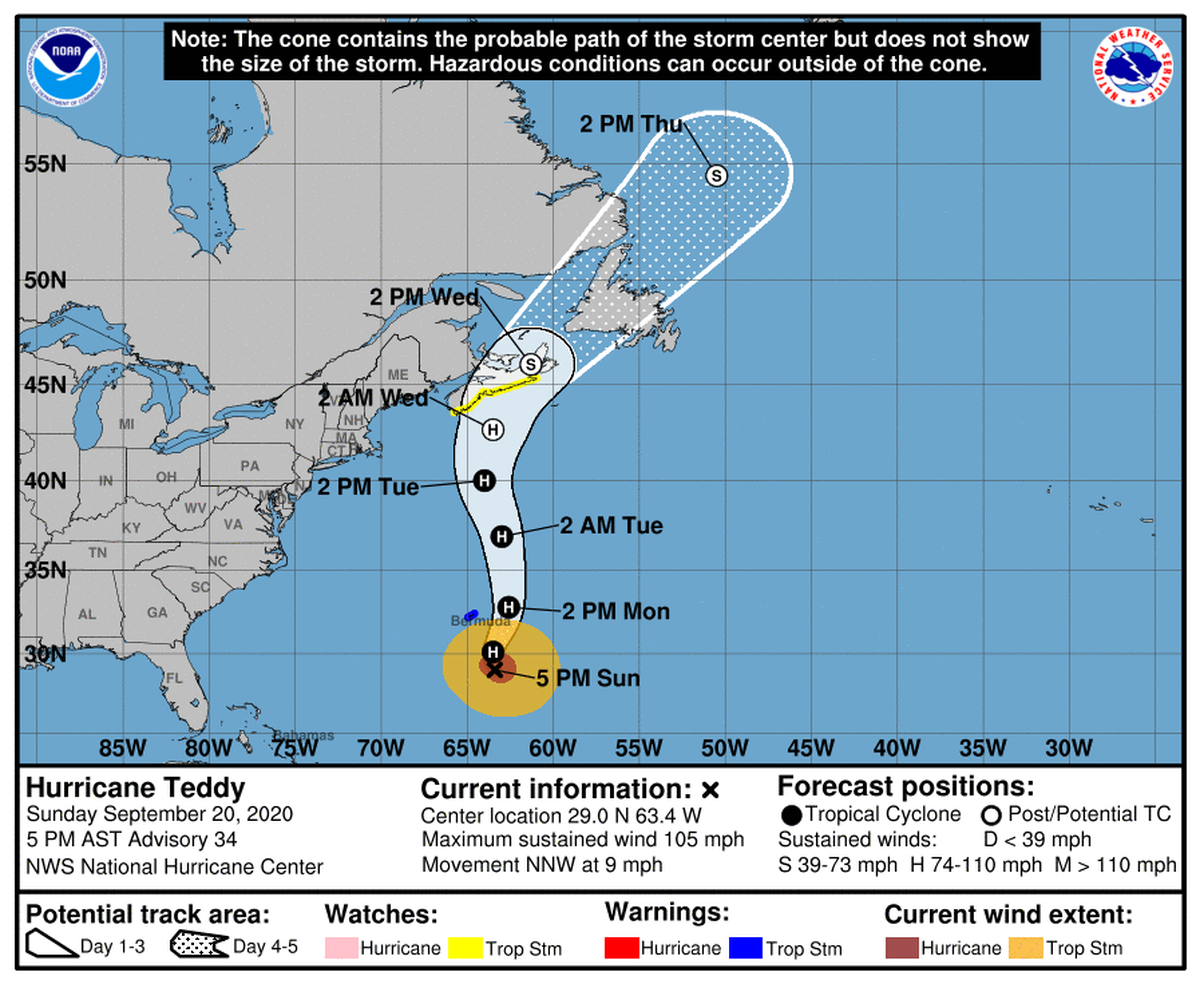
Bermuda issued a tropical storm watch Friday evening as Hurricane Teddy, now weakened to a Category 2 storm from a Category 3 on Saturday, continued its path toward the island at 9 mph.
As of the 5 p.m. Sunday update, it had maximum sustained winds of 105 mph, with higher gusts. Teddy was about 245 miles south-southeast of Bermuda and is expected to bring tropical storm-force winds to Bermuda starting Sunday night. Those conditions could continue into Monday night, forecasters said.
Teddy is predicted to take a turn toward the north Sunday evening, then continue toward the north early next week. Teddy will approach Bermuda on Sunday with tropical storm-force conditions as the center passes just east of the island Monday morning.
Teddy is a large hurricane, forecasters said. Hurricane-force winds currently extend outward up to 80 miles from the center and tropical storm-force winds extend outward up to 230 miles.
From Bermuda, it could reach Nova Scotia late Tuesday or Wednesday. Forecasters said it was expected to remain a large, powerful hurricane through Tuesday before becoming a post-tropical cyclone Wednesday.
The return of Paulette?
Paulette, which struck Bermuda as a Category 2 hurricane last week before rocketing off to colder waters, might make a comeback. As of the Sunday 2 p.m. update, forecasters said the post-tropical cyclone, now a few hundred miles south of the Azores, had a 60% chance of reforming in the next two days and 60% in the next five days.
The system is due to move southward for the next couple days and then move eastward.
“The cyclone could develop tropical or subtropical characteristics during the next day or two,” forecasters said.
Low-pressure system moves over Central Florida
Forecasters said Sunday morning that a small and weak low-pressure system just off the coast of east-central Florida would likely move inland or dissipate later in the day. By 2 p.m., the system had reached just northwest of Lake Okeechobee in south-central Florida.
The system was bringing disorganized showers Sunday afternoon, according to the hurricane center. Forecasters said “some development” could take place as the system moves east over the Gulf of Mexico late Sunday into Monday, but that the conditions expected late Tuesday or Wednesday appeared “unfavorable” for cyclone formation.
The chance of development was 10%, both in the next 48 hours and in the next five days.
This story was originally published September 18, 2020 at 8:01 AM.