NOAA calls for a busy 2020 hurricane season, with the possibility of ‘extreme activity’
The 2020 Atlantic hurricane season has already broken one record, and it might be in line to break another.
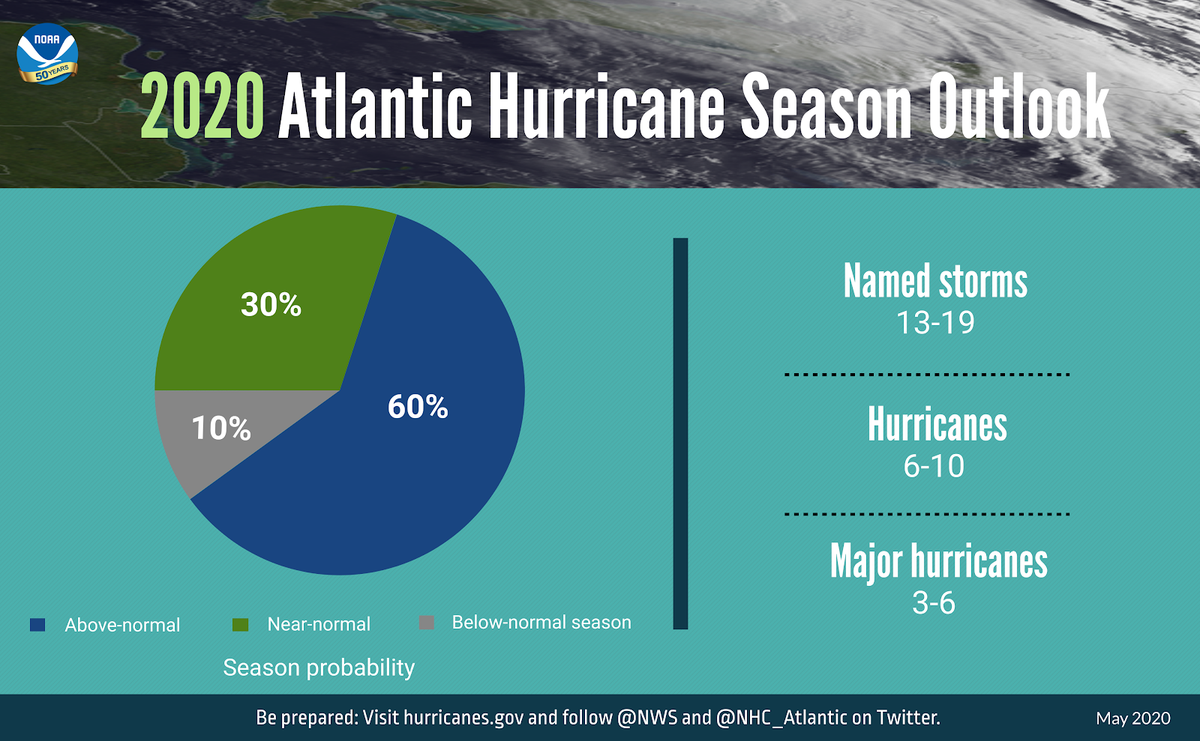
Arthur, the tropical storm that formed weeks before the season’s start, marked the sixth season in a row with an early storm. On Thursday, NOAA announced the basin is likely in for another above-average hurricane season. If it proves to be an active season, it could be the fifth consecutive above-average hurricane season, beating the previous record of four consecutive seasons from 1998 to 2001.
NOAA predicts the formation of 13 to 19 named storms (including Arthur), 6 to 10 hurricanes and 3 to 6 major hurricanes. If a weather pattern known as La Niña forms later this year, it could push the season to the upper end of those predictions.
“We’re predicting this to be an above-average season, possibly extremely active,” said Gerry Bell, lead hurricane season forecaster with NOAA’s Climate Prediction Center.
La Niña is one extreme of a climate pattern that affects hurricane formation. The other extreme, El Niño, is known to depress hurricane formation in the Atlantic.
The latest update from NOAA shows a 50 percent chance that the Atlantic will remain right in the middle of the two extremes, in what’s known as neutral conditions. But there’s also a 40 percent chance that a La Niña could develop.
“It’s not a given right now,” Bell said. “We’re just not sure yet, because this time of the year is a low confidence time.”
Previous university forecasts this year have also called for an active season, in part due to the way April’s record-breaking heat warmed up the swath of Atlantic Ocean where hurricanes often form and the potential formation of La Niña.
“It is not possible to predict how many of these potential storms will hit land,” said acting NOAA administrator Neil Jacobs. That will become clearer as each individual storm is tracked by the National Hurricane Center.
Unlike other years, a hurricane making landfall carries extra risk this year as the coronavirus continues to spread throughout the U.S.
Emergency managers worry that people told to evacuate when a hurricane is coming won’t feel safe in a crowded shelter.
Miami-Dade County has plans to test evacuees for COVID-19, open up additional shelters and even seek out hotel rooms as a socially distanced evacuation option.
Carlos Castillo, FEMA acting deputy administrator for resilience, said his organization has experience with handling multiple disasters at once.
“We have not taken our eye off the ball in responding to other disasters that may occur at this time,” he said.
He urged anyone in a hurricane risk zone to include cleaning supplies, disinfectant and a cloth mask in their evacuation kit.
Jacobs also addressed another COVID-19 impact on hurricane season — the collection of weather data on commercial aircraft. As passenger flight frequency has cratered, the World Meteorological Organization reports that data collection has dropped 75 to 80 percent.
Jacobs confirmed NOAA has received less data, but because it doesn’t have another system to compare against to see how much of an impact that loss of data really has, “we can’t say for sure whether there’s a degradation or not.”
He does expect the debut of new satellites focused on the tropics in coming weeks “would surpass any decrease we see” from commercial flights.
Despite the season’s record-breaking potential, Bell said climate change doesn’t appear to be a factor. Several recently released NOAA studies show climate change is indeed having an impact on where hurricanes form and how strong they are, but the Atlantic basin is one area where global warming is overshadowed by natural factors.
“There may not be any global warming signal to be seen in the Atlantic because the other factors are so dominant,” Bell said.
However, a hotter planet leads to hotter ocean temperatures, which raise sea levels and add on to potential inundation. Storm surge-driven flooding is the deadliest part of a storm.
Bell said NOAA has been counting an average of two additional storms a year since 2000, partially because protocol says they have to name them and partially because the technology to identify weaker and smaller storms has vastly improved.
“It’s not necessarily a climate signal we’re seeing with these May storms,” Bell said. “It may be that they just weren’t recorded before for various reasons.”
This story was originally published May 21, 2020 at 12:26 PM.