Tropical Storm Karen could loop toward Florida and the Bahamas this weekend
Tropical Storm Karen ruffled Puerto Rico and the Virgin Islands with heavy rains and 40 mph winds on Wednesday and was headed into ocean over the next few days.
Next up? A loop.
Forecasters for the National Hurricane Center said Karen will move northeast for a few days before it takes a sharp right turn on Friday and loops back around to point west, toward Florida and the Bahamas.
But whether the storm will inch any closer to the eastern seaboard — or maybe dissolve at sea — is still up in the air.
At 5 a.m. Thursday, the hurricane center reported that Karen had weakened, with maximum sustained winds of 40 mph and said the system was “barely a tropical storm.” While some strengthening was possible, forecasters also said unfavorable atmospheric conditions could keep Karen in check enough to lose its tropical storm status and continue to weaken.
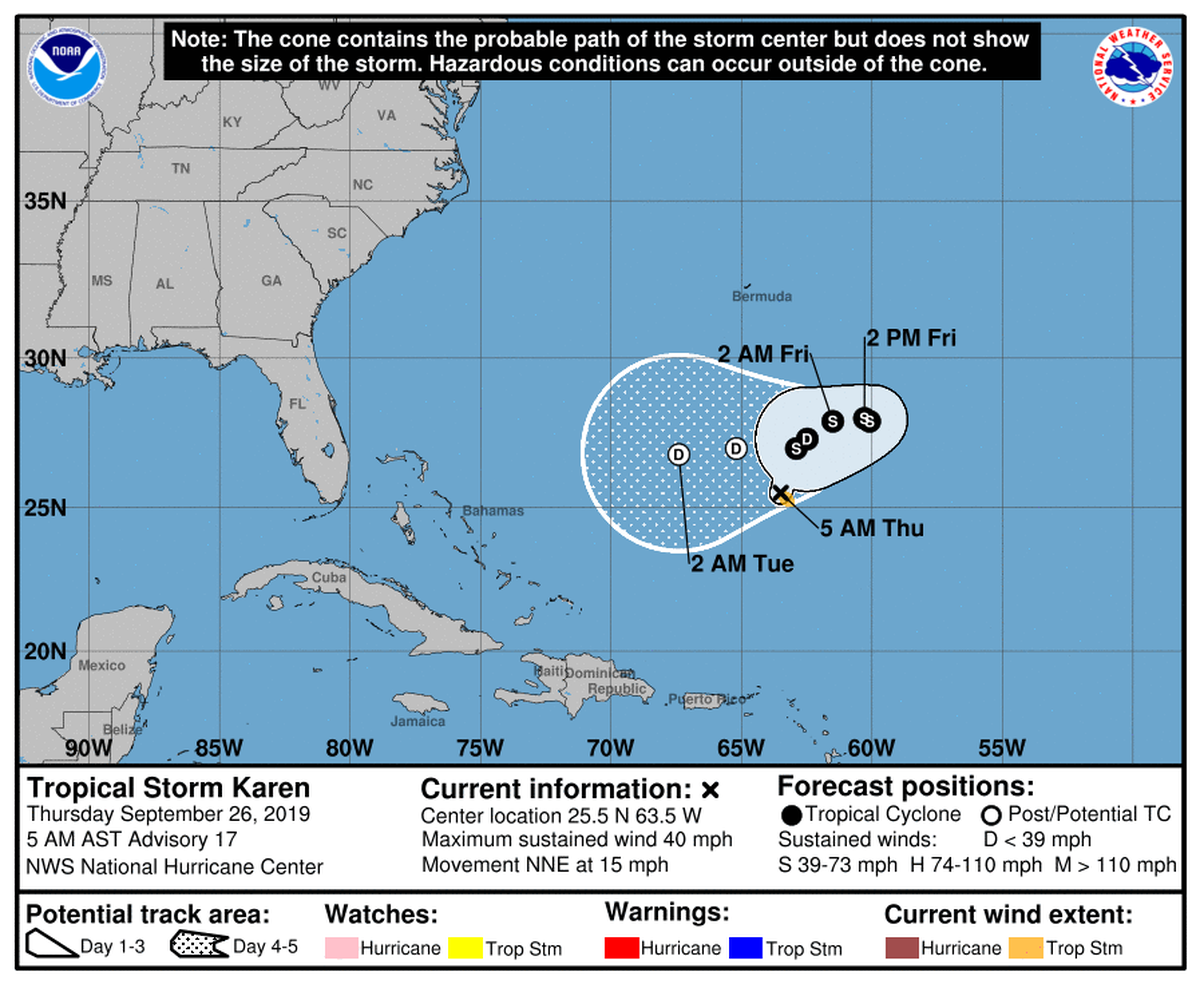
Forecasters said Karen was being steered by a high-pressure area over the central Atlantic and a low-pressure area east of the Bahamas, which is pushing the storm north and eventually northeast. By Friday, forecasters said it will bump into a ridge to the north left by post-tropical cyclone Jerry, which will start the storm on its loop.
It’s an eerily similar situation to 2004’s Hurricane Jeanne, which formed east of the Leeward Islands before crossing Haiti. The mudslides and flooding it caused there killed more than 3,000 people. The then-weakened storm kept going into the Atlantic before making a clockwise loop and coming in for a Category 3 landfall in Stuart, Florida.
Jeanne’s weird path was — like Karen’s — impacted by another recent storm, Hurricane Ivan. Slow-moving Jerry is expected to cross Bermuda Wednesday night, and fast-moving Karen could be affected by Jerry if it gets close enough. The potential interaction between the two storms is part of why forecasters said Karen’s future path is “quite uncertain.”
Unlike Jeanne, however, “conditions now do not favor a strong system,” said Craig Setzer, Miami Herald news partner CBS4’s chief meteorologist.
Puerto Rico, once again, escaped the most dire predictions about the storm. Towns in the central highlands reported heavy rain and some washed out roads and power outages, but there were no immediate reports of loss of life.
Gov. Wanda Vázquez traveled to Utuado on Wednesday to meet with local officials. The town had been hard-hit by Hurricane Maria in 2017 and has not fully recovered.
Utuado Mayor Ernesto Irizarry said that a bridge that connected the community of Pons, where some 30 families live, had been washed out during the storm and it would require extensive repairs.
Local emergency officials said that heavy rains and flash flooding could still affect the central highlands, even as the center of the storm had moved north, past the island.
This story was originally published September 25, 2019 at 7:46 AM.