Will all the action in the tropics affect Miami weather? And when will we feel the fall?
There’s a lot of spaghetti on the storm maps — potential forecast paths in a tropical basin filled with Fiona and several other disturbances.
Meanwhile in South Florida, the National Weather Service and local meteorologists note that the daily forecast this week into next includes drier air with a high heat index but also the chance of potentially hazardous thunderstorms.
Wednesday also marks the first day of fall (and everyone seems to be posting lyrics from Earth, Wind & Fire’s classic song, “September,” on social media).
So when will South Florida actually feel the fall now that we have a soundtrack for the occasion?
Tropics’ effect on Miami weather?
.png "two_atl_5d0 (1).png")
First: You may be wondering: Is all that activity in the tropics the reason the South Florida weather is going through some changes we may not like?
Yes and no, explains National Weather Service in Miami meteorologist Ana Torres-Vazquez.
“South Florida could feel mainly marine and coastal impacts from Fiona in the form of swells, mainly for Palm Beach County and Broward County,” Torres-Vazquez told the Miami Herald on Wednesday.
Swells are collections of waves that are produced by storm winds that could be blowing hundreds of miles out to sea, as opposed to waves, which are generated by winds blowing locally, according to Sciencing. Swells characteristically have smoother, more regular and uniform crests and a longer period than wind waves, according to the National Weather Service.
These Fiona-related swells and maybe some from a new disturbance that started on Tuesday night a few hundred miles east of the Windward Islands could manifest in higher winds, higher wave heights, rip current risks and the potential for high surf in Florida, Torres-Vazquez said.
“That is what will be the main bulk of the impact and that will be mostly occurring starting maybe Thursday and into Sunday, she said, regarding Fiona’s Florida impact.
So, mostly just marine-related.
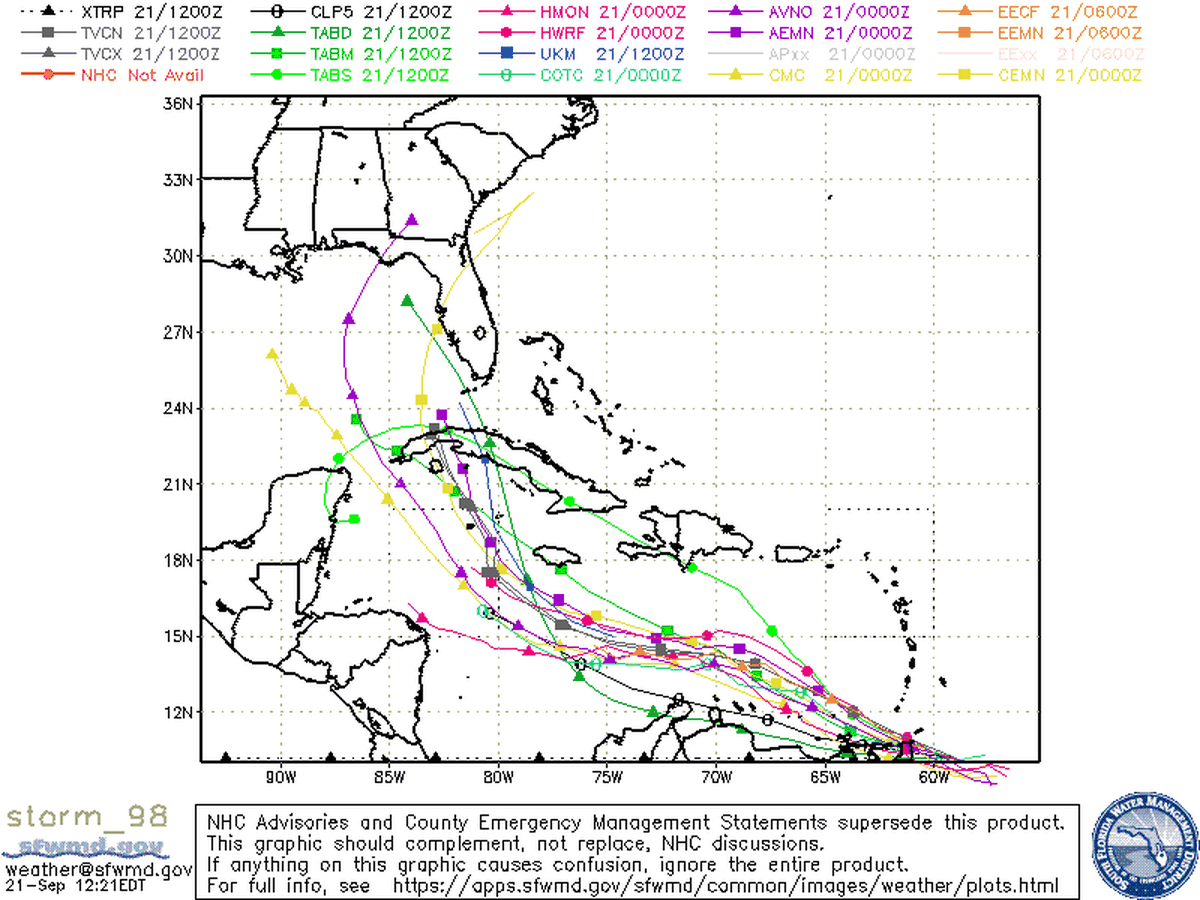
Sigh of relief? Not quite.
“It’s a bit of a doozy from the point of view that it’s going to be a drier period of time so people will think, ‘Well let’s go to the beach.’ But along the Atlantic coast beaches, you could have rougher waters and the risk for rip currents, which are always very dangerous. So it is definitely something to look out for,” Torres-Vazques said.
In terms of the more local conditions from mid-week until the start of next week “that’s not so much being driven by what’s happening in the tropics currently in terms of hurricanes, but more being driven by the synoptic weather pattern over the U.S.,” she said.
Synoptic weather is a way to refer to weather patterns that are broader in range, both in space and in time that can span a week at a time and can occur all over North America, she said. They tend to be the drivers of the more localized weather across the country.
“Right now we have a bit of a ridge building. There will be a weak cold front making its way across the U.S. and southward towards Florida that will also provide some of that influence to generate those storms and whatnot that will dive pretty southward over South Florida to the weekend and eventually move away later next week,” Torres-Vazquez said.
South Florida forecast
So because of this pattern, expect scattered to numerous thunderstorms in South Florida and the Keys each day, with a 30% to 40% chance Wednesday through Sunday and 50% Monday and Tuesday in the Keys and a bit higher in Miami-Dade, Broward and Palm Beach (50% storm chance on Wednesday and on Saturday in Miami, for instance.)
Some of these storms could bring lightning, gusty winds up to 40 mph, and heavy rainfall with the slow storm motion meaning localized flooding is possible.
Waterspouts are possible. And rip currents are to increase across all Atlantic coast beaches over the weekend as a northeasterly swell moves into these waters, the weather service said.
When will the fall really start?
We know what Earth, Wind & Fire and the map says, but EW&F was formed in Chicago and its songwriters weren’t thinking of Florida.
Heat index values will continue to be near the triple digits most days through next week, according to the weather service, so all that “21st day of September” jazz doesn’t apply in Miami or Orlando.
Torres-Vazquez notes Sept. 21 is the start of what is considered astronomical fall when the tilt of the earth and its position in relation to the sun can make for some cooler days. Meteorological fall typically starts at the start of September, she also notes.
“But we are in Florida. We are much closer to the tropics and so it may take until sometime late October, early November until we start to see those temperatures cool down a little bit and those conditions shift from kind of a wetter weather pattern to drier conditions,” Torres-Vazquez said.
So what you can expect is at least another month of warm and stormy conditions with some respite from the swelter.
“A few evenings here and there where you’re like, ‘Wow! It dropped to like the low 70s. This is great!’ But we’re in South Florida.”
This story was originally published September 21, 2022 at 3:16 PM.