We sometimes take for granted the way we cross the bay. There’s a causeway, and we get on it.
Then we sit in traffic or curse construction.
But take a breath. Roll down the window. Enjoy the view. Feel the breeze.
And then think about this: Miami’s causeways aren’t easy to manage. They get old. Bridges break down. Spans get replaced. Traffic piles up.
But what would it be like without them?
Here’s a look through the Miami Herald’s archives at the causeways that link Miami and Miami Beach across Biscayne Bay. The Venetian, MacArthur, Tuttle and 79th Street causeways have been through a lot over the years.
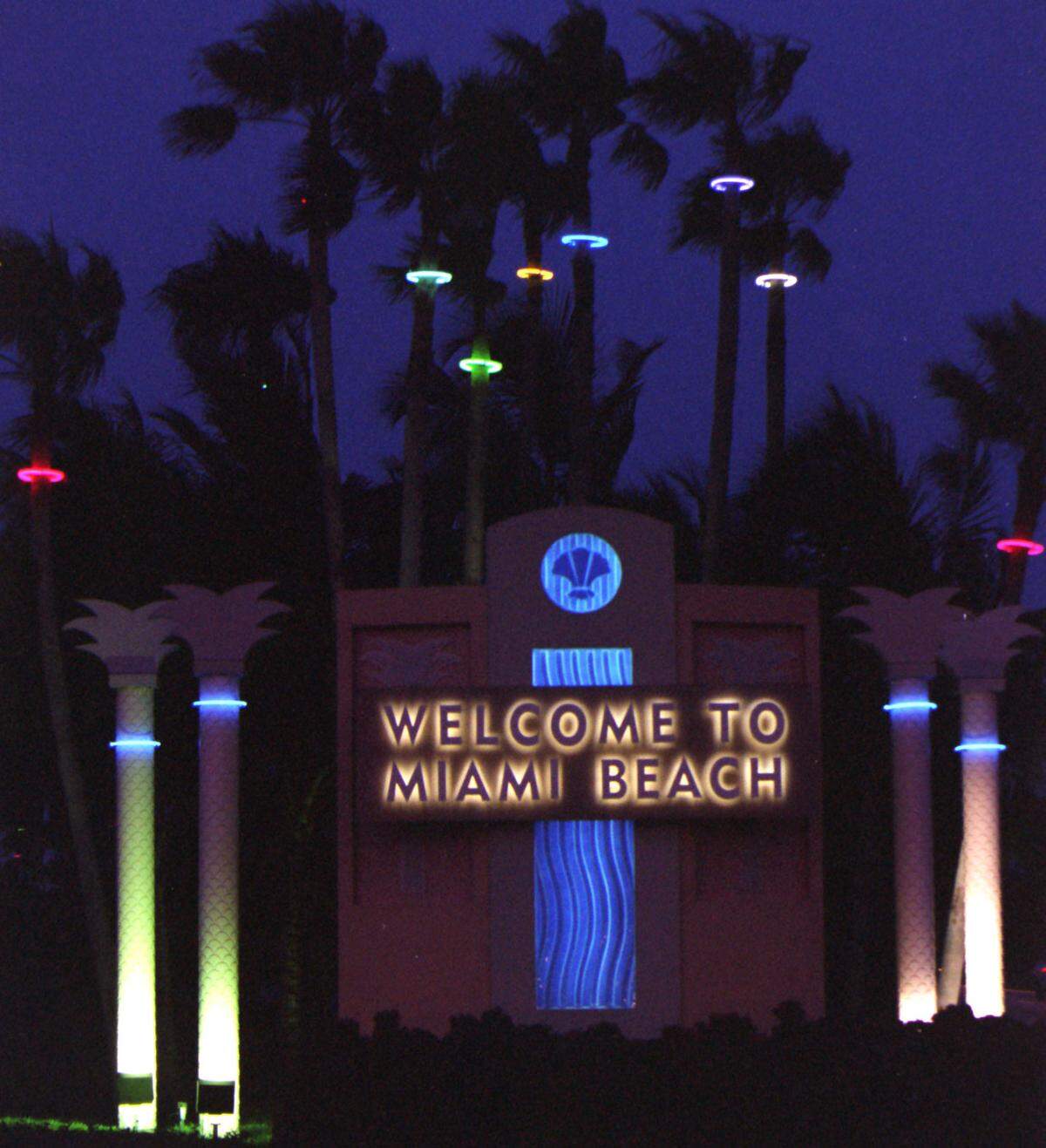
A sign at the end of a causeway. Miami Herald File
Spanning history
Published April 17, 1988
In 1913, when young Miami was pronounced Miam-uh, John Collins built the first link between the mainland and Miami Beach: the Collins Bridge.
Twelve years later, the wooden span was replaced by the Venetian Causeway, which connects 15th Street in Miami to Dade Boulevard on the Beach.
Few islands dotted Biscayne Bay in the early 1920s. A mangrove swamp called Bull Island was the only one off Miami Beach.
The demand for waterfront property prompted developers to hack down the mangrove forest, fill in the small island and rename it. Belle Island sounded prettier than Bull. The Bay Biscayne Improvement Co. convinced wealthy snowbirds, such as department store owner and catalog magnate J.C. Penney, to move into exclusive waterfront homes there.
Meanwhile, Bay Biscayne busily built more islands along the causeway. The company’s dredges pumped up sand and soft rock from the bay bottom to create a string of causeway islands with Italian names: Rivo Alto, DiLido, San Marco and San Marino.
The man-made isles were platted as residential islands with the bay for a back yard. Families built large, comfortable homes and planted trees and shrubs. The result: quiet streets and secluded homes.
There has always been a toll on the causeway and controversy about removing it. In 1944, the company that owned the Venetian, the Miami Bridge Co., proposed lifting the toll but changed its mind when islanders objected and tried to buy out the company.
In the early 1960s, the first high-rises were built on the Venetian Isles, first on the south side of Belle Island. Over time, the number of apartment buildings increased on Belle and Biscayne islands.
Meanwhile, the procession of traffic on the Venetian flowed and ebbed. In 1958, at its peak, the privately owned highway was a major link between the Beach and Miami. About 25,000 motorists a day paid a 10-cent toll to cross the Venetian.
One year later, the Julia Tuttle Causeway opened and motorists deserted the Venetian. Like the MacArthur Causeway south of the Venetian, the Tuttle charged no toll. The Tuttle had another benefit: No drawbridges to slow traffic.
The Venetian traffic count dropped to 8,000 cars a day. Today, no more than 7,000 motorists cross the deteriorating causeway daily.
Metro-Dade county wants to rebuild the Venetian, which it bought in 1950 for $3.8 million. The reconstruction cost is an estimated $33.7 million. It cost about $2 million to build the Venetian in 1925.
A view of MacArthur Causeway and downtown Miami onboard Virgin Voyages Scarlet Lady cruise ship that was docked at PortMiami on Tuesday, September 28, 2021. MATIAS J. OCNER mocner@miamiherald.com
Preserving the causeways
Published April 20, 1988
By Beth Dunlop, Architecture Critic
More than anything else, our causeways show us what is special about Miami: the thrust of tall buildings into the vast blue sky, the turquoise sparkle of Biscayne Bay - our most magnificent natural asset.
Our causeways give us a profound sense of place. They give us a way to look at our architecture, understand our economy, catalog our natural resources, even count pelicans perched on posts.
Our causeways ought to be treated as treasures, exalted for their long views and cherished for the way they let us truly enjoy the spectacular scenery.
Instead, many of them face “improvements” that, while intended to make them faster or safer, could also transform them into speedways, blocking our views and forever removing the intimate associations that link us -- in our autos or on foot -- to Biscayne Bay. Already, those views have been obstructed by crash barriers on the Julia Tuttle, and there is more to come -- on the MacArthur and the Venetian as well; the Venetian Causeway is scheduled to be replaced within the next few years.
Our causeways shouldn’t be treated like any old road, left to the whim and short-sighted practicalities of routine highway improvement. They should become the centerpiece of a visionary urban design scheme.
Perhaps some of them should become the domain of state or county park services, instead of road departments. Certainly, they ought to court bicyclers, walkers, fishermen and photographers rather than prohibiting them, as many do now.
At minimum, the state causeways should be downgraded so that they are not even state highways, much less part of the federal nterstate system. They are not race courses, and they do not need to be traversed at high speed. Downgrading, though it would transfer the costs to another governmental body, would give us much more flexibility in how the causeways could be used.
And at least some of them ought to offer meandering drives across the bay, with places to stop, park, even picnic. For most people, the causeways are the only place to see the bay; all of us ought to make the most of this.
Maybe - and this is not really a radical idea -- one side of some causeways, the Tuttle or the MacArthur, could even be closed every so often on a Sunday to allow bicyclists and pedestrians a chance to enjoy the water’s edge. It happens in New York’s Central Park, in Washington, D.C.’s, Rock Creek Park; there is no reason why it couldn’t happen, occasionally, here.
The Rickenbacker Causeway, linking Miami to Key Biscayne, shows us that our causeways can be upgraded without sacrificing either safety or beauty. Opened in 1986 with a span that rises 76 feet in the air, the Rickenbacker offers something for everybody. The views are unimpeded. Bicyclists and pedestrians have a separate lane. At the edge is the beach, linear park carved out of the old 1947 causeway. The views are magnificent, the juxtaposition of road and beach is a glorious sight, especially on a good day for sailing, when the bay is filled with catamarans and windsurfers. Really, it embodies many of the reasons that we live here and not in some landlocked city elsewhere.
There are eight causeways in Dade County, from the Rickenbacker at the south to the William Lehman at the north. Each is different, in character and views, in the way they cross the water. Some soar; others are low, slow and really rather personal. In some spots, the water laps so close to the roadway that it seems it might splash passing cars.
True, the causeways have their annoyances -- bridges that open and shut, tourists who slacken to capture a particularly lovely view or even abruptly stop mid-lane to watch a cruise ship glide out the channel.
But, oh, what views!
On the causeways, there are romantic glimpses of Miami’s skyscrapers -- utterly glorious on a brilliant day, an eerie sight when the weather is cloudy or misty. Up close, from the MacArthur, the skyline unfolds as a dramatic vista. That skyline vista takes different shapes from more distant vantage points, and yet it is always an enthralling sight, even from miles away. The sunset works a special magic on the silhouette of downtown Miami.
At dusk on the Julia Tuttle Causeway, the late-day sun casts a golden light on Miami Beach, and the buildings glow, literally. At dawn on the MacArthur, you can pace a cruise ship as it comes into port. Where else in the world can you drive side by side with ocean liners?
No less amazing is the sight of the ocean from the Lehman Causeway. It is almost like seeing the desert beyond the mountains, though this is a manmade moment. And it is a rare moment, for -- and this is one of the great ironies of life in South Florida -- there are few places to look at the ocean, just in passing. The land is so flat here that we have few vantage points.
Artists understand the significance of our causeways, seeing them in ways we seldom do. From the moment he arrived in Miami, Christo was drawn to the causeways. He spent endless hours criss-crossing the bay, stopping often, riveted by a special view or a particular juxtaposition of land and water.
His love of the causeways eventually became Surrounded Islands, a pink polypropylene ode to Monet’s Water Lilies. He wanted us to see more than just the sparkling waters of Biscayne Bay; he wanted us to see our causeways as they could be.
Once, my family and I took an English visitor with us on a trip from Miami to Pensacola, seeking Florida’s architectural history. As we drove across the Julia Tuttle Causeway on our way home, she told us that of all the sights in America, she found this passage across Biscayne Bay, with Miami in one direction and Miami Beach in the other, to be the most beautiful. How little we who live here appreciate this.
Fishermen and photographers use the causeways, especially during the tourist season and the times when the shrimp run. They do so illegally, for it’s against the law to stop to admire the magnificent panorama that is Miami, and it’s likewise against the law to fish from almost every causeway bridge.
To destroy one of our most remarkable resources with insensitive design and engineering would be a much worse crime -- one that could affect us all in ways both subtle and blatant.
Our causeways defy any firm rules: Each is unique and ought to be treated in a different but gentle way, bearing in mind that these are more than mere roads. They are so important they ought to be national parkways, official scenic landmarks at the very least.
As plans progress --for the Venetian, the MacArthur, the Tuttle -- the goal should be borne in mind that our causeways let us celebrate all that is beautiful about Miami, if we slow down and enjoy it.
What to know about the causeways
Published July 31, 1983
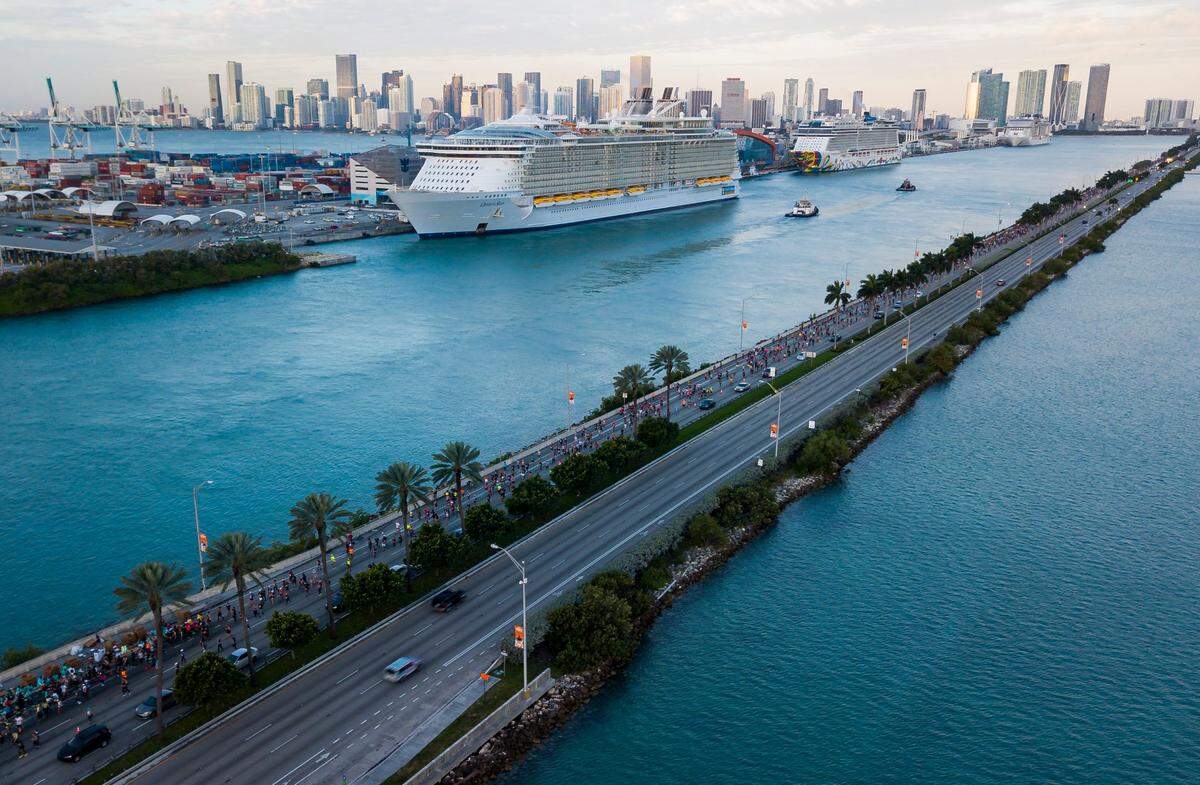
An aerial view of MacArthur Causeway shows runners making their way toward Miami Beach from downtown Miami as they participate in the Miami Marathon and Half Marathon in February 9, 2020. MATIAS J. OCNER mocner@miamiherald.com
MACARTHUR CAUSEWAY
Estimated daily traffic: 42,000.
Built in 1920 and rebuilt in 1959, the MacArthur is the grandaddy of the causeways and one of most troublesome.
According to Gabriel Romanach, Florida Department of Transportation (DOT) district project manager, the bridge has “no structural problems.” But according to the hundreds of steaming drivers who were trapped on the causeway July 4, there’s certainly something wrong with the drawbridge.
“The bridge goes up and down hundreds of times every day and even when it’s down it takes a beating,” said Ron Klein, a Florida DOT engineer. “It is just a problem of repairing a worn- out drawbridge mechanism.”
Those repairs will cost about $500,000 and will be finished in October, if all goes according to plan.
View of the west entrance to the Venetian Causeway. Pedro Portal pportal@miamiherald.com
VENETIAN CAUSEWAY
Estimated daily traffic: 9,141
The Venetian was opened in 1926, when Calvin Coolidge was president. It should have been replaced under Nixon, according to Charles Baldwin, chief of Dade County’s Highway Division of Public Works.
“We’ve been trying to get money to replace it since the 1970s,” he said. “At the present we are just trying to keep it in the margin of safety.”
This year, that task will cost the county about $150,000 for a new fender system, $32,000 for a new submarine cable for the drawbridge and $200,000 for repairs to the piling.
A new causeway would cost the county about $35 million, Baldwin said.
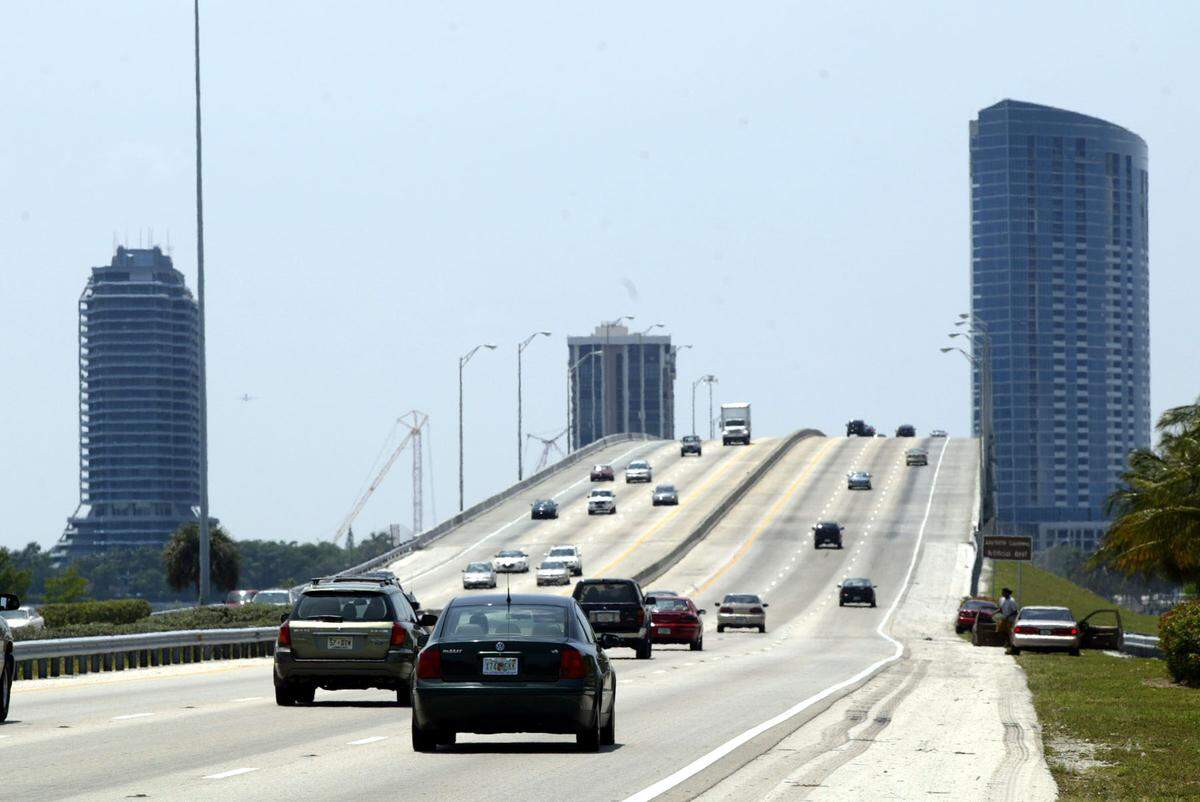
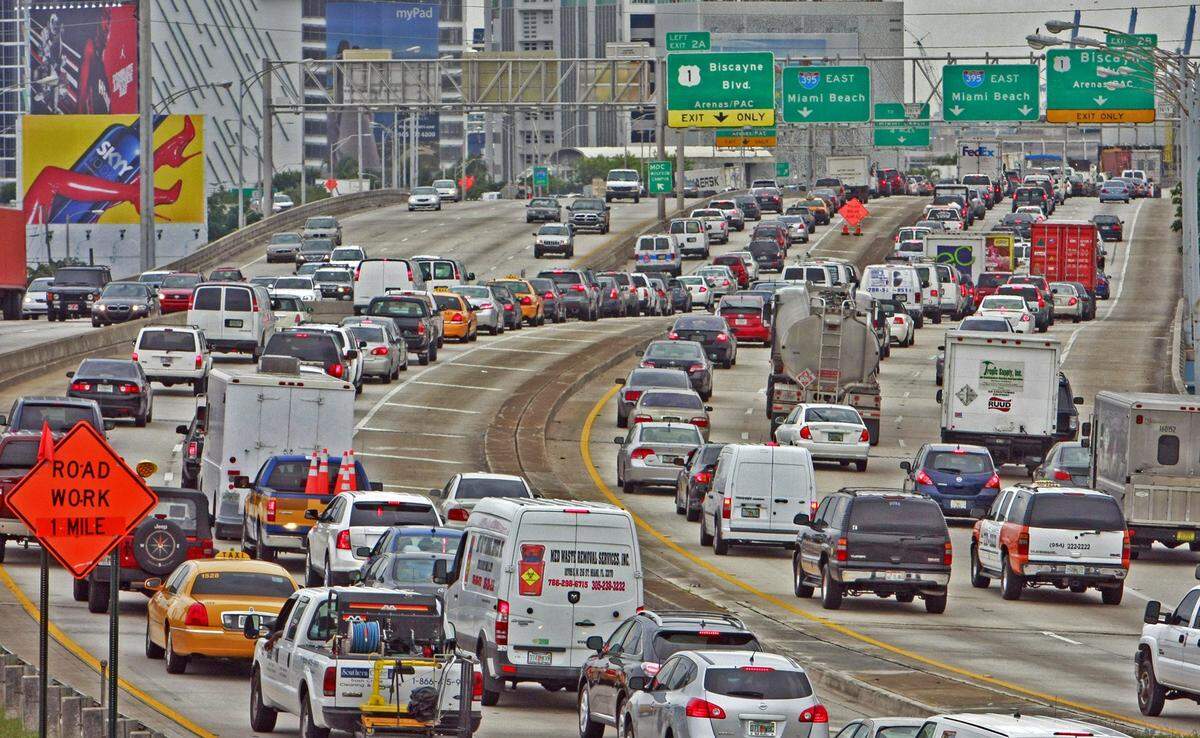
Traffic on the MacArthur Causeway. Alexia Fodere Miami Herald File
JULIA TUTTLE CAUSEWAY
Estimated daily traffic: 28,452
The Julia Tuttle Causeway is 24 years old and going strong, except for one problem.
“The bridge is too narrow,” Goodknight said. “It was built to design standards of 20 years ago and just doesn’t have the margin of safety. We’ve seen accidents involving the design features. Our plan is to widen the shoulders, to widen the bridge.”
That plan, Goodknight said, is still in the thought stages.
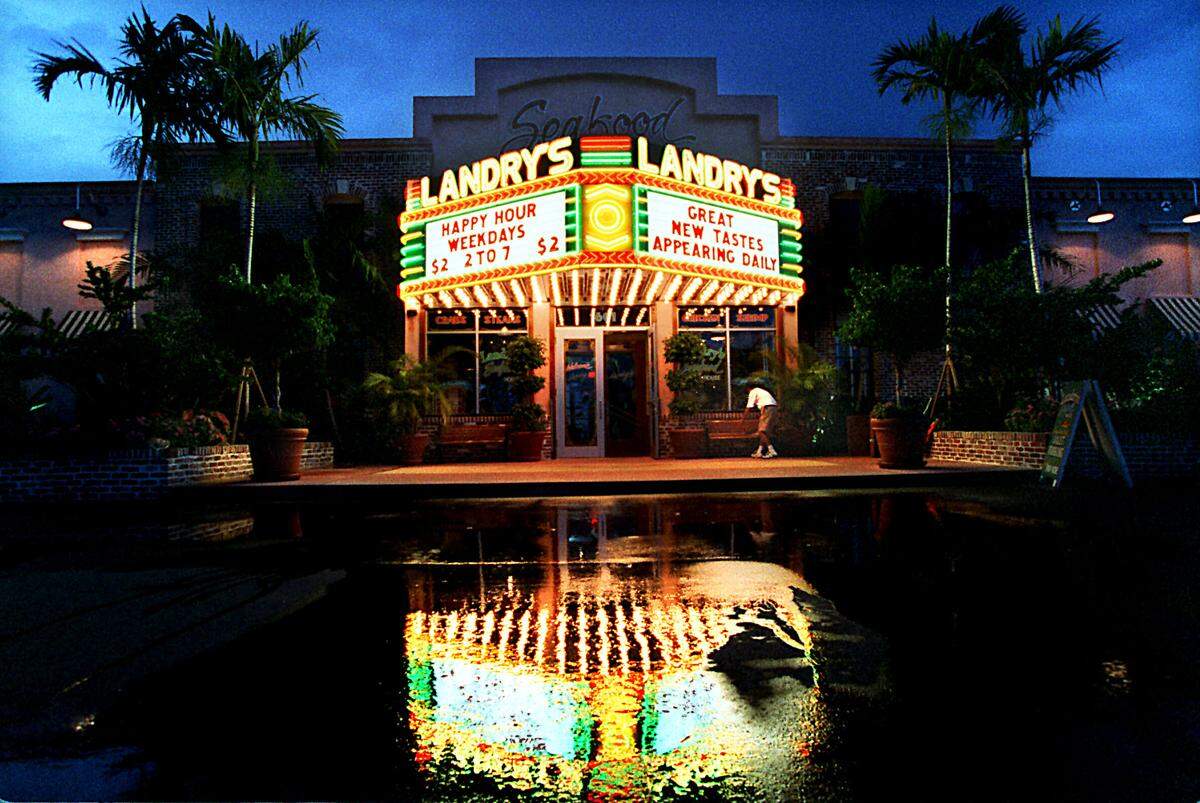
Landry’s Restaurant on the 79th Street Causeway. Chuck Fadely Miami Herald File / 1995
79th STREET CAUSEWAY
Etimated daily traffic: 29,800
The 79th Street Causeway, built in 1928 and rebuilt in 1948, is one of the healthiest. The bridge was widened and bolstered in the late 1960s and early 1970s but since then has needed only minor repairs.
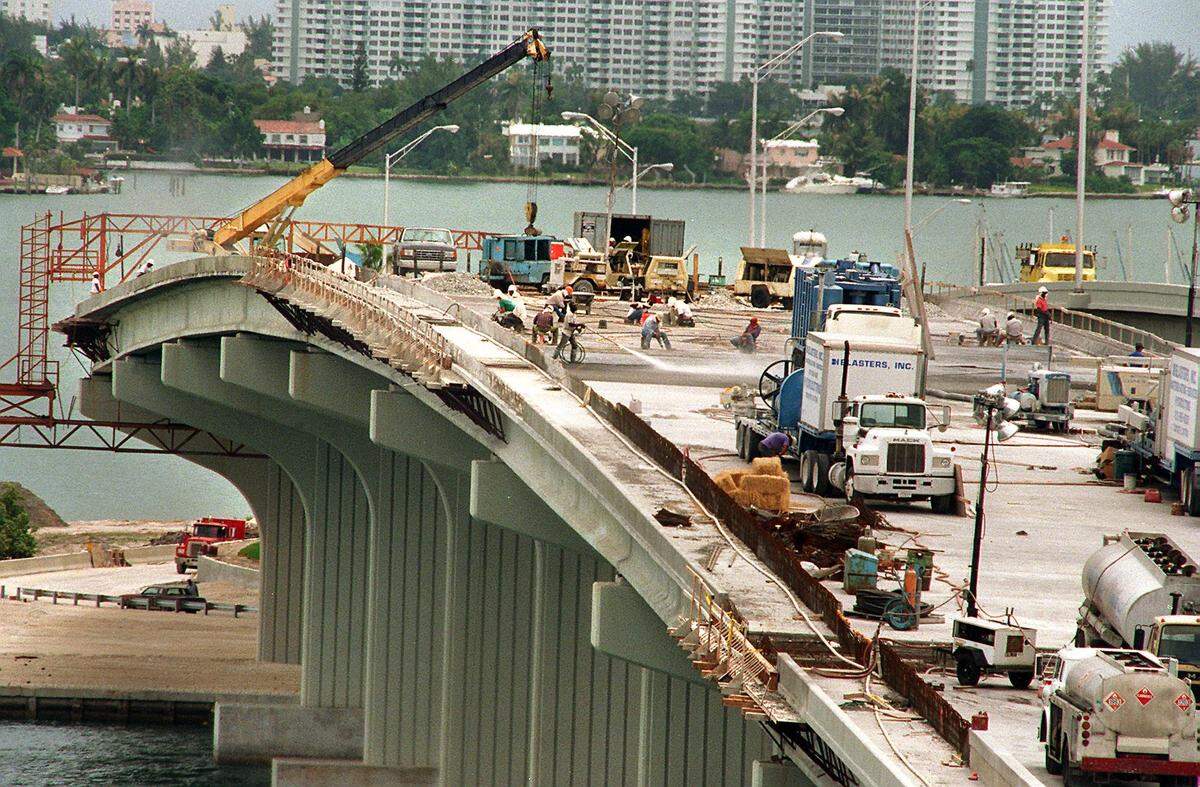
Workers hose down fresh concrete on the MacArthur Causeway that crosses from Miami to Miami Beach . Tim Chapman Miami Herald File / 1996
Work on the span
Published Aug. 27, 1993
Each day, thousands of Miami Beach-bound motorists look to the right of the MacArthur Causeway drawbridge and see a barge jammed with equipment.
What is it?
Answer, according to state Department of Transportation spokesman David Fierro: a staging barge with a crane and drilling equipment, and a separate barge to haul off silt from the bay bottom.
Construction workers are using the equipment to drill 108 drill shafts, into which concrete will be poured. The shafts will be the underwater supports for the new $30.2 million fixed- span bridge being built to replace the existing MacArthur Causeway bridge.
Each shaft will be 120 feet deep, and 83 inches in diameter.
As the drill goes into the bay bottom, a metal casing will be put into the hole to keep the shaft walls from collapsing. Water inside the shaft will be pumped out so that the drilling can proceed, Fierro said.
Work on the project started in August and is scheduled to be finished in the fall of 1995. The western half of the new 65- foot-high bridge will be built a few feet south of the existing bridge. The eastern half of the new bridge will be in the same place as the old bridge, after it’s demolished.
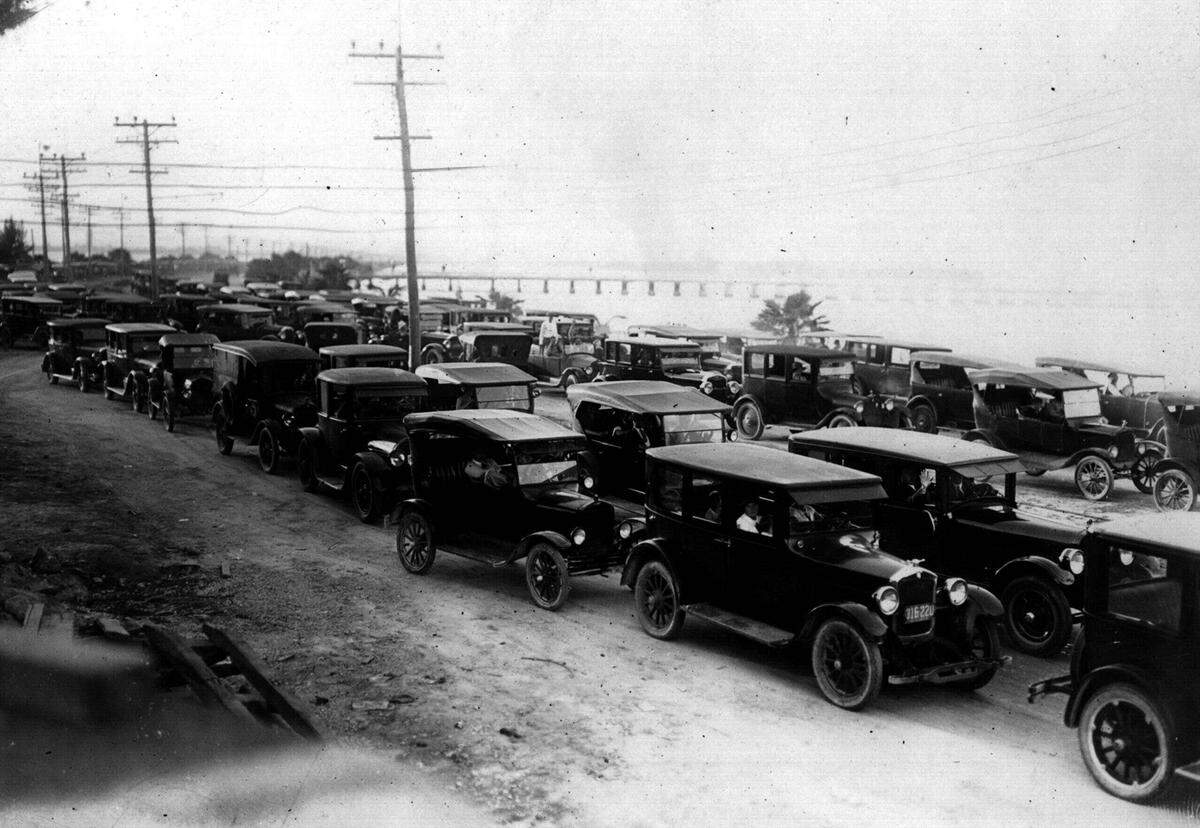
In 1921, traffic was already clogging what would come to be called the MacArthur Causeway. The bridge to Star Island is visible in the distance behind the causeway. Miami Herald File
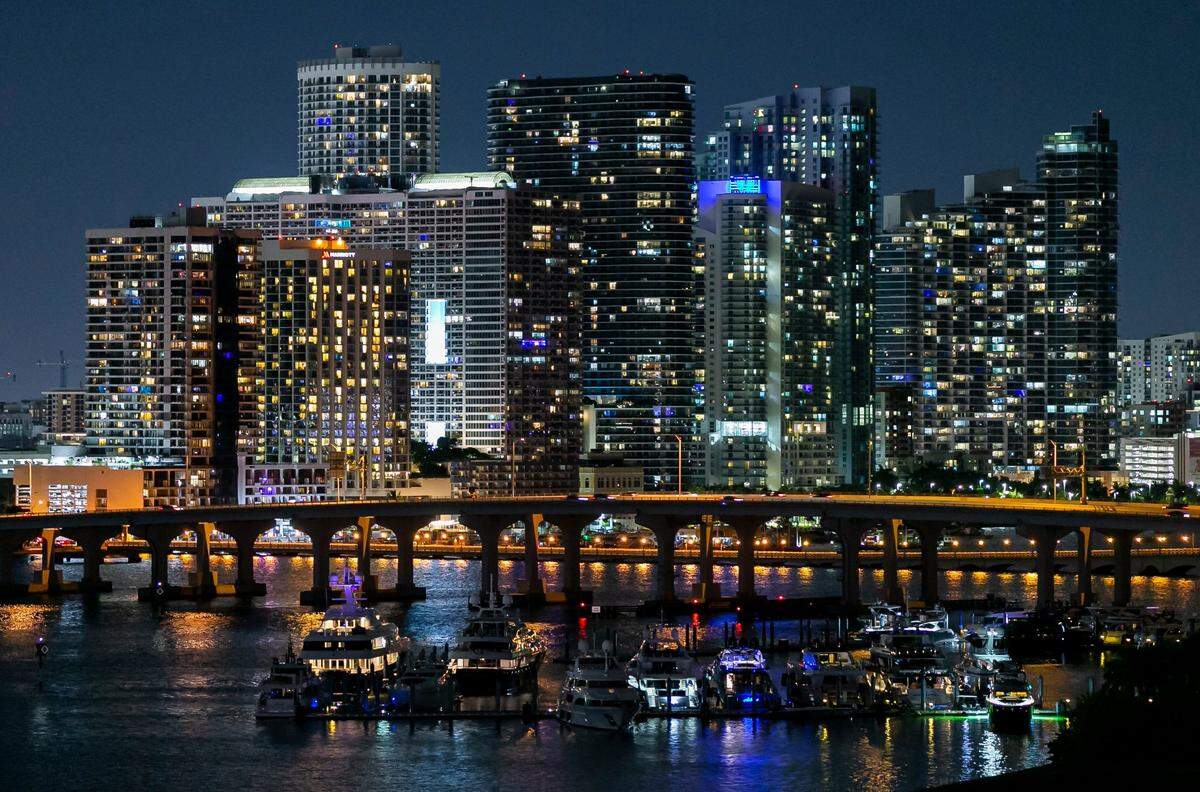
A vivid rainbow shines over the MacArthur Causeway 2010. Miami Herald File
MacArthur transformation
Published Aug. 17, 1996
Construction of the second half of the new twin-span MacArthur Bridge is likely to remain a work in progress until the end of the year. If so, the $30.2 million project will conclude a year behind schedule.
Originally promised as a 750-day project to be finished by late 1995, unexpected delays are being blamed on removal of the previous span, a balky, uncooperative drawbridge that often got stuck.
“Demolition of the old bridge took longer than the contractor originally estimated,” said Yvonne McCormack, public information specialist for the state Department of Transportation.
Removal of the concrete fender system that protected the ship channel under the old drawbridge caused a lengthy halt this year, she noted.
The late MacArthur did achieve one positive end. Its remains were used to build a huge underwater reef in Biscayne Bay north of the Julia Tuttle Causeway.
It is down and out now and work is proceeding at a pace where the state is “hoping for completion by the end of the year,” said McCormack.
A first step is anticipated by late October when one lane of westbound traffic from Watson Island to Biscayne Boulevard will be shifted to the new, second span.
Meanwhile, work continues this week on final preparation of the road surface of the westbound bridge. A final 220-foot long section requires an additional layer of concrete.
When finally completed there will be three lanes of nonstop traffic on each of two separate high-level bridges over Biscayne Bay. The spans link Miami Beach and the downtown Miami mainland via the MacArthur Causeway and Interstate 395.
A view of the west entrance to the Venetian Causeway. Pedro Portal pportal@miamiherald.com
Venetian progress
Published Feb. 28, 2016
For once, something is arriving on time in Miami.
After nine months of getting rerouted to other traffic-riddled causeways to travel between the cities of Miami and Miami Beach, commuters will be able to take the slower scenic route across Biscayne Bay on the reopened Venetian Causeway starting at noon Monday.
The 730-foot stretch of the west bridge connecting the Venetian Islands to the mainland was completely reconstructed. The old one - crummy and covered with metal plates in its weakest spots - badly needed to be replaced. Construction started June 1 last year, shutting down a crucial thoroughfare and forcing pedestrians, bicyclists and cars to take the MacArthur or Julia Tuttle causeways. According to the county, the parts of the old bridge that were removed were submerged to create an artificial reef.
Miami-Dade Mayor Carlos Gimenez, County Commission Chairman Jean Monestime and County Commissioners Sally Heyman and Audrey Edmonson will be on hand at the Miami entrance to the causeway to cut the ribbon for the $12.4 million project that is finishing on schedule. In addition to a new bridge, the roadway on the approach has been redone and new lighting installed.
After the 11 a.m. ceremony, the roadway and sidewalk are scheduled to be open for traffic around noon.
On Saturday, Belle Isle resident Scott Diffenderfer told the Miami Herald he was “thrilled” that the causeway was reopening on time, even if it means more people will be rolling through the series of islands that have experienced a welcome side effect of a closed-off causeway - peace and quiet.
“Traffic has been so horrible on the other causeways that residents are happy to get relief,” he said. “The Venetian has been nice with less traffic but not worth the inconvenience of having to use the MacArthur or the increasingly gridlocked Tuttle.”
This headache caused by the west bridge will be going away for now, but a migraine awaits on the horizon. Replacement of the west bridge was fast-tracked as an emergency project because of its poor condition. But the rest of the 90-year-old causeway is in bad shape, too, and the Florida Department of Transportation is currently in the second year of a three-year, $2.8 million study to examine how the rest of the roadway will be updated or replaced - in either case, a long and expensive task. That study is supposed to be done in 2017.
A debate will likely ensue on just how to fix the historic causeway, the oldest in Florida. Built in 1926, the Venetian is on the National Register of Historic Places and has local protections from the cities of Miami and Miami Beach. Preservationists are expected to push for preserving as much of the old structures as possible and keeping the character of the low-scale causeway intact.
Engineers and residents will hash out the details during public workshops. But that’s for later. This week is for easier trips across the bay.
The previous bridge, also named for World War II Gen. Douglas MacArthur, was a low-level span opened in 1961 with two lanes in each direction. Due to its low height, its drawbridge had to be raised and lowered with exhausting frequency.
The two new spans are 72 feet high from peak to bay and are separated by a designed-in gap to accommodate a possible future Metrorail line.
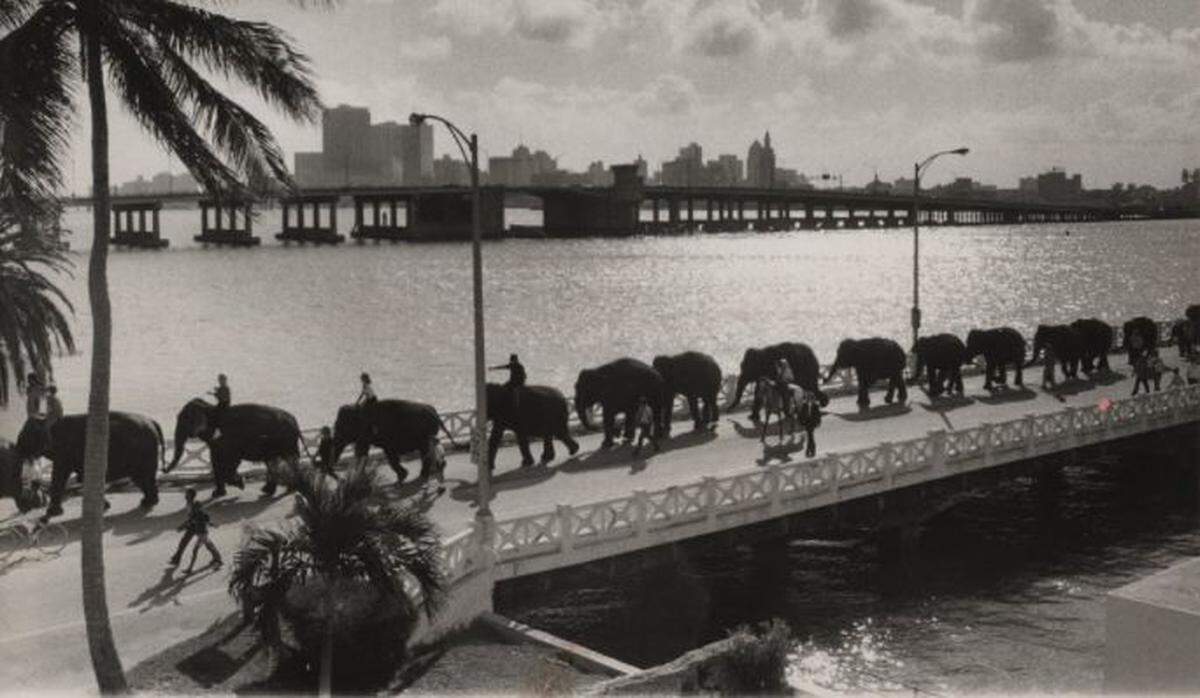
Circus elephants cross the Venetian Causeway in 1975. Miami Herald File
Bridge challenge
Published June 7, 1999
The restored Venetian Causeway will reopen to through traffic Aug. 31, the Florida Department of Transportation says.
“Barring any last-minute weather or any other major problems, that’s what we’re shooting for,” said Brian Rick, a DOT spokesman. Road engineers are certainly keeping their fingers crossed, given that August is at the height of hurricane season.
If state road engineers stick to the schedule, it will be the first time in three years that vehicles will be able to reach Miami Beach from Miami over the 73-year-old causeway - the oldest in Miami-Dade County.
Although most of the work on the east end of the causeway was completed more than a year ago, replacement of the west end drawbridge is not quite complete.
Completion of the project marks more than construction of a bridge. It marks the end of one of the most ambitious and unconventional roadway reconstruction projects in South Florida history.
Although the state transportation agency initially planned to raze the old causeway and build a new one, it ultimately caved in to pressures from Venetian island residents who fought to preserve the original roadway.
Residents succeeded in persuading the federal government to designate the Venetian Causeway as a national treasure. It was listed in the National Register of Historic Places in 1989.
The designation halted plans by the state transportation agency to demolish the old causeway, including the 12 bridges that connect the residential islands to the mainland and Miami Beach.
The designation forced state road engineers to change their plans. Instead of building a totally new causeway, they settled for restoration and renovation.
Under the redrawn plan, only the east and west drawbridges would be replaced, while the rest of the causeway would be restored to its original splendor.
But in 1995, the Coast Guard stepped in with unexpected last-minute objections.
Coast Guard officials told county commissioners that restoration designs were not satisfactory. They called the west drawbridge, near the Herald building, a hindrance to navigation and urged design changes. They wanted a higher and wider bridge.
Initial plans called for keeping the west drawbridge at its original height of five feet, eight inches and to widen the passageway underneath from 48 to 90 feet.
The Coast Guard wanted the height raised to at least 12 feet and the width widened to at least 125 feet.
Conservationists stood their ground and forced the Coast Guard to back down. The compromise: The bridge would be 12 feet high, but the passageway underneath would be widened to only 90 feet.
Unlike other roadway projects, which have as much charm as a 15-lane expressway, restoration of the causeway was treated more like an artistic endeavor.
For example, the guardrails - which had been collapsing and falling into the bay - were replaced, but their original design - a cross-stitch pattern - was duplicated.
Other touches: decorative street lights with frosted glass tops made to fit with the look of Art Deco South Beach.
While the whole project was aimed at recapturing the causeway’s original flavor, a high-tech addition may be on the way.
Electronic toll collection similar to that in operation on the Rickenbacker Causeway has been scheduled for the Venetian as well.
Whether the system will be in effect the day the Venetian reopens is unclear.
County public works officials say that while it’s possible that electronic toll collection will be in place that day, humans for sure will be on hand to collect tolls the old way.
Restored causeway
Published Sept. 5, 1998
Skimming over the shallow waters of Biscayne Bay, its low profile a notable contrast in a place known for hype and hip, is something old, something new, something borrowed and something to provoke a sacre bleu !
Lighted by 242 decorative street lamps casting a soft glow from a more two-lane kind of time, edged by a guardrail with a vintage X-marks-the-spot design, topped by a charming bridge tender’s house, a pearl necklace like no other is coming to Miami.
It is the soon-to-be restored Venetian Causeway, and it is now making its way across Biscayne Bay.
When the $28 million, 12-bridge project is complete next summer it will re-link Miami at Northeast 15th Street and Miami Beach via the six Venetian Islands.
Work on the first 11 bridges, begun in late 1995, is finished. The last, and major, piece in the project is a new west drawbridge and roadway. Costing some $16 million, it is now a bit more than halfway complete.
Most highway-bridge projects have all the charm of Interstate 95. Such public works are built for utility, not beauty. But the new Venetian will be both essential and unusually attractive.
“I call it romantic,” said Evelio Hernandez, project manager on the job for the Florida Department of Transportation. “With its soft white lights and low railing, it will be really distinctive.”
That this can actually be happening in South Florida, a place where the 10-year-old Miami Arena is considered out of date, is due simply to one huge force: history.
The American Society of Civil Engineers puts the average life of a bridge at 50 years. Anything older should be replaced, it recommends. The Venetian is 72 years old and parts of it were actually falling down.
Yet restoration, not razing and replacement, is under way because residents of the Venetian Islands have always regarded the public causeway as their main street. It’s the only land link they have and they refused to let it become a faceless expressway.
Opened in 1926, the Venetian follows the footprint of Miami’s first bay bridge, the all-wooden Collins Bridge that opened on June 12, 1913.
To give it status, the Venetian was officially placed on the National Register of Historic Places in 1989. Any move to alter its other-era looks would have been fought, probably in court.
So the state agreed to restore. Somewhat reluctantly, the U.S. Coast Guard, responsible for the open waters, went along. It hasn’t been easy and isn’t cheap.
Consider that the all-new MacArthur Causeway span, a towering, six-lane, high-rise bridge just south of the Venetian, cost $30.2 million when it was finished in 1996. And it replaced a creaky old, four-lane drawbridge opened in 1961.
The Venetian will cost nearly as much at $28 million and will be far from new. When finished, its two-lane bridges will have the exact same width - 41 feet, 10 inches - as they did in 1926. No breakdown lanes. No flyovers.
This fact of life presented engineers like DOT’s Hernandez with an unusual challenge. Since they couldn’t just throw out the old, they had to get creative. Which is how they came up with a concept one doesn’t often hear of in construction projects: entombment.
In most instances where the old structure was deteriorated, repairs were made using sandblasting and chipping, then installing new steel reinforcing and concrete. It was patchwork.
But many of the pilings under the half-mile-long west bridge, for instance, were so badly deteriorated they were beyond any sort of repair.
Prohibited from total replacement, engineers simply encased the old pilings in a new underwater outer piling, thereby preserving the old -- like the U.S.S. Arizona is entombed under the sea at Pearl Harbor.
“We don’t like to say it is structurally more sound,” said Hernandez. “But it won’t get any worse now.”
The old bridge was in such poor condition it had a severe weight restriction of two tons imposed on it. When fully reopened, Hernandez estimates the weight limit may be increased to as much as 27 tons.
Guardrails, which in 1994 and ‘95 had been collapsing from the old bridges and falling into the bay, could not be restored. So their original design, listed in the Historic Highway Bridges of Florida, was duplicated.
Hernandez calls it a “paired X design” supported by square-capped posts. The distinctive cross-stitch pattern is now known officially as “a Venetian railing.”
Rather than being scrapped, however, the old bridge railings were reused. They were given a new life, taken by barge north of the Julia Tuttle Causeway where they were sunk to help create a new reef for restoration of Biscayne Bay.
Other new additions include decorative street lights, the kind with frosted glass tops often seen in old black and white television shows of small-town America. Lighted from east to west, their soft glow will cast a pearlescence that fits with the famous Art Deco look of South Beach.
The gateway west bridge, for instance, will feature 84 lights, 42 on each side. Contrast that look with the futuristic Dodge Island Bridge to the south, lighted by a neon-like blue glow at night.
And while the roadway won’t be any wider, the fully restored west bridge will have new sidewalks on both the north and south sides. Romantic walks, anyone?
A showpiece of the restoration is the addition of new bridge tender’s houses for the two drawbridges or, more accurately, bascules. Now being built, the west bridge tender’s control house will be downright glamorous -- 47 feet high with a barrel tile terra cotta roof, columns, arches and wide picture windows -- made of bulletproof glass.
Bulletproof glass is now standard issue in all Florida drawbridge houses after a few incidents when motorists, furious at being stuck at an updrawn bridge, took out their anger by firing off a few rounds at the bridge tender. And unlike 1926, the tender’s manse will be fully air conditioned and have a fancy bathroom.
Hernandez said the whole house will have a “a Mediterranean look.”
The actual mechanical works -- gears, electrical circuits and steel decking -- of the bascule will be totally new, however. The boat channel will be wider, having a passage 90 feet wide vs. the old 42 feet. More importantly for most small boaters and drivers on land, it will be eight feet higher, offering 16 feet of clearance when closed vs. the old eight feet.
Still, vehicle traffic back and forth on the causeway will still be delayed when the bridges are raised to accommodate boats. Also there still will be a toll collected by Dade County on the Biscayne Island end of the causeway.
Consider it all part of the price we pay for going back to go forward. Cutline Herald File HOW IT LOOKED THEN: In 1952, a new toll booth and bridge tender’s house were built on the Venetian. They’re being replaced. Herald File MIAMI’S FIRST BAY BRIDGE: The Venetian follows the footprint of the all-wooden Collins Bridge, which opened on June 12, 1913. Herald File A HIGHER DRAWBRIDGE: When finished, the Venetian drawbridge will be eight feet higher, offering 16 feet of clearance. The boat channel will be wider, too: 90 feet wide vs. 42 feet. With its picket-fence railing and sidewalks, the finished Venetian will lure joggers and walkers.
Julia Tuttle Causeway in 2015. WALTER MICHOT Miami Herald File
Tuttle Causeway trees
Published May 29, 1994
The man must be mad. Day after day for three months, he has dragged a fat steel screw behind his tractor, and with it he has bored hole after hole - thousands of holes - enough holes, John Lennon would have said, to fill Albert Hall.
In the holes go trees. Trees hauled by endless convoys of trucks. Tall, thick trees. Trees born a human lifetime ago. Forty-five holes for Malayan coconuts, 284 for Maypan green coconuts, 56 for silver buttonwoods, 80 for royal poincianas, 199 for green thatch palms, 98 for Montgomery palms, 224 for Washington palms, 50 for gumbo limbos.
More holes, more trees. Forty-three for floss silks, 100 for live oaks, 334 for giant sabals. More every day. The man bounces past on his tractor, dragging his whirling screw. Too much! he cries over the engine roar. Too much!
Seemingly overnight, Miami Beach finds itself with a rain forest. On the Julia Tuttle Causeway, after the last crest before the beach, a once-barren interchange lies transformed as if by voodoo spell.
One day, a barren crossroads, the next, a budding Amazon jungle. It is no mere tree-planting. It is nature run amok. Crossing the rise in the road is like blundering into a fireworks display -- boom! -- everything exploding at once.
“A visual stunner,” says Mark Sigars, project manager for family owned Siga Landscape Contractors of Davie, whose man on a tractor has been boring holes since February. “And it’s not even in bloom yet.”
Miami Beach is prettying both causeway entrances, but one bears no resemblance to the other. On the MacArthur Causeway, regal palms march into South Beach in lockstep, like palace guards. But on the Tuttle, the palms don’t march, they party.
It is riotous and raucous, a $759,000 orgy of green with scheduled summer blooms of gold, red, yellow and purple -- modeled after the tropical splendor of Rio.
But it has a weird history. The spectacular lushness is partly owed to the aesthetic shortcomings of Central Florida cattlemen, who practically gave the best stuff to Miami Beach. And some of the palms are so rare and valuable, their identities are secret -- for fear of treejackers absconding with leafy gold.
Its designer, landscape architect Peter Strelkow of Davie, conceived the plans in the late ‘80s, while living in Miami Beach. His idea was an entrance that more than merely welcomed. “I wanted a celebration,” he says, “a symphonic celebration.”
Three hundred sabal palms soaring 60 feet high -- like the cry of violins. One hundred yellow poincianas exploding in bloom -- like a peel of French horns. Fourteen thousand purple queens in a carpet -- like a crash of cymbals.
And four giant native jungle hammocks of gumbo limbo, spicewood, myrtle of the river, pigeon plum, black ironwood, Jamaica dogwood, wild coffee -- like a tuba in B-flat: the pitch of an alligator mating call.
His inspiration was the tropical gardens in Rio de Janeiro designed by renowned South American landscape architect Roberto Burle Marx.
Grand idea, the Beach’s beautification committee told Strelkow six years ago, with one drawback: no money source. A couple of tries the city made for state grants failed.
But Strelkow persisted. He altered the plans to include the four large native hammocks, which impressed the state Department of Transportation. Beach Commissioner Susan Gottlieb, frustrated by six years of talk, lobbied to bolster the DOT funding with tourist taxes and a donation from Mount Sinai Hospital. Finally last year, there was $759,000 -- “enough to do it right,” says Gottlieb.
The heart of Strelkow’s plan is “bold masses” -- dramatic clusters of tall trees in stunning numbers. The most striking “bold masses” in place are the groupings of giant sabal palms -- 60 to 80 in each stand.
Looking at them - more than 300 soaring trees, planted virtually overnight - conjures equal parts alarm and awe: Surely a dozen Caribbean islands had to be surreptitiously stripped bare to accumulate such a collection.
The mighty sabals were found right in Florida, says Siga’s owner and chairwoman, Winifred Sigars, who does the searching for them.
She acquired the trees -- each of them 50 to 60 years old -- from Immokalee cattlemen eager to clear grazing land. The price was $175 apiece, including transport to Dade. At local nurseries the same price will buy you a four-foot infant of a citrus tree.
In fact, 28 of the 40-foot-tall sabal palms could be purchased for the cost of just one of the date palms planted on the Beach’s MacArthur Causeway. Each date palm, imported from a defunct plantation in Arizona, cost $5,000. “That’s what you call bang for your buck,” says Strelkow.
The lack of value ranchers put on the trees is altering the natural face of the state.
“They’re disappearing from Central Florida fast,” says Sam Sigars, Winifred’s son, a Sierra Club member and a specialist in wetlands restoration. “It’s a shame. The sabal is the state tree, but because they’re so cheap, they’re going quickly.”
Another massive grouping of Washington palms was acquired from a dump on Ives Dairy Road in North Dade.
Miami Beach government was not completely apprised, but Strelkow also threw in a living sculpture of his own design, free of charge. One of his jungle hammocks is surrounded by Washington palms - except for an opening like a door, where a herd of gumbo limbo trees seem to pile out, headed west, helter- skelter, for Miami.
“I call it Fleeing Tourists,” Strelkow says.
For now, the freshly planted sabals and Washingtons, like the rest of the project, only hint at their spectacular potential. Their tops, pruned to ease the stress of relocation, will grow out in a couple of months.
And the Sigars are planting 1,000 flowering air plants in them.
Later this summer, the palette will simply explode. Eighty royal poincianas will bloom first, then the 101 Hong Kong orchid trees, the 116 yellow poincianas, the 79 African tulip trees, the 5,650 Keys spider lilies.
“The blooms of flowering trees aren’t always predictable,” says Strelkow, “so it will always be changing, always in flux.”
Fifty little bushes are called “yesterday, today and tomorrow.” They bloom for three days, the blossoms gradually changing from white to purple.
Give the place a few years, says project manager Mark Sigars, Winifred’s other son, and motorists will have trouble keeping their eyes on the road. “Everything is planted with the future in mind,” he says. “Some of these trees are only 14 feet tall, but will grow to 60 to 80 feet. It’ll be a rain forest. There’s nothing else like it in South Florida.”
The shame is that parking and picnicking in the groves is illegal -- because of safety concerns based on the causeway’s tragic police history, which includes fatal robberies. Still, Winifred Sigars wishes there were paths for strolling and signs labeling the rare trees. “I’ve said from the onset I thought there should be places people could park,” she says.
But folks have years to look, years to appreciate. The attraction is forever, rooted into the earth.
“The only threat to its longevity is if the DOT decided at some point to widen these roads,” says Sam Sigars. “But that could never happen.”
Traffic heads west on the Julia Tuttle Causeway in 2005. Patrick Farrell Miami Herald File
Tuttle expansion
Published Aug. 18, 1988
An expansion of the Julia Tuttle Causeway will begin next month, as part of a $14 million state project to add 20 feet of width to the causeway road and four bridges between Miami Beach and Miami.
Work during the first six months of the two-year project will be underneath the bridges and will not affect traffic, said Jorge Figueredo, a spokesman for the state Department of Transportation.
The DOT project will add two 10-foot shoulders to the outside lanes of the causeway, from Biscayne Boulevard in Miami to Alton Road in Miami Beach.
he causeway will not be widened by filling in bay bottom. Instead, workers will trim shrubbery and relocate trees to add the shoulders to the flat stretches of the causeway.
The main Julia Tuttle bridge and three smaller bridges will be widened by driving piles into the bay bottom to support the new outside shoulders.
When the work is finished in 1990, the causeway will still be a six-lane highway. But it will have emergency pull-off lanes, instead of the two-foot shoulders it now has.
“The big part of the project is safety improvements,” Figueredo said. The causeway averages 13,127 eastbound and 14,931 westbound commuters each day, according to DOT statistics. It is used more often than the MacArthur Causeway, but less frequently than the 79th Street Causeway.
The project also calls for installing permanent concrete barrier walls on the outside lanes of the bridges. Figueredo said the walls would be no taller than the existing temporary barricades, about 30 inches.
The $14 million contract was awarded in June to Archer- Western Contractors, which is currently working on the Sunny Isles Causeway project.
The DOT also has plans for the MacArthur Causeway, south of the Tuttle. Construction is expected to begin in December 1989 on a two-year, $12 million expansion of the causeway. Workers will fill in the bay bottom to add 43 feet to the causeway between Watson Island and the East Channel Bridge at Terminal Island. The existing six lanes will be widened, and eight-foot shoulders and turn lanes will be added.
The state also is preparing plans for a $30 million project to raise the MacArthur bridge from 30 to 65 feet, said DOT engineer Jose Abreu. If approved by the federal government, the new bridge would be completed in 1993 or 1994.
Who was Julia Tuttle?
Julia Sturtevant Tuttle first visited Miami in 1874, when she brought her ailing husband south from Cleveland. Her husband died in 1886, and Julia Tuttle returned to live in Miami in 1891. She bought 640 acres of downtown property.
Tuttle earned her place in Florida history by giving railroad magnate Henry S. Flagler 100 acres of land in exchange for Flagler extending his railroad line from Palm Beach to Miami. The first train arrived in 1896. Tuttle died in 1898 and was the 12th person buried in the Miami Cemetery. The causeway named in her honor, which opened in 1959, has an average of 28,000 daily crossings between Miami and Miami Beach.
Sam grins. “Ha!”
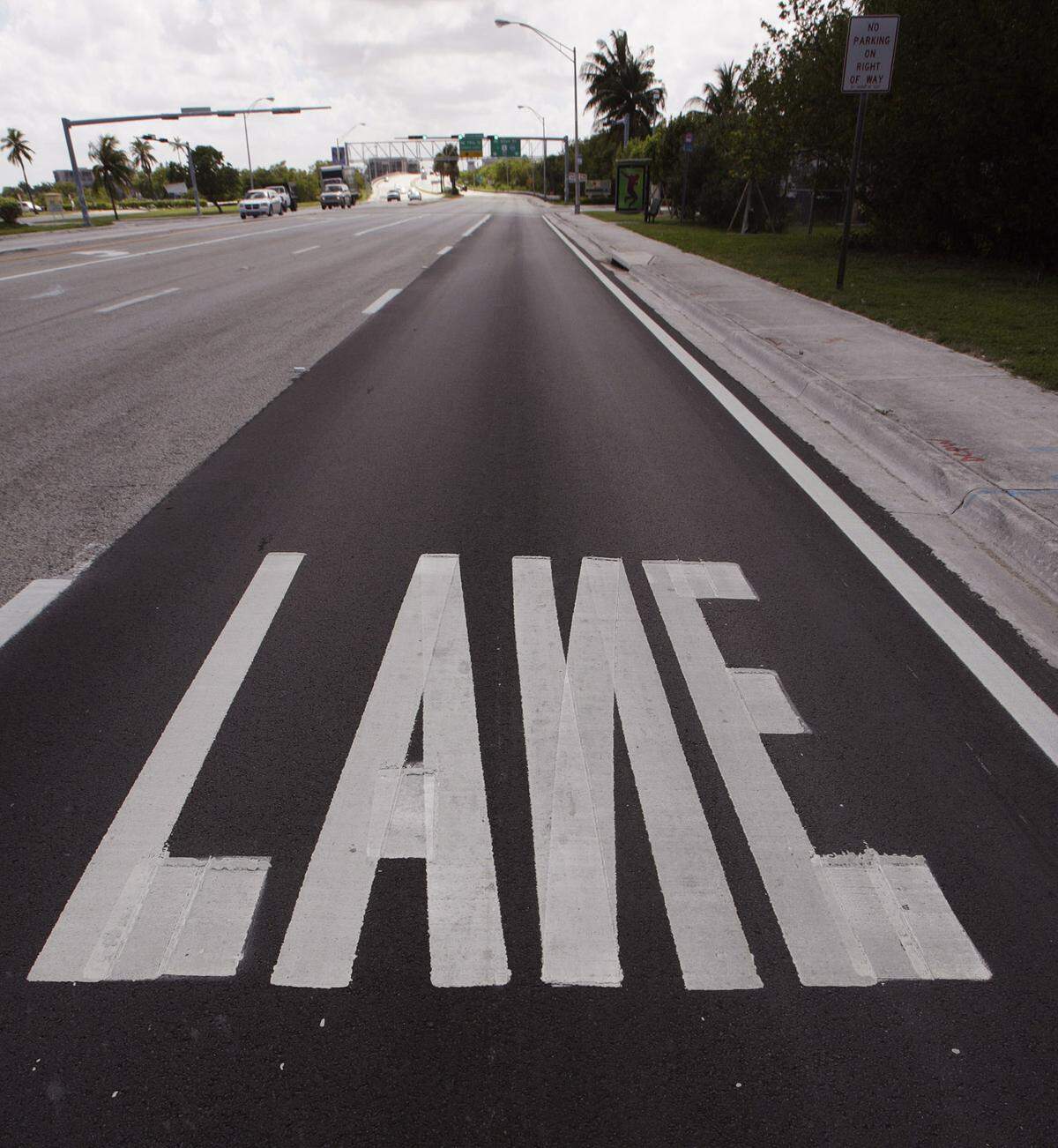
The “n” is spelled backward on the 79th Street Causeway. NURI VALLBONA Miami Herald File / 2008
Along the raucous 79th Street Causeway
Published Feb. 15, 1988
It was late in the evening, Halloween 1967, a time when pistols smoldered and nice women didn’t.
Thomas “The Enforcer” Altamura stood in the foyer at the Place for Steak restaurant, awaiting his customary table. Minutes later, he was sprawled on the ground, his face to the floor, a bullet in his head.
Anthony “Big Tony” Esperti had done the dirty deed. Something to do with a squabble over village territory.
Shoot-outs, all-night boozing and dancing. Frank Sinatra crooning a song or two at the mike. Jerry Lewis wise-cracking at a table near the back.
No B-movie here. Only snippets of memorable moments at the Place for Steak, the 66-year-old restaurant at 1335 79th St. Causeway, once the turf of mobsters, hookers and out-of-towners looking to swallow a good time whole.
Place for Steak is one of the few survivors of North Bay Village’s raucous era, when restaurants closed at 7 a.m. and the drinking hour began at midnight.
After the mob murder, the place really took off.
“All I know is instead of business falling off, it became more popular,” said Chris Mortensen, Place for Steak dining room manager and a 15-year employee.
Place for Steak owner Peter Schwadel said mobster types still stop in at the restaurant, only not as frequently as before.
“We’re not as busy as it used to be back then,” said Schwadel, who took the place over from Hy Uchitel almost four years ago. “The whole area isn’t as busy as it used to be.”
Schwadel recently filed Chapter 11 proceedings in federal bankruptcy court. He said he’s trying to clear away debts held over from the previous owner. The restaurant is still relatively successful, Schwadel said.
Place for Steak wasn’t the only late-night home for the underworld in 1967.
Earlier that year, a bomb ripped through Happy’s Stork Bar, coming dangerously close to Esperti and his girlfriend. It was one of 10 bombs that exploded in the city that year.
The Penthouse, a popular bay-front restaurant, catered to the rowdy crowd and quickly became a mobster hangout. The Top Draw was another mob haunt. The Bonfire, a former jazz spot, was known as hooker haven. And Dino’s, a ritzy restaurant and lounge, was owned by singer Dean Martin. Today, none of these places remains.
“Whenever anyone was in town,” Mortensen said, “they’d come to Place for Steak. People partied until 5 a.m. Times have changed. People just don’t go out.”
Today, Restaurant Row is no longer thriving. With one or two exceptions, restaurateurs say they’re struggling for new life.
Place for Steak survives, said Schwadel, because of loyal customers and its resiliency.
“It has changed with the times,” Mortensen said. The restaurant still features live bands, only with a more contemporary sound.
“People that have stayed with us,” Mortensen said, “they remember the good times and it brings them back.”
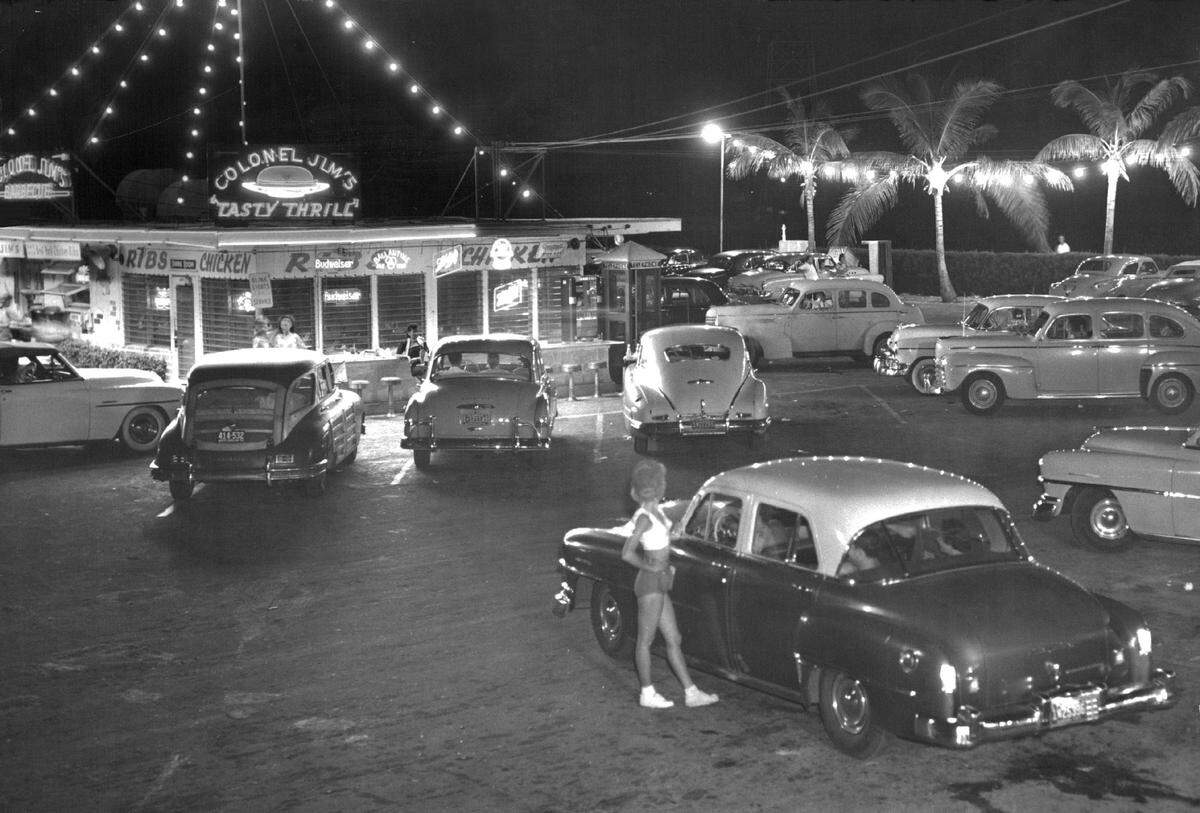
In 1952, a car hop at Colonel Jim’s Tasty Thrill drive-in on the 79th Street Causeway. Bill Sanders Miami Herald File
This story was originally published October 14, 2021 at 8:22 AM.


.JPG "rainbow00 biscayne MHD (1).JPG")