
Evicting tenants is illegal right now. This company tried it anyway — and got caught
David Ellis worked 60-hour weeks providing corporate audio-visual services to events at hotels from South Beach to Aventura. As the coronavirus pandemic spread, he was laid off on March 5 as hotels closed like dominoes. He quickly let his landlord know he might be unable to pay April rent.
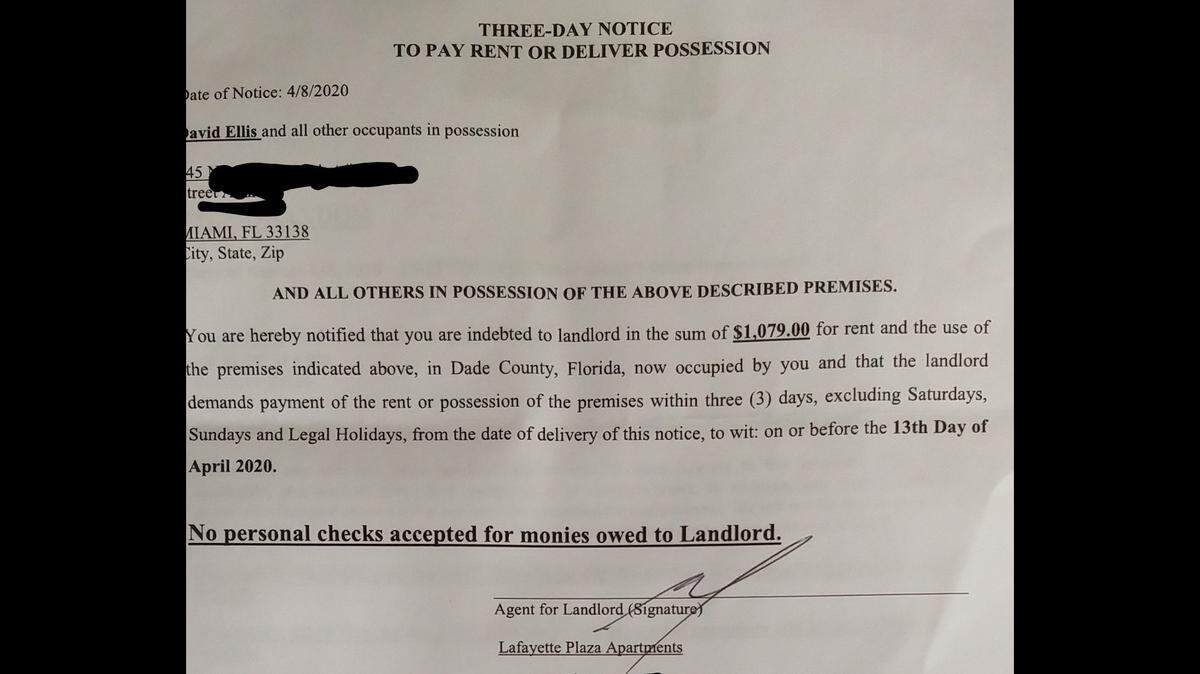
In the month that’s followed, Ellis has been unable to file and receive unemployment benefits because of Florida’s broken system. And as if living a hard-luck country music song, the out-of-state developer of his building, which has benefited from huge federal tax breaks for low-income housing, had an envelope slipped into the groove of his door days before Easter weekend.
The enclosed letter from Lafayette Plaza Apartments warned that “the landlord demands payment of the rent or possession of the premises within three (3) days.” Failure to pay by April 13 could lead to eviction proceedings, it warned.
Notwithstanding the question of where Ellis would go and who he could hire to move him amid Miami-Dade’s County’s stay-at-home order, the eviction notice appears to be illegal.
Evictions were ceased altogether in Miami-Dade on March 12, when Mayor Carlos Gimenez ordered an indefinite moratorium on them. A statewide suspension on evictions imposed by Gov. Ron DeSantis on April 2 made even eviction notices illegal.
Breaking the law
Still, some landlords have served tenants who have lost their jobs and fallen behind on their rent with notices.
“We have heard from a handful of renters who have received eviction notices, and hundreds more who are fearful of what comes next when they can’t make rent,” said Alana Greer, co-director of Community Justice Project, which provides legal assistance to community leaders and grassroots groups in low-income areas in South Florida.
“But if tenants can’t pay their rent due to the COVID crisis, landlords are prohibited from evicting them at this time,” Greer said. “That prohibition likely includes sending eviction notices, and federal law explicitly prohibits certain landlords from sending them.”
Some landlords may not realize the new federal CARES Act, which was approved by Congress on March 27, applies to them. The law placed a 120-day moratorium on eviction proceedings and interest fees on late rent in buildings that receive any kind of government subsidy or are part of federally backed VA loans and mortgages sold to Fannie Mae or Freddie Mac.
“About half of multi-family apartment buildings have federally backed mortgages and millions more receive federal subsidies,” Greer said. “And when they do start eviction proceedings, they will have to give a 30-day notice instead of the usual three days. So the earliest anyone covered by federal law could go to court to process an eviction is late August.”
The Herald and its parent McClatchy reached out to the developer of Lafayette Plaza Apartments about the notice Ellis received. Representatives from Gatehouse Group Inc. in Mansfield, Mass., did not return calls for comment.
But a Florida lawyer who handles evictions for Gatehouse called back to say the three-day notice sent to Ellis and an undetermined number of other residents was done without legal consultation.
“It was inadvertent on their part,” said Kaye-Ann Baxter, a private Miami lawyer who handles eviction proceedings for a number of landlords including Gatehouse. “They are going to be rescinded.”
That was welcome news for Ellis.
“I feel great about that part,” he said, asking why landlords “are making people panic?”
Modest rent
Ellis transplanted to Miami from New York about 15 years ago. His nearly $1,100 monthly rent is modest by local standards, and he expects once people like him start getting stimulus money it will go straight to landlords.
“It’s like saying I killed all your chickens but I still want eggs in the morning,” said Ellis, wondering why Gatehouse and others don’t consider using security deposits as rent for coming months and let renters slowly build back up their deposit when they finally get back to work.
Carolina Fernandez, spokeswoman for Catalyst Miami, a nonprofit association that assists low-income residents with legal, housing and employment services, said she is aware of only one active eviction case since the coronavirus shutdown.
“People are worried, but I’ve only had one person who had an actual eviction notice posted on her door,” Fernandez said. “She is a single mom who lost her job due to the coronavirus pandemic and lives in a government-run building. The notice said she had to pay her rent by April 14 or the management would take possession of her property.”
Fernandez declined to provide more details about the case, citing the woman’s worries about reprisals from her landlord. But the woman was referred to a nonprofit legal group for assistance on how to handle the notice.
County court records show that 499 evictions have been filed since March 12, when the county began the emergency declaration, and 181 of those cases were filed as non-payment. The court system does not distinguish between residential and commercial evictions, so it’s impossible to tell how many of these are filed against apartment dwellers.
But those evictions aren’t going anywhere for the foreseeable future.
“There are landlords who are filing eviction lawsuits, but they’re all paused to the extent that the Office of the Clerk is not issuing a summons,” said Jeffrey Hearne, director of litigation at Legal Services of Greater Miami. “So these evictions are not going anywhere. And landlords of affordable housing or subsidized properties should not be sending notices to tenants right now. So many tenants get a notice from the landlord and think they have to move out. Many people come to us with the notice saying ‘The sheriff’s going to show up at my door.’ But that only happens after a court order.”
According to Greer, any renter in Miami-Dade who receives an eviction notice should contact Legal Services of Greater Miami. Folks in other counties can check florida.evictionprotection.org to see how their courts are handling evictions during the moratorium.
Moratorium on evictions
But landlords and management companies overseeing subsidized housing around the state should know better, according to the Florida Housing Finance Corporation, which oversees the development and management of affordable housing.
“To our knowledge, developers are aware of the law and we thank them for understanding,” said Taylore Maxey, press secretary for the organization. “Florida Housing has sent out information to our property owners and managers regarding procedures and the law; we have been discussing these issues with the Coalition of Affordable Housing Providers and continue to urge them to suspend any evictions or rent increases during these uncertain times. At this time [the Lafayette Plaza eviction] appears to be an isolated case.”
Once the moratorium lifts in August, however, landlords that have already filed electronically will begin moving swiftly. For those who rent low- and middle-income apartments, it’s not clear who their new tenants would be given that the kind of jobs open to those renters are generally in Miami’s large service sector.
“The courts are accepting electronic filings of evictions, even though no one is going to act on them now,” Baxter said. “Some landlords want to be in the queue and first in line once the courts reopen. I’m advising my clients to enter payment arrangements with their tenants. But ultimately they’re going to have to pay the piper. Because landlords are suffering as well. They’re going to try to get some money.”
This story was originally published April 16, 2020 at 8:00 AM.

_pp%20Cropped.jpg)