
Did a truck without a driver just pass you on the road? Yes, and there are more coming
What would you do if you saw a truck barreling down the turnpike with no driver behind the wheel?
If you were on driving on Florida’s Turnpike on June 16, you may have passed a white 18-wheeler driving by itself without a soul in the cab. It was a test by a trucking company that has an eye on the future.
The truck, operated by San Francisco-based startup Starsky Robotics, drove 9.4 miles that day. Merging onto the highway and navigating through traffic, the semi changed lanes and exited the stretch of Central Florida highway without an issue.
That’s more than you can say about trucks with drivers on the Palmetto Expressway at rush hour.
The driverless turnpike truck even broke a record for the fastest unmanned road-legal vehicle at 55 miles per hour.
Starsky’s test drive came just two weeks before a new Florida law goes into effect allowing self-driving vehicles with no humans on board. Certification or inspection won’t be required, and vehicles don’t have to alert other drivers that they are unmanned.
On June 13, Gov. Ron DeSantis signed the law, which aims to encourage companies that test and build autonomous cars to continue development.
“With this bill, Florida officially has an open-door policy to autonomous vehicle companies and I encourage them to relocate from California to Florida,” DeSantis said as he publicly signed the measure in front of a Starsky-branded truck.
But the driverless vehicle that traversed Florida’s Turnpike on June 16 isn’t fully autonomous. There’s a human controlling the truck from afar.
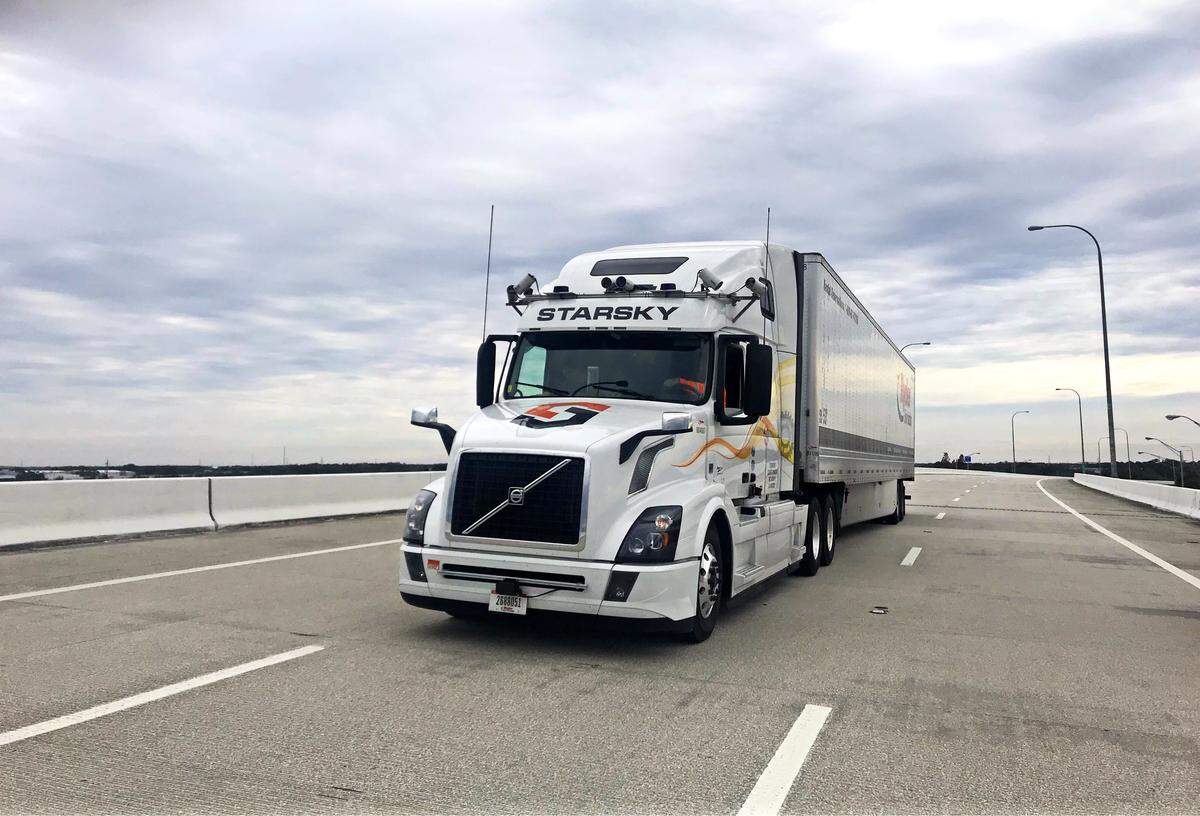
Starsky’s trucks use a hybrid driving system that team up computers and a remote human operator. And the company is hiring. It put out a call earlier this month for drivers to remotely control the trucks.
“Humans are far better at navigating many of the nuances of driving than even the most advanced computer systems, which is why we use remote drivers to help the trucks at their most contextually complex junctures,” Starsky CEO Stefan Seltz Axmacher wrote in a blog post.
Still, the ability to use a remote-control operator is a step away from previous Florida laws that required a human to be in the vehicle and able to take over if needed.
Axmacher called the company’s test drive a feat not only for Starsky, but for the entire self-driving industry. Mercedez-Benz, Tesla Semi and startups Embark and TuSimple also work to develop driverless trucks.
The push for self-driving trucks is rooted in a national trucker shortage. With nearly 71% of all freight tonnage in the U.S. being moved by trucks, according to the American Trucking Associations, the $726 billion industry was short of 51,000 drivers as of late 2017. As a result, shipping costs are increasing, according to Business Insider.
Starsky is developing a shipping business alongside its autonomous trucking business. With 36 human-driven and three autonomous trucks, it has already hauled 2,200 loads, according to TechCrunch.
Expect to see more self-driving trucks on your commute. Planning to deploy his trucks by the end of 2020, Axmacher said that “unmanned tests will go from once a quarter to once a month to once a week to every day.”
In time, Axmacher said he hopes Starsky trucks will “come to be the most reliable driver in your rearview mirror.”
This story was originally published June 27, 2019 at 3:10 PM.