In Florida, home of the 97-year-old inmate, prison healthcare costs spiraling

Like a lot of 60-year-olds, James Langdon experiences pain: migraines, eye, knee and hip pain, as well as persistent mobility impairments.
Unlike most 60-year-olds, Langdon gets his healthcare and pain management from the state of Florida, courtesy of the taxpayers.
Langdon is a prisoner.
Back in 1993, Langdon committed a burglary assault that got him sentenced to life in prison, a sentence that even his victim, who told the Herald she supports his release, thinks was extreme.
He is one of many inmates who are growing old and will most likely die inside the Florida prison system, which accounts for one of every four inmates serving a life sentence in the United States, according to the authoritative nonprofit criminal justice news outlet The Marshall Project. Older people living in unhealthy environments like a Florida prison rack up high medical costs — including costs related to accommodating the kinds of physical disabilities associated with old age.
The average age of Florida prisoners has climbed from 32 in 1996 to 42 today, according to Florida Department of Corrections records. At the moment, Florida is currently incarcerating inmates as old as 97, prison officials said.
People in their 60s, 70s, 80s and 90s require exponentially more medical care than younger populations. Many aging inmates have complained they are not getting adequate treatment.
Langdon told the Herald that he is allotted only 30 ibuprofen pills every three months despite chronic pain. His observable limp and other mobility issues have gotten him a bottom bunk pass for the past 10 years, but last year that pass was not renewed, he said, in spite of the persistence of his mobility issues.
The prison system does not discuss individual inmates’ treatment, but FDC Press Secretary Paul Walker told the Herald that “ensuring inmates incarcerated in Florida’s prisons receive all necessary medical and behavioral treatment in line with evolving national standards is one of FDC’s top priorities, and a core constitutional responsibility.” Overall spending per capita on Florida prison healthcare is actually much lower than in some other large systems — but it is rising.
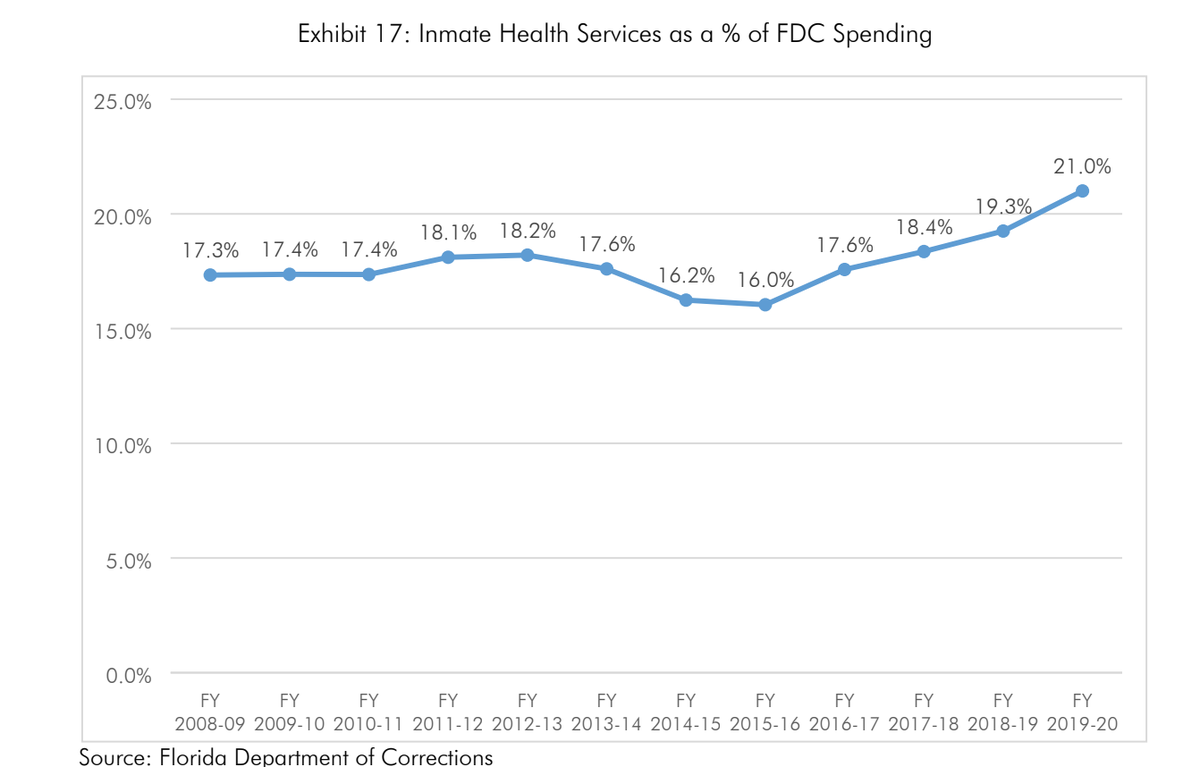
Florida’s prisons are full of people like Langdon, whose crimes are decades in the past but whose aches, pains and chronic conditions are current, real and costly. Taxpayers pick up the tab for the ever-increasing cost of their care, raising questions about whether Florida is imprisoning inmates beyond the point where they present any danger to society.
One reason the prison population is getting old is that Florida effectively did away with parole.
“It means the need for wheelchairs, mobility devices, hearing aids, visual alarms, vision assistance, all of that is going to continue to shoot up,” said Carrie Boyd, the Florida policy director for the Southern Poverty Law Center Action Fund.
Over the past decade, the raw number of elderly prison inmates — defined as those over 50 — has nearly doubled, including 10 inmates 90 or older.
“It’s just not smart policy. Laws need to be changed,” Boyd told the Herald. “It can cost double for the state to house prisoners over 50 and people with physical disabilities, but the same demographic is much less likely and able to re-offend than younger adults.”
State Sen. Jeffrey Brandes, a Republican from St. Petersburg who calls the prison system “largely a healthcare provider that houses inmates,” has drawn up legislation that would provide a glimmer of hope for inmates serving life under the state’s “two-strikes” law. That two-strikes legislation, passed in 1997, prescribed life sentences for those who committed a second offense within three years after finishing a prison sentence.
Brandes’ proposal would curtail that practice, which has tied the hands of judges, and allow those already serving life for their second strike to go back to court and seek a resentencing — and be represented by a lawyer.
Brandes’ initiative appears to be going nowhere.
“These bills are overwhelmingly bipartisan, which is a rare thing,” Brandes, who is leaving the Legislature due to term limits, told the Herald. “But they’re not moving anywhere because there’s an onus on punishment in Florida’s current correctional system, instead of trying to actually correct behavior.”
As a result, Florida’s current sentencing structure doesn’t allow for the type of sentencing discretion or nuance that is critical in any sensible criminal justice system, Brandes said.
“By incarcerating people who don’t pose a threat, especially after they reach a certain age, we’re denying the science of sentencing that is supposed to provide some sort of public safety value,” he added. “It’s not logical and it’s incredibly costly to Florida’s taxpayers and residents who get trapped in this system alike.”
In the meantime, costs are likely to keep rising. A recent court settlement between the FDC and federally funded advocacy agency Disability Rights Florida mandates that the FDC make further accommodations for the disabled — potentially providing some relief for prisoners like Langdon but also likely bumping up costs even further. The department has agreed to similar settlements in the past when sued, only to backslide, prompting Disability Rights to go back to court.
“There’s an especially heightened need for oversight and accessibility in a system that controls every aspect of an individual’s life,” Dante P. Trevisani, the executive director of the nonprofit law firm Florida Justice Institute, told the Herald. The firm, alongside injury law firm Morgan & Morgan, litigated the matter.
The department gets sued a lot over healthcare, often successfully. The issues, often resulting in consent decrees, have ranged from denial of hernia surgeries to withholding of mental health care to deprivation of Hepatitis C treatments. The legal costs rise with the healthcare costs.
“Everything from making emergency announcements to providing food, work, programming and medical care is controlled by prisons. All of that needs to be accessible for disabled individuals,” Trevisani said. “And for a very long time, it hasn’t been.”
The latest settlement with Disability Rights requires Florida prisons to foot the cost of putting in paved recreation tracks, providing wheelchairs or walkers to prisoners with mobility issues, having visual alert systems in place for people with hearing impairments in case of emergency and providing qualified sign language interpreters and captioned telephones.
In addition to those issues addressed in the lawsuit, most prisons lack air conditioning, which makes them sweltering and especially unhealthy during the Florida summer. Jennifer Lynn Seeber has seen the issue through the eyes of a longtime family friend. That friend, who she requested remain unnamed for fear he might face retribution, suffers from multiple sclerosis, has been immobile from the chest down on and off over the past 20 years, and is currently incarcerated. MS makes it difficult to regulate a patient’s body temperature, she said, and even a small rise in body temperature can make symptoms dramatically worse.
Seeber said it is so hot in his prison that he often can’t get out of bed in the morning. His legs won’t let him.
“When people go to prison, they don’t lose their human rights. Part of someone’s prison sentence isn’t having their wheelchair taken away,” Curtis Filaroski, a senior staff attorney with Disability Rights Florida, told the Herald. “But we’ve heard from plenty of folks in the Florida prison system who’ve been deprived of the basic services they need to live in dignity and independence.”
The prison system is well aware of the problem — and that current trends suggest it will worsen.
According to FDC’s own calculations, the percentage of the prison population classified as elderly will continue to rise over the next five years, from 28% to 34%.
Langdon will likely be among them. The inmate, who spent the last decades in prison earning his certification as a law clerk and mentoring other prisoners, has had a nearly spotless disciplinary record for the past 20 years. Both of his parents died while he was incarcerated, and he was not allowed to attend either funeral. Now, his younger sister is fighting a difficult battle with cancer, and he’s terrified he won’t get out in time to say goodbye. He’s also desperate to reconnect with the two daughters he had to leave behind to serve his prison sentence. He’d like to meet his grandchildren, and not in a prison setting.
Despite Langdon’s good behavior, and the fact that his victim penned a letter to the FDC supporting his release, Langdon says he was told by the Office of Executive Clemency that it could take years to even begin an investigation regarding whether he should be granted a sentence reduction.
With his chronic health issues and the current state of healthcare behind bars, he’s not sure he has that long left.
Miami Herald staff writers Ana Ceballos and Ben Conarck contributed.
This story was originally published February 17, 2022 at 8:30 AM.