Even the judge said he didn’t belong in prison. Florida blew him off. The man just got COVID
William Forrester has 11 more months to come out of prison but fears he won’t.
“I have less than a year left before I go home, I’ve waited 12 years to say that,” he wrote in a July 7 email shared with the Miami Herald.
Six days later, he tested positive for COVID-19.
Since April, he had twice appealed to the Florida Department of Corrections to furlough his sentence and put him in home confinement but to no avail.
“I am 64 years old, COVID could easily kill me. ... Please have mercy on me,” he wrote in his furlough application to the FDC.
Forrester had been sentenced to the minimum mandatory term of 15 years for a false opioid prescription. Florida requires all convicted individuals to serve 85 percent of their sentence, meaning Forrester could rejoin society after serving for a few more months and completing roughly twelve-and-a-half years.
He had three surgeries fighting lung cancer before he was convicted, has only one lung now and suffers from a chronic lung inflammation that obstructs airflow. He also has heart disease and sleep apnea and had pneumonia five times since he’s been imprisoned — all underlying health conditions that make him extremely vulnerable to the virus.
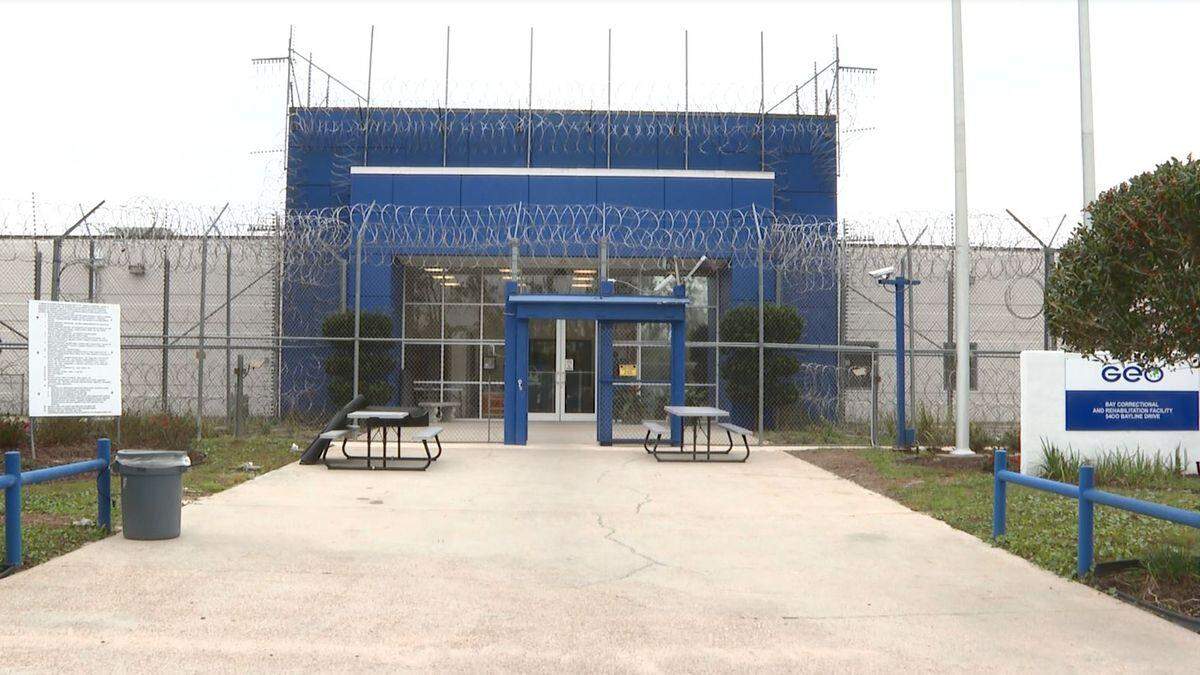
Bay Correctional Facility in Panama City, where Forrester is held, reported its first COVID case on July 8. As of Monday, the number stands at 67 positive cases with 58 tests pending. Four staffers at the prison have also tested positive.
The facility is run by Boca Raton-based Geo Group, a private prison contracting firm with deep pockets and tremendous political influence both in Tallahassee and Washington.
As of Monday, 2,591 inmates and 827 staffers across the state’s prison system have tested positive for the virus. Tests for 3,825 more inmates are pending. Twenty-nine have died of COVID-19 — all of them inmates.
The Florida Department of Management Services, the state body that oversees the operation of private prisons, declined to comment.
Trapped
Data compiled and analyzed by The Marshall Project, a Pulitzer Prize-winning investigative nonprofit that focuses on criminal justice issues, show inmates in Florida’s prison system are roughly three times more likely to contract COVID-19 than if they were in the general population.
After the outbreak of the virus, as cases across the country surged, medical experts and prison reform advocates called for the release of low-level offenders and elderly inmates.
Some states did release some inmates. Florida did not.
Florida does not have release options that many other states can exercise — it abolished parole in 1983 and under its “conditional medical release” statute, inmates must either be facing imminent death or be “permanently incapacitated” before they can be considered for release.
FDC cannot release anyone permanently and the state does not have any release mechanism for the chronically ill or the elderly.
Forrester is like the roughly 8,300 Florida other inmates 60 and over — especially vulnerable to the virus.
But the state’s Clemency Board does have the power to commute sentences, meaning inmates could go home and never come back. Gov. Ron DeSantis also has the power to grant a reprieve — inmates could leave and return to finish the rest of their sentences when it was deemed safe to do so.
Forrester applied for his sentence to be reduced in May.
He attached a letter of support from the judge who had tried him.
“At the time of sentencing and even today I believe the sentence was excessive,” wrote Senior Circuit Judge Roger McDonald in the letter to the Executive Clemency Board.
The judge wrote that if it hadn’t been for the mandatory sentencing, he would have kept Forrester in confinement for only three years and that given the pandemic and his health conditions, he recommended that his “sentence be reduced to time served and that he be placed on ‘Drug Offender Probation’.”
“If I thought Mr. Forrester was a danger to society, I would not recommend early release from DOC.”
The judge also noted in his letter that at $5.52 a day, the cost of supervising an offender on probation was a tenth of the cost of housing an inmate inside a prison.
But Forrester was not granted relief.
He is currently on minimum custody and has served enough time to qualify for work-release, meaning he would be allowed to work off prison premises and his confinement requirement would be just five hours a day. But due to COVID and because he has only one lung, he is considered disabled, not able to work and has to stay in minimum custody.
On May 28, Forrester applied for a furlough with the FDC — a temporary release that the FDC can grant on its own authority. Forrester would remain in the custody of the state, but serve his sentence under home confinement.
In his application he noted that he listed a specific end date for his furlough, secured a sponsor and noted that he was willing to pay for electronic monitoring during his period of home confinement.
The forms were returned to him on grounds that he had filled out the wrong ones. He reapplied along with a copy of the rules on June 18. A week later, they were again returned stating that since his request was medically related he needed to apply for a medical furlough, which was only available to inmates on work-release and not minimum custody.
Living on a prayer
In the first week of July, inmates at Bay started showing symptoms.
“The inevitable has just happened. Please keep me in your prayers,” Forrester wrote in a July 4 email.
In another email five days later, he wrote that prison authorities posted a bulletin saying that due to the pandemic all inmates were going to be given four free stamps and one free phone call to communicate with their loved ones but at the same time, they were not being allowed to use the telephones or the charging station for their tables to prevent “cross-contamination.”
“They also have stopped all distribution of Tylenol and ibuprofen compound-wide; medical says it masks a fever,” he wrote.
“This is really wrong for myself because they stopped giving it to me ... and told me to start getting it from the officers station for the many chronic pain issues I have, which makes it miserable for me.”
In that same email, Forrester said that there was “some other bug going around this facility that lasts a few days. Symptoms are headaches, bad body aches, bad stomach cramps, cough, runny nose, slight diarrhea, but no fever.”
Greg Newburn, state policy director of the Florida chapter of the prison reform advocacy group, FAMM, said that the release of vulnerable inmates should be part of the state’s COVID response and that “there has got to be some number of people inside who would have been safe to release.”
“We should be doing what the federal government and other states are doing and finding and releasing low-risk people who don’t need to be incarcerated anymore,” he said.
“There’s just no reason to keep somebody like Forrester in prison.”
Miami Herald staff writer Samantha J. Gross contributed to this report.
This story was originally published July 14, 2020 at 1:26 PM with the headline "Even the judge said he didn’t belong in prison. Florida blew him off. The man just got COVID."