
Jack Latvala, former Florida Senator and Tallahassee power broker, dies at 74
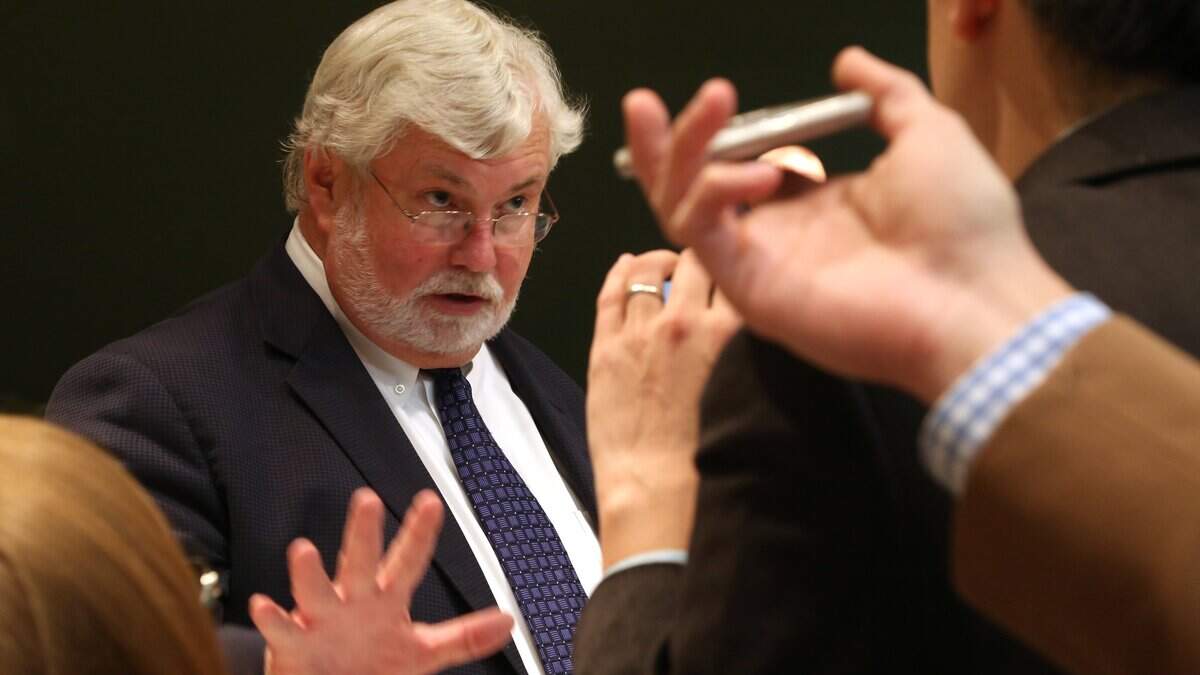
Jack Latvala, a longtime Florida senator representing north Pinellas County and powerful Tampa Bay leader who remade the state’s Republican Party, died Wednesday.
He was 74.
During his time in Tallahassee, Latvala built a reputation as the most skilled and influential lawmaker in the statehouse, a position enhanced by a consulting business that recruited dozens of candidates, many who still hold office today. But allegations that he sexually harassed women put an abrupt end to his four decades in politics and a bid for governor.
Latvala was never charged with a crime.
“It is with profound sadness that our family shares the news of the passing of Jack Latvala,” his son, Pinellas County Commissioner Chris Latvala, texted the Tampa Bay Times. “We are grateful for the outpouring of love, prayers and support during this difficult time.”
Woodrow J. Latvala was born in 1951 in Oxford, Mississippi. He grew up in Polk County. After graduating from Stetson University, he threw himself into politics. He grew close to Jack Eckerd, the St. Petersburg drugstore titan and erstwhile candidate for governor and U.S. Senate.
As Republicans battled for relevance in the shadow of Watergate in the mid-1970s, Latvala’s political career started modestly. He worked behind the scenes as an operative who recruited Republicans in Central Florida to run for legislative seats, hardly an easy task in a state controlled by Democrats.
In many ways, he was a relic of that era — where personal connections meant everything, compromise trumped ideology and it was customary for powerful men to make deals over drinks at the bar or in a Capitol backroom suite.
In other ways, however, Latvala was a visionary who saw the future before others did.
By the early 1990s, he had become a one-man political machine, making millions off direct mail and recruiting candidates to run for statewide and local races. Many credit Latvala for saving the Republicans from oblivion by providing party leaders the data tools, expertise and technology needed to overthrow Democrats and launch a reign of dominance that continues today.
“Jack was a mastermind and political architect,” said Pinellas Sheriff Bob Gualtieri, who first hired Latvala as a campaign consultant in 2012. “His apparatus was Jack. He’d pore through the data himself. Analyze it himself. He didn’t have a large backroom operation. It was Jack. And it was effective.”
Latvala wore two hats: consultant and a candidate himself.
In 1994, Latvala embarked upon his first tour of the Senate, the same year that Republicans gained a majority in the upper chamber for the first time since Reconstruction.
He climbed the ranks of leadership until term limits forced him out in 2002. He returned to the Senate eight years later and tried, unsuccessfully, to win that chamber’s presidency. In 2015, he conceded after years of jockeying for the top spot and was rewarded with a coveted consolation prize: appropriations chairperson.
From that perch, Latvala showed what made him special. Few lawmakers matched Latvala in mastering the legislative arts. He could expertly pack state budgets with millions of dollars for hometown pork while befuddling adversaries with his nimble use of obscure procedural rules to pass or block bills.
“In a world where people love to put labels on everyone — liberal, conservative, Democrat, Republican — Jack was a complete independent,” said former Clearwater Mayor Frank Hibbard. “Even if people didn’t like him, they respected him because of his knowledge and that he could get things done. He knew how to return a favor.”
Latvala was known for his style as much as his acumen. His Capitol persona was larger-than-life: bombastic, confrontational, gruff and blunt. Fearsome, too.
“You’d get that look, from the top of his glasses,” Gualtieri said. “And he’d say, ‘What are you doing? Stop the expletive now.’ Love him or hate him, there’s no two Jacks. He did it his way.”
Although an architect of Florida’s modern Republican Party, he often bucked leadership in later years, showing a penchant for rare bipartisanship, especially when it came to protecting the state pension, providing in-state tuition for undocumented immigrant students, expanding conservation and opposing the privatization of prisons.
Those stances won him new friends — but it also made some powerful enemies. When scandal hit, he found few lifelines to grab. Gov. Rick Scott and House Speaker Richard Corcoran, hardly fans, were among the first to call for his resignation.
On his 66th birthday, Nov. 3, 2017, revelations broke that would destroy his political career.
Multiple women made anonymous claims that Latvala had sexually harassed them. A Senate report later included their testimony that said Latvala had groped them and attempted physical contact in exchange for him awarding legislative favors. A woman came forward weeks later to say she ended her lobbying career so that she would never owe Latvala anything.
Latvala resigned after a retired judge issued a 33-page report documenting the claims of the lobbyist, with whom Latvala had a 20-year relationship. It included text messages that Latvala had sent outlining his support for her agenda if she would engage in sexual contact with him.
Her “testimony raises issues of public corruption and ethics violations not within the scope of this report,” the judge wrote.
Latvala’s resignation came as the #MeToo movement rode a torrent of revelations of powerful men across industries using their positions to harass women. Latvala, who always seemed to be well armed and a step ahead of opponents, found himself suddenly out of step and defenseless.
“My political adversaries have latched onto this effort to rid our country of sexual harassment to try to rid the Florida Senate of me,” he wrote in his resignation letter.
It would be another three months before Latvala pulled the plug on his campaign for governor, where he was appealing to voters as a vanishing breed, that of a centrist. Ron DeSantis stormed Florida politics that year from the right and ended up winning the GOP nomination and the office later that year.
Months after he ended his campaign, Tallahassee State Attorney Jack Campbell said there was not enough evidence to charge Latvala for trading votes for sexual favors with the lobbyist.
“There is insufficient evidence to prove beyond a reasonable doubt that Mr. Latvala was unlawfully compensated or rewarded for his official behavior as a Florida senator,” Campbell said in a letter. “Since criminal charges are not warranted, this office will take no further action on the matter.”
Latvala retreated from public view but was still active in politics. He helped his son, Chris Latvala, move from the Florida House to the Pinellas County Commission. He drained millions of dollars from his political committee to support other local and state candidates and his son’s business.