
DEI support tanked UF’s last president. How does Stuart Bell’s record stack up?
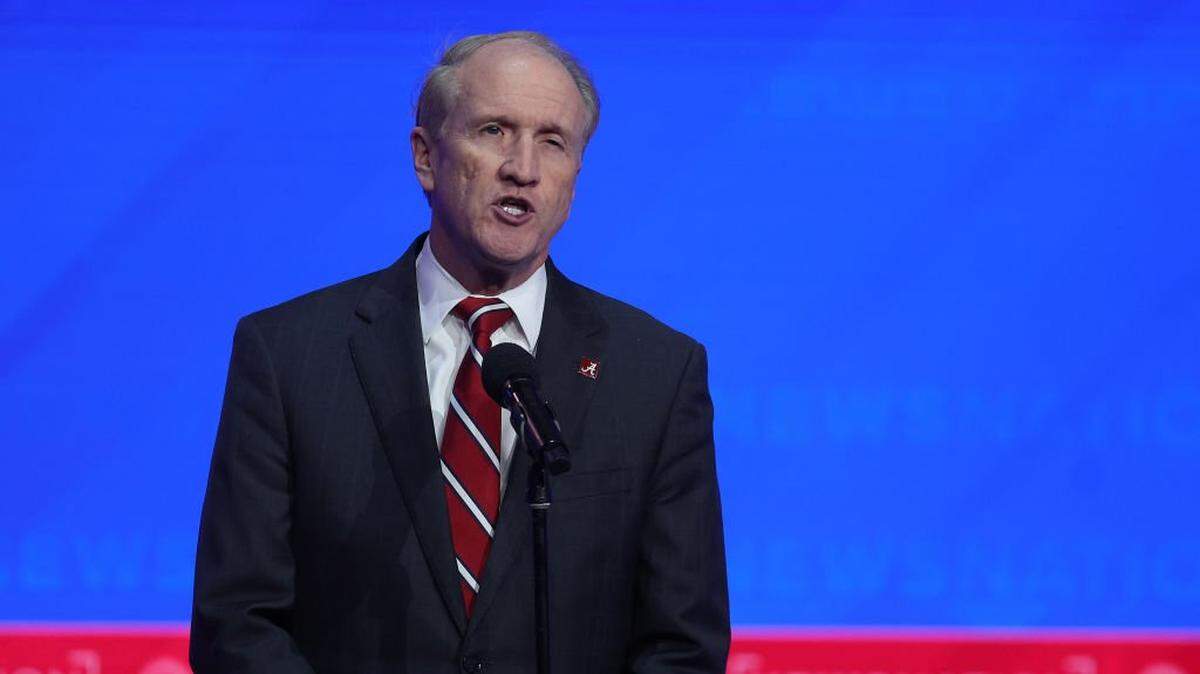
When University of Florida named Stuart Bell its lone presidential finalist Monday, culture warriors moved almost immediately to raise the same question that doomed UF’s last pick: Is he too tied to diversity, equity and inclusion initiatives to lead a public university in the state where, as Gov. Ron DeSantis once declared, “woke goes to die?”
Within hours of Bell’s selection, higher-education conservatives had seized upon the former University of Alabama president’s long record overseeing aggressive diversity recruitment and campus inclusion programs. And that’s giving some Gators an uneasy sense of déjà vu.
It’s an early sign that Bell could face the same rough-and-tumble confirmation fight that derailed former University of Michigan leader Santa Ono’s bid for the UF presidency just last year.
Ono — backed by UF trustees, many of whom have deep ties to the state’s Republican Party — was ultimately rejected by the State University System’s Board of Governors after conservative activists attacked his support for diversity programs at Michigan, arguing he was too aligned with what Florida Republicans call “woke ideology.”
Now Bell, a longtime engineering administrator who spent a decade leading Alabama, is entering a university system where DeSantis and Republican appointees have taken a sledgehammer to DEI programs, restricted how race and gender can be taught and pushed college presidents to align with the state’s conservative political agenda.
The question looming over Bell’s candidacy is whether Florida leaders will view him as a pragmatic and ideologically pure administrator, or as another left-wing academic in disguise seeking to unwind the state’s conservative reforms.
READ MORE: University of Florida on the hook for $2M payout after snubbing interim president
That tension is especially striking given Bell’s record in deep-red Alabama, once the epicenter of the nation’s civil rights movement. Reached through a UF spokesperson, Bell declined to comment on his current attitudes toward diversity initiatives.
Bell v. Ono
If Santa Ono became a cautionary tale for ambitious university presidents seeking to lead Florida’s flagship university, Bell may now be the next test case.
At Michigan, Ono championed what was once considered one of the most well-funded and expansive DEI apparatuses in higher education. A deeply reported New York Times investigation from 2024 found that the school had spent roughly $250 million since 2016 to implement “DEI 1.0” and “DEI 2.0” plans across more than 50 campus departments.
By the time Ono emerged as UF’s lone finalist last year, Michigan was already beginning to retreat from some of those initiatives amid mounting political pressure. Ono himself publicly distanced from DEI, writing in a Wall Street Journal op-ed that the movement had become “more about ideology, division and bureaucracy, not student success.”
That wasn’t enough to salvage his candidacy.
But Bell’s handling of DEI at Alabama stands in stark opposition was to Ono’s — and arguably produced far more profound results.
Amid the nationwide reckoning over race following George Floyd’s killing in 2020, Bell presided over one of the most consequential diversity overhauls at any Southern flagship university.
Rather than focusing primarily on symbolic gestures or campus programming, Bell’s administration poured resources into recruiting students from within Alabama and, after several high-profile racial controversies, repairing the university’s reputation among Black community leaders.
“Diversity ambassadors” fanned out across Alabama’s historically Black counties, expanded outreach to underrepresented students, increased faculty diversity initiatives and launched antiracism workshops and training programs. The university also invested in scholarship and mentorship programs aimed at students of color.
Those strategies produced measurable demographic changes.
A Chronicle of Higher Education analysis found that Black and Latino enrollment at Alabama surged during Bell’s tenure, while the percentage of white students in the freshman class fell by nearly 10 percentage points. By last fall, Black students made up 14% of incoming freshmen — among the highest shares at flagship public universities nationwide.
Alabama’s record Black student enrollment under Bell is a far cry from Michigan’s, which, even with the expansive DEI initiatives, remained stagnant. Black students make up just 5.2% of UF’s nearly 62,000 student body, according to fall 2024 data.
Still, Bell’s diversity initiatives began drawing fire from conservatives years before his UF candidacy.
At the same time, Bell’s diversity initiatives increasingly attracted conservative backlash.
A 2023 report by Scott Yenor — a controversial conservative scholar at Boise State University who has advised DeSantis on higher-ed issues — released a scathing report on Alabama’s diversity efforts.
Yenor’s report, titled “Going Woke in Dixie?” describes what he called Alabama’s “most extensive DEI apparatus” and argued Bell’s administration had embraced diversity initiatives as an institutional ideology.
“DEI at Alabama is not really about achieving equality or giving opportunities to underrepresented groups,” Yenor wrote. “It is actually just the perpetual project of persuading Alabama faculty, staff, and students to see themselves as nothing other than a member of an oppressor or victim group.”
Months later, Alabama’s GOP-dominated Legislature voted to ban public universities from maintaining DEI offices, funding diversity initiatives or requiring programs tied to what lawmakers called “divisive concepts” about race.
The law mirrored similar efforts in Florida, where DeSantis and Republican leaders have spent years dismantling DEI programs across the state university system. At the University of Florida, administrators have already eliminated DEI positions, closed diversity offices and redirected roughly $5 million previously allocated to diversity programming.
What’s different this time?
In some ways, Bell’s predicament already resembles Ono’s.
Like Ono, Bell emerged from a tightly controlled presidential search as the lone finalist — a process that left the former Michigan president twisting in the wind as conservative critics piled on.
And some of the same conservative networks that mobilized against Ono are now turning their attention toward Bell.
Among the loudest critics is John Sailer, a senior fellow at the Manhattan Institute, the conservative think tank closely associated with anti-DEI activist Christopher Rufo, who helped spearhead opposition to Ono’s candidacy.
Bell’s online critics have amplified a dossier of opposition research authored by Sailer, which splices in information from Yenor’s “Gone Woke in Dixie?” report. Sailer, whose social media thread had amassed 415,000 views as of Wednesday evening, said in an interview that UF “picked another candidate who appears to be kind of an old-guard insider — a very conventional pick who, in my view, isn’t aligned with Florida’s reform agenda.”
But there are signs this confirmation battle may unfold differently.
UF’s search committee vetted Bell’s DEI record, according to UF spokesperson Steve Orlando. Unlike Ono, Bell immediately nabbed an endorsement from DeSantis. The governor called Bell a “great pick” shortly after UF announced him as the lone finalist, signaling that at least some of the state’s top Republican leadership is prepared to defend the selection.
Sailer said that aggressive early messaging suggests university leaders know another ideological fight may be brewing.
“The fight over Santa Ono is top of their mind,” Sailer said. “You don’t ask the governor to weigh in immediately unless you think you need to come out swinging.”
He called DeSantis’ quick endorsement “unusual,” arguing Bell’s record is “totally inconsistent with the reform agenda the governor has championed.”
“At best, you’ve got a conventional candidate who doesn’t really add to the prestige of the university,” Sailer said. “At worst, you have somebody who’s spent a decade approving the very agenda DeSantis has fought against.”
There is more to come on the “woke” skeletons in Bell’s closet, Sailer said, and he plans on soliciting behind-the-scenes intel scrutinizing the candidate in the coming weeks.
What’s different this time?
The political pressures surrounding Bell’s candidacy underscore the increasingly precarious situation for anyone seeking to lead a major public university in Florida.
These are hard jobs, and there’s reason to believe that the pool of candidates for the UF presidency has narrowed. Any Gator-in-chief must oversee a gargantuan institution with a $10 billion budget, a nationally prominent research enterprise, a massive health system and one of the country’s most powerful college athletics brands.
But in Florida, presidents must also navigate an unusually muscular political environment in which Tallahassee increasingly shapes decisions traditionally left to university administrators.
That has left many higher-education leaders attempting a difficult balancing act: maintaining academic credibility while satisfying a Republican political establishment deeply skeptical of modern university culture.
Even Sailer struggled to identify a candidate with the administrative bona fides to lead UF who also passed MAGA’s political litmus tests.
“I don’t know if I could name someone off the top of my head,” he said, “but I don’t think it’s impossible to find somebody who doesn’t raise obvious red flags and isn’t like a higher-ed insider.”
Bell’s own words suggest he understands the assignment.
“The University of Florida is a special place, and I look forward to the opportunity to lead this top-tier university and help firmly establish UF among the nation’s top three public universities,” Bell said in a statement released Monday. “I will continue to keep UF focused on the pursuit of truth, knowledge, and excellence while standing strong against ideologies and fads that have no place in the classroom.”