
DeSantis’ redistricting map moves ahead despite skepticism from some lawmakers
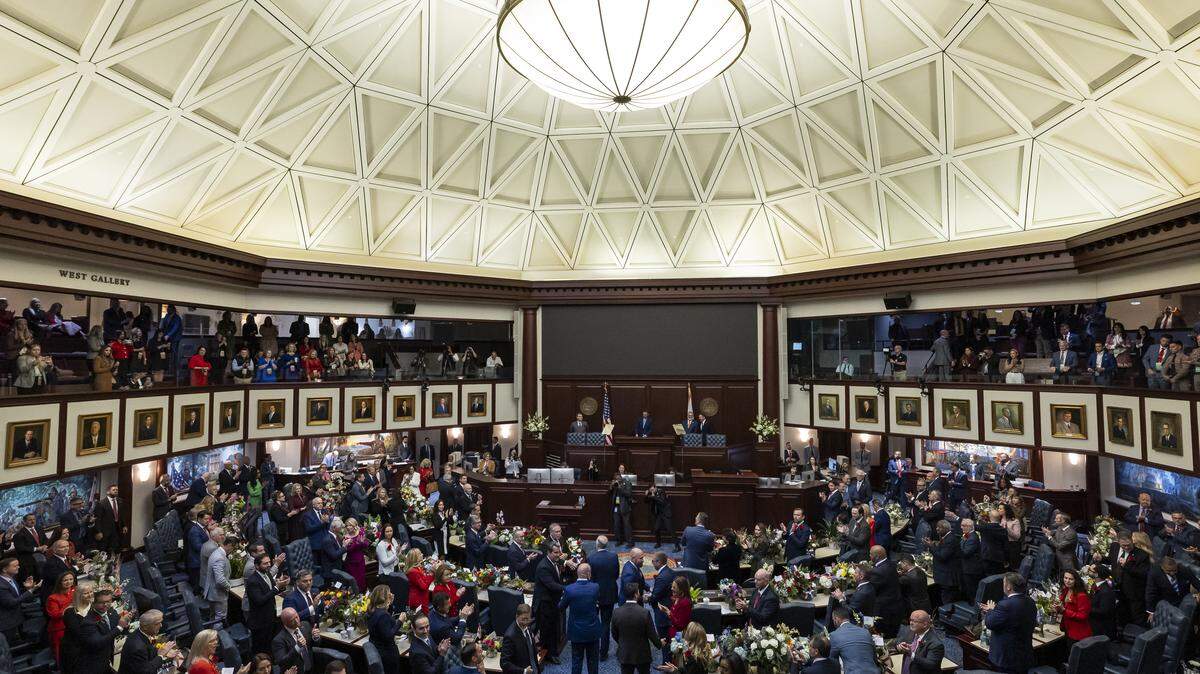
Florida lawmakers on Tuesday grilled members of Gov. Ron DeSantis’ team over his proposed redistricting plan that could give the GOP four more seats in Congress.
Legislators in particular honed in on acknowledgement by the governor’s staff that they used partisan information to draw the map.
Jason Poreda, an employee with the governor’s office who drew the map, and Mohammad Jazil, a private attorney who often works with the state, presented the plan and DeSantis’ legal justification to the House and Senate.
It was the first chance lawmakers had to ask specific questions about the map, which Poreda said he began working on two weeks ago. He finished his work over the weekend, and the proposal was sent to lawmakers Monday.
Fox News received the proposal before lawmakers, as an exclusive red-and-blue color-coded map showing Republicans’ pickup opportunities.
“We should all be upset with the governor’s office,” said Sen. Shevrin Jones, D-Miami Gardens. “He has no respect for us.”
Despite having little time to review the plan, lawmakers moved the plan forward out of their first committees. The full legislative bodies will vote on the map later this week.
Lawsuits are sure to follow. And they’ll likely center on Florida’s constitutional ban on partisan gerrymandering, which voters adopted through the Fair Districts Amendment in 2010.
DeSantis’ office, when it sent the map to lawmakers Monday, also sent a legal memo with its justification about why it thinks the Fair Districts Amendment doesn’t matter.
The constitutional language bans drawing districts to help a political party. It also bans lawmakers from diluting minority voting power.
The memo, sent by general counsel David Axelman, implied the governor’s office doesn’t need to follow that law as a whole because the office believes the part related to race and redistricting is unconstitutional.
Axelman said he believes the U.S. Supreme Court is poised to issue a ruling saying that using race in redistricting is unconstitutional.
In presentations to lawmakers on Tuesday, Jazil doubled down on that thinking.
“The text of Article 3 Section 20 sets up a tiered structure,“ Jazil said. ”Now, what happens when you take a tier out from under you? The structure falls.”
Some Senate Republicans appeared skeptical of the rationales the DeSantis administration offered.
Sen. Jennifer Bradley, R-Fleming Island, asked Jazil whether a court had ruled that Fair Districts as a whole must be discarded if one part did. Jazil said it was the “executive branch’s argument on the issue.”
She also questioned whether the governor’s map was built on “a legal theory ... underpinned by two ifs” — the assumption about how the U.S. Supreme Court will rule, and the assumption that the Florida Supreme Court will agree with DeSantis’ argument about the Fair Districts Amendment having to come down.
Jazil agreed.
Bradley later joined two other Republicans in voting against it.
“I have a duty to uphold the constitution that I swore to defend,” she told senators.
“I can’t do it,” she added. “It’s just unconstitutional.”
Lawmakers in the House and Senate also asked Poreda whom he consulted with to make the map.
Poreda said he wasn’t “going to get into any discussions” he had with other staff based on the advice of legal counsel, which led audience members to let out a frustrated groan.
Florida House leadership appeared to agree with DeSantis’ legal argument.
Rep. Jenna Persons-Mulicka, R-Fort Myers, who is sponsoring the redistricting bill in the House, called the governor’s legal memo “persuasive.” Persons-Mulicka, who is sponsoring the redistricting bill in the House, stood by House Speaker Daniel Perez’s side at a morning news conference and answered most redistricting questions for him.
“We made a decision in 2022 that was not based on prior legal guidance, but was upheld recently by the Florida Supreme Court,” she said. “We feel confident again in moving forward with the maps presented by the governor’s office.”
In 2022, DeSantis’ office vetoed the congressional map approved by lawmakers. Instead, he strong-armed the Legislature into passing his own plan, which dismantled a seat in North Florida held at the time by Democratic U.S. Rep. Al Lawson.
DeSantis’ office argued the seat, which stretched across the Panhandle to Jacksonville, relied too much on race. The Florida Supreme Court agreed and upheld DeSantis’ map last summer.
But a few weeks later, as President Donald Trump began pushing red states to redistrict to keep the GOP’s control of Congress, DeSantis began floating the idea that there were problems with the map he’d gotten approved.
Though Poreda on Tuesday said he used partisan data to draw Florida’s maps, he asserted that he did not create the map to give Republicans an advantage.
But Democrats said the goal is obvious, pointing to Fox News’ exclusive access and the administration’s unprecedented use of political data.
Rep. Anna Eskamani, D-Orlando, on Tuesday dismissed the idea that politics weren’t at play.
“You don’t send a colored map of red versus blue to Fox News without the intention of trying to ignore Florida’s constitutional standards and requirements around Fair Districts,” Eskamani said.
Perez, who has worked over the past two years to assert the House as an independent body, told lawmakers Tuesday that he plans to put the governor’s proposal to a vote on Wednesday.
The House did not put forward its own map. Neither did the Florida Senate.
“The governor drew a map, and it is our job to entertain that map, to debate it, to converse it and to eventually vote on it,” Perez said.
Some lawmakers said they hadn’t been given enough time to fully evaluate the proposal.
Rep. Susan Valdés, a Tampa Republican, said she thought the Legislature was “jumping the gun a little bit.”
“I wish we had a little bit more time to study and not just rush into things.”
Valdés said she was less concerned about the shape of the new districts and more worried about whether the act of redrawing them was constitutional.
When Rep. Linda Chaney was asked about the idea of splitting St. Petersburg into two districts, she made a face and took a long pause.
“I like that the district doesn’t cross the bay anymore. I think that makes sense,” the St. Pete Beach Republican said.
This story was originally published April 28, 2026 at 12:46 PM.