Beatings and pepper bombs: Conditions worsen at Alligator Alcatraz, detainees say

Late-night beatings. Pepper-spray “bombs.” Meager meals washed down with cloudy water sipped from moldy cups.
These are the daily ordeals relayed by immigrants held inside the remote Everglades detention camp known as “Alligator Alcatraz,” where detainees say food is scarce, the cages where they sleep reek of urine and complaints can be met with chemical sprays or solitary confinement in cramped cells.
New accounts reviewed by the Miami Herald suggest living conditions inside the controversial facility have worsened since Gov. Ron DeSantis touted it last summer as a temporary “one-stop shop” for rapid deportations reserved for the “worst of the worst.”
Nine months after the hasty construction of the detention camp — which now houses 1,383 detainees, according to April data from Syracuse University’s Transactional Records Access Clearinghouse — their families and attorneys say it has morphed into an increasingly hellish waystation for immigrants of all backgrounds ensnared in the Trump administration’s war on illegal immigration.
The DeSantis administration has repeatedly denied allegations of mistreatment at the site. The U.S. Department of Homeland Security has similarly dismissed reports of inhumane conditions, flooding and hunger strikes as “hoaxes.”
But recordings of phone calls between detainees and their relatives, along with interviews, 911 calls and written complaints, paint a picture of an isolated facility plagued by chronic food shortages, questionable drinking water, mold-related health problems and lapses in medical care.
The daughter of one Cuban detainee held in Alligator Alcatraz for more than three months described multiple incidents of guards beating detainees and deploying pepper spray in housing units. Arianne Betancourt said in an interview that “whenever they do stuff to punish them it’s usually in the middle of the night. It’s usually when they’re asleep.”
Betancourt, a community advocate at the social-justice organization Workers Circle, relayed her father’s accounts of substandard food items on the Alligator Alcatraz menu, including boiled tofu, half-frozen chicken nuggets and partially cooked rice. Her father, Justo, told her that the average serving amounts to three spoonfuls. “Portions for a small child” is how one attorney’s client described the meals.
“With each passing day there is less and less humanity,” Justo Betancourt said in a phone call reviewed by the Herald, during which he described an April 6 pepper bombing and restrictions on food. “The guards here think that we are murderers.”
Those concerns were echoed in two complaints to the Department of Homeland Security’s Office for Civil Rights and Civil Liberties, filed in March by a West Palm Beach woman whose fiancé was at the site. She requested anonymity, citing fears of retaliation.
The first complaint alleged that guards “physically assaulted” her fiancé after he requested phone access and described “unsanitary and unsafe living conditions,” including bugs in the showers, poor ventilation and the use of the same drinking cup without proper sanitation.
“The detainee fears retaliation for reporting these issues,” it read, “and feels unsafe and in a state of severe distress.”
In a second complaint, the woman said her fiancé had lost more than 15 pounds due to persistently small food portions and was developing “skin rashes and open wounds” linked to mold in his drinking cup.
In an interview with the Herald, the woman said her partner had lost hope and felt that his “near future is death.”
When the Herald spoke on the phone to the detainee, who also requested anonymity for fear of retaliation, he said, “People are protesting outside. People from Congress walk through here and see what’s going on. They really don’t care.”
“It’s not gonna change in here.”
‘He couldn’t breathe. His chest was burning’
A spokesperson for the Florida Division of Emergency Management, the state agency which operates Alligator Alcatraz, confirmed that guards have used pepper spray, or “OC gas,” on three occasions but said it was deployed in response to detainees “inciting violence” and damaging parts of the camp.
The spokesperson, Stephanie Hartman, said “no injuries were reported, and everyone involved was medically cleared in an abundance of caution.” She declined to answer further questions about two reported pepper bombings, including whether affected detainees were transported away from Alligator Alcatraz and their current whereabouts.
A U.S. Department of Homeland Security spokesperson noted in a statement that the facility has passed two federal inspections in the past six months.
“Here are the facts: Alligator Alcatraz does meet federal detention standards,” the spokesperson said. “All detainee facilities are clean. Any allegations of inhumane conditions are FALSE.”
Detainees and their family members describe a starkly different reality — one of a remote detention center marked by limited oversight, isolation and neglect, and a troubling shift toward guards’ use of “pepper bombs” that disperse chemical irritants across entire housing units rather than targeting individuals.
According to five family members and an attorney who spoke with the Herald, guards working for a private contractor most recently used chemical agents in the early morning hours of April 6, when many detainees were asleep in bunk beds crammed into chain-link cages. In recorded calls, detainees described a powder-like substance spreading through at least two cell units — each holding roughly 30 men — filling the air and triggering immediate physical distress.
Those exposed reported shortness of breath, chest pain and intense burning sensations on their skin and faces, symptoms consistent with high concentration of oleoresin and capsicum, the active ingredient in pepper spray.
On April 6, the West Palm Beach woman who had not heard from her fiancé held at the site called 911 seeking help. She told the dispatcher, “they were sitting in pepper spray for two hours the last time that this situation happened,” she said, referencing an April 2 incident.
“He couldn’t breathe. His chest was burning. His face, his skin, his face felt like it was deteriorating,” she said.
Another detainee’s relative, who requested to speak anonymously citing fears of retaliation, also said detainees affected by the April 2 pepper spraying were left to sit in it for two hours.
Family members say some detainees did not receive prompt medical attention after the incident, despite federal detention standards requiring evaluation following the use of chemical agents. Several men were removed from their units after exposure and transported out of the facility, according to relatives, who say they have since been unable to contact them or determine where they were taken.
Their account of events mirrors a recent filing in federal court on behalf of detainees who said they were pepper-sprayed and severely beaten after they protested being cut off from the phones that act as lifelines to their attorneys and the outside world.
Photographs taken April 8 and attached to the filing showed one detainee, Raiko Lopez Morffi, with a black eye and an injured arm. Morffi’s lawyer, Katie Blankenship, alleged that guards broke another man’s wrist and terrorized detainees, who responded by barricading the entrance to their cell.
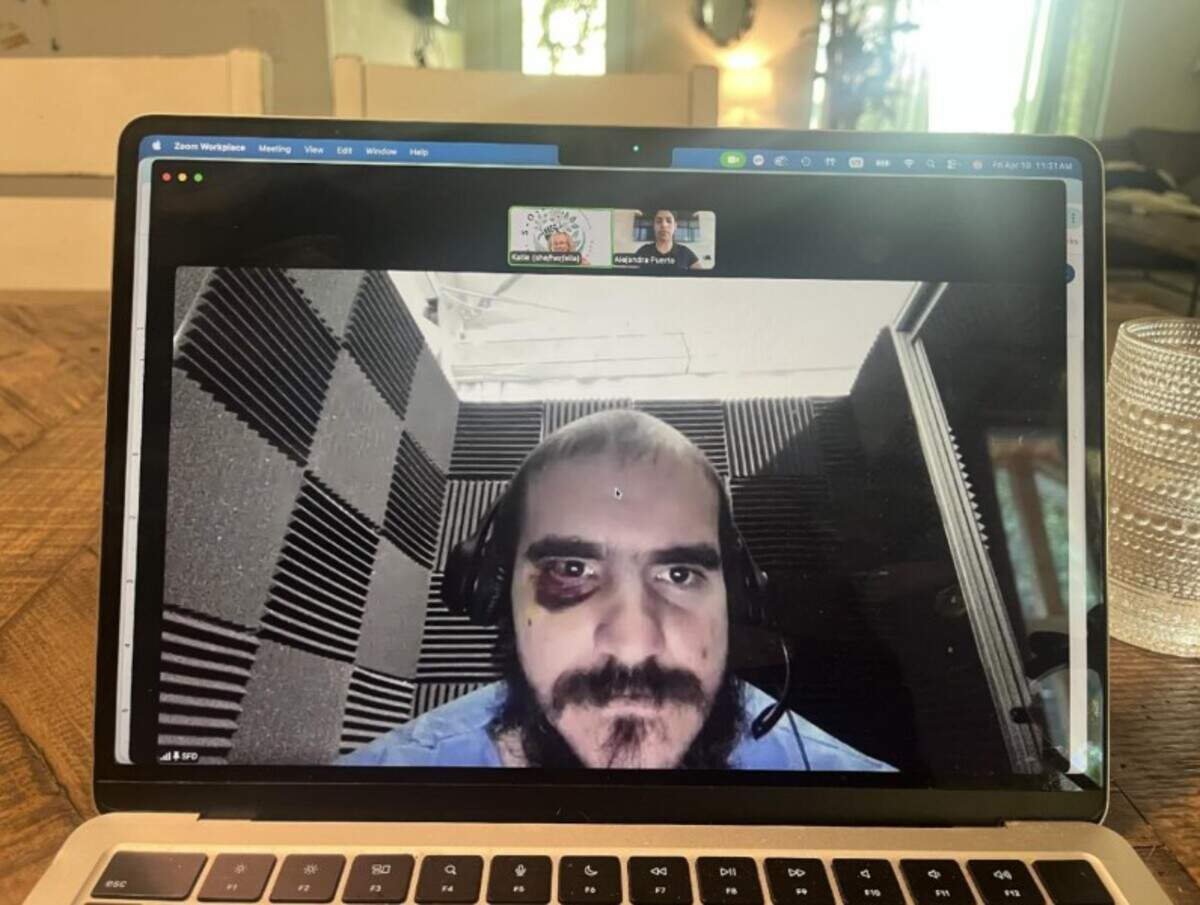
In an interview with the Herald on Wednesday, Blankenship said when she spoke with Morffi, about a week after the incident, he told her he was being transferred to an uncomfortably narrow solitary confinement unit known as “the box,” which state and federal immigration officials say does not exist.
‘Cruel and unnecessary.’
Alligator Alcatraz was built in haste under emergency direction from state officials, assembled in a matter of days on a seized airstrip last summer using temporary structures as a rapid-response solution to overcrowding in existing detention centers.
From its earliest days, relatives of detainees described basic infrastructure failures: toilets that didn’t flush, erratic air conditioning in the South Florida heat, limited access to showers and hygiene supplies and frequent barriers to making phone calls.
Food and water were among the most consistent complaints. Families reported small portions, sometimes spoiled or infested with bugs, and drinking water that appeared cloudy or was stored in shared containers without clear sanitation protocols.
Many of those conditions have persisted — and, according to recent accounts, worsened — with new allegations now extending beyond neglect to include physical abuse and punitive measures by guards.
Attorneys representing detainees say the DeSantis and Trump administrations have failed to comply with a court order requiring that detainees receive improved access to phones and attorneys. Members of Congress are asking pointed questions about allegations about the use of “the box” as punishment.
For advocates and accountability groups who study detention systems, the accounts of Alligator Alcatraz detainees — particularly the reported use of pepper spray in enclosed housing units — reflect broader concerns about how such facilities operate with limited oversight and transparency.
Federal standards governing immigrant detention facilities require that the use of force — including chemical agents like pepper spray — be limited, documented and followed by medical evaluations. Detainees also must have consistent access to food, clean drinking water, sanitation, medical care and communication with attorneys and family members.
Those standards, outlined in U.S. Immigration and Customs Enforcement detention guidelines, are intended to ensure that facilities — including those operated through state partnerships — meet baseline conditions for safety and humane treatment.
But advocates and oversight groups have long warned that compliance can vary widely, particularly in newer or rapidly established facilities with limited transparency. That gap is what concerns researchers like Justin Mazzola of Amnesty International USA, who said the use of chemical irritants in confined settings raises particular risks.
“They’re inherently open to be used in arbitrary and discriminate ways,” he said.
Mazzola, who has studied immigrant detention systems for more than two decades, said facilities like Alligator Alcatraz can allow abusive conditions to persist with little accountability.
Detainees at Deportation Depot, another state-run pop-up detention facility located in northeast Florida, were pepper-sprayed on at least two occasions, the Associated Press reported in January.
“If you want to see how a country treats its people, see how it treats people in detention,” Mazzola added. “This is the epitome of that.”
Public attention to the detention center’s operations began to fade last fall after U.S. District Judge Kathleen Williams ordered the DeSantis and Trump administrations to scale down operations. But the ruling was paused by an appellate court, and the state continues to operate the facility.
Now, federal scrutiny of Alligator Alcatraz has intensified in recent weeks amid mounting allegations of torture within the facility.

Democratic Sens. Jon Ossoff of Georgia and Richard Durbin of Illinois, both ranking members of the Senate Judiciary Committee, launched an inquiry in March following reports of detainees being punished with confinement in a cage-like structure, referred to as “the box,” sometimes with shackled hands and feet and little to no access to food or water.
After a surprise visit last week, U.S. Rep. Debbie Wasserman Schultz, a Broward County Democrat, told reporters that she observed roughly 1,500 men crammed in caged conditions she described as “cruel and unnecessary.” She said federal immigration officials barred her from speaking with detainees about alleged mistreatment.
In a statement on Monday, Wasserman Schultz said while she did not witness “any protests or hunger strikes, or physical discipline of detained people” during her visit, she called the Herald’s reporting and recent ACLU court filings “deeply disturbing.”
“Reports of physical discipline of detainees for protesting are abhorrent and further evidence that this facility needs to be shut down,” the congresswoman said. “It’s been a monument to cruelty from the start.”
Wasserman Schultz said during her visit, as she walked through cages, some of the detained men looked “listless.”
“ICE release me,” she said some called out to her and the guards in Spanish. “I want to go home.”
Miami Herald Staff Writers Ana Claudia Chacin and Veronica Egui Brito contributed to this report.
This story was originally published April 18, 2026 at 11:13 AM.