Florida has a new way to file complaints about prayer suppression in schools
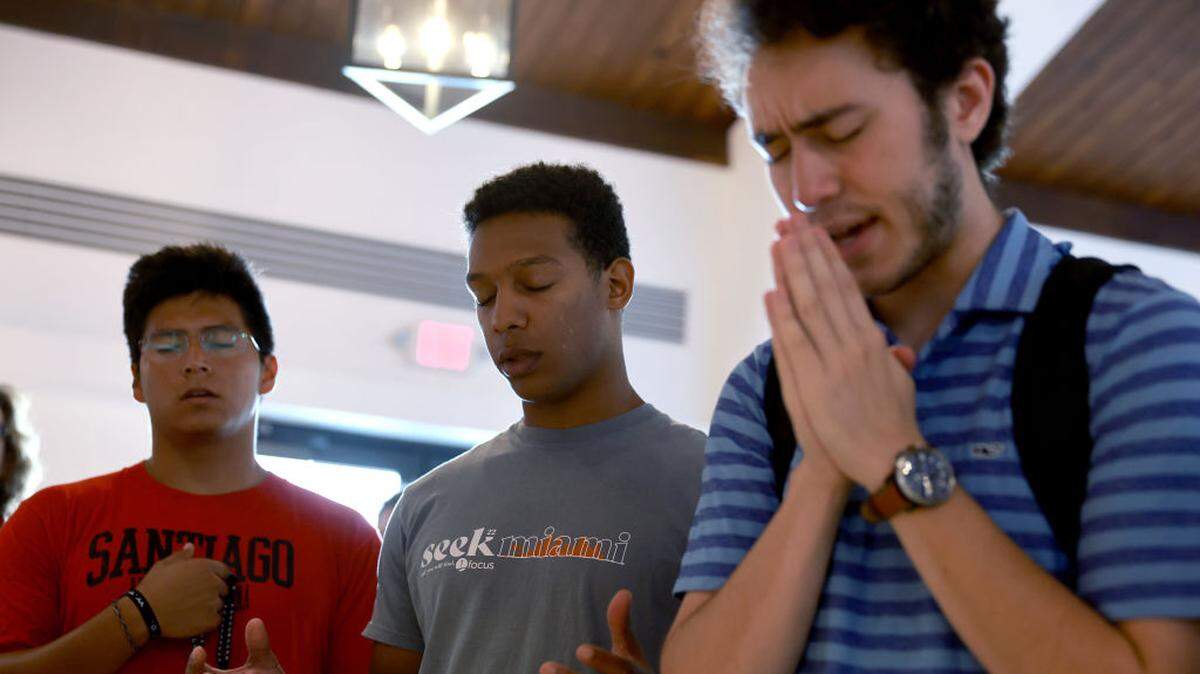
The Florida Department of Education wants to remind parents that prayer and religious expression are allowed in public schools. It’s doing that by issuing new guidance and a new way to track and investigate formal complaints.
In a letter sent to parents earlier this week, Florida Education Commissioner Anastasios Kamoutsas announced the department’s new complaint process, which allows parents and individuals to submit complaints to the department if the updated guidance on prayer and religious expression in schools is not followed.
In the letter, Kamoutsas said that students, teachers and other school employees have protected “constitutional rights to religious expression, including individual prayer” in public schools.
“Florida will continue to safeguard the constitutional protections for voluntary prayer and religious expression in our public schools,” Kamoutsas wrote in the letter.
The letter specified some examples of how religious expression in public schools should be treated the same as secular expression. For example, an essay with religious content should be graded with the “same standards” as a secular essay, and religious student organizations should be treated the same as secular student organizations.
People can now submit complaints to the department at FLFaith@fldoe.org. The Department of Education would then investigate the complaints and report them, along with any lawsuits filed against the school district or charter school, to the U.S. Department of Education.
Miami schools recognize National Day of Prayer
The updated guidance comes just over a week after the Miami-Dade County School Board voted for the fifth year in a row to recognize the National Day of Prayer in the district’s public schools.
The measure proposed by school board member Danny Espino commemorates the day of prayer, which falls on May 7 this year, and “directs the Superintendent to inform all schools and District staff to respect students’ and staff’s recognition of the National Day of Prayer in accordance with applicable School Board Policies.”
Espino celebrated five years of recognition for the day of prayer on social media and thanked the faith‑based advocacy organization Christian Family Coalition Florida and its executive director, Anthony Verdugo, for showing up to the meeting to advocate for the action.
“Moments of reflection, unity, and community engagement continue to bring people together across our district,” Espino said in his post.
What do federal guidelines say about prayer in schools?
The guidance comes at a time when the Trump administration is highly focused on advocating for religious freedom in the United States and a month after the U.S. Department of Education released new guidance on religious expression, replacing prior guidance from the Biden administration.
The guidance reiterates that individuals within public schools have a right to act and speak in accordance with their religious beliefs, provided they do not invade the rights of others.
Here are some key points:
- Students, teachers and other school officials have a right to pray in school, for example, as long as they’re not doing so on behalf of the school.
- Public schools cannot sponsor prayer or pressure students to pray. For example, a school principal may not lead a prayer at a mandatory school assembly.
- Public schools can regulate student speech that “materially disrupts classwork or involves substantial disorder or invasion of the rights of others.” For example, a student can’t pray out loud during math class in a way that prevents others from learning.
- A school should “not favor secular over religious views or one religious view over another.” For example, “school officials cannot express hostility toward religious student groups by demeaning their beliefs.”
The guidance refers to recent cases from the Supreme Court, including a well-known case about a Colorado baker who was accused of violating the state’s antidiscrimination law after refusing to bake a cake for a same-sex wedding due to religious beliefs.
“If a public school teacher called a student’s religiously based view that marriage should be between one man and one woman ‘despicable’ and lowered the student’s grade in response, that teacher would demonstrate religious hostility and violate the student’s constitutional rights,” the guidance from the U.S. Department of Education reads.
This story was produced with financial support from Trish and Dan Bell and donors in South Florida’s Jewish and Muslim communities, including Khalid and Diana Mirza and the Mohsin and Fauzia Jaffer Foundation, in partnership with Journalism Funding Partners. The Miami Herald maintains full editorial control of this work.
This story was originally published March 21, 2026 at 5:00 AM.