Miami GOP Reps. walk a tight rope amid Trump immigration crackdown
President Donald Trump has issued sweeping actions on immigration, forcing Miami’s GOP lawmakers into a careful balancing act: supporting both Trump and constituents threatened by his policies.
On his first day in office, Trump terminated a Biden-era parole process that has allowed over half-a-million Cubans, Nicaraguans, Venezuelans and Haitians to temporarily live and work in the United States. A week later, his administration rolled back an 18-month extension of deportation protections for over 505,000 Venezuelans who are now waiting to see if the Trump administration will renew their program or leave them at risk of deportation — for some as soon as April.
Under the now-canceled Temporary Protected Status extension, beneficiaries would have kept their immigration benefits through October 2026. Trump’s Homeland Secretary Kristi Noem has until Saturday to extend protections for roughly half the recipients.
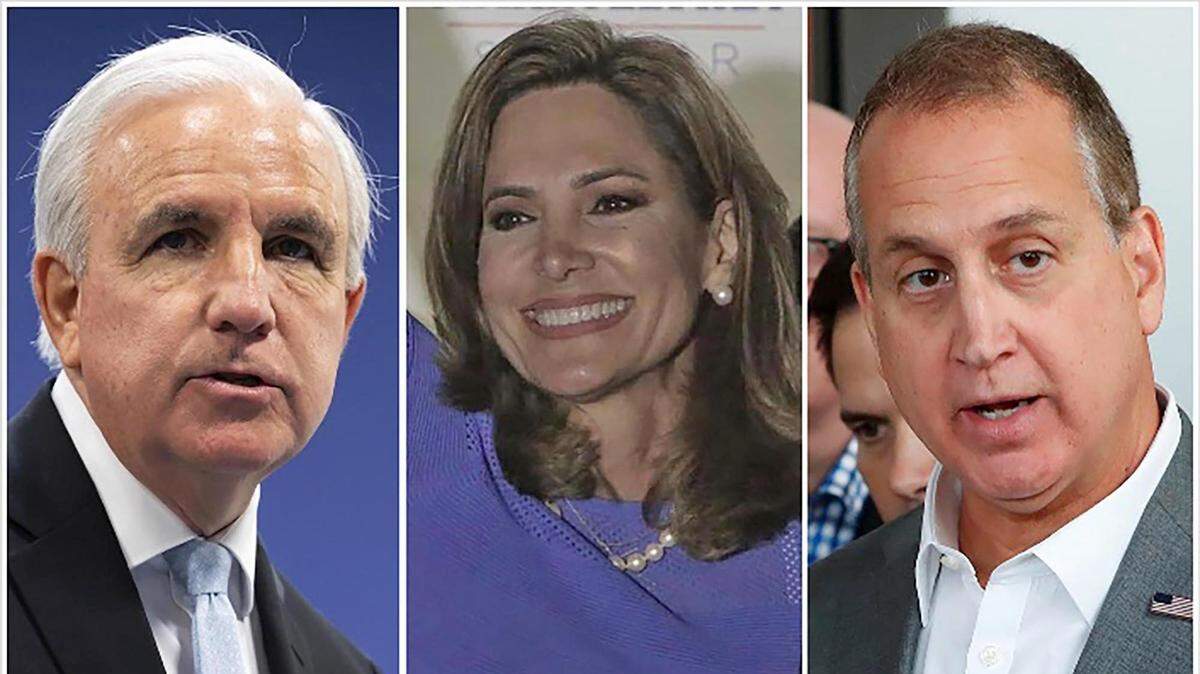
In response to the revocation of the Biden administration’s extension of Temporary Protected Status for Venezuelans, Miami Reps. María Elvira Salazar, Mario Díaz-Balart, and Carlos Giménez released a statement on Wednesday committing to protect people fleeing persecution in Venezuela. They also defended Trump’s crackdown on undocumented immigration in the name of public safety — writing that “some individuals have exploited our generosity.”
“We will continue to do everything possible to ensure that those seeking freedom from persecution and oppression are protected,” they wrote.
The lawmakers did not directly address the rollback in their statement. But in statements made publicly and to the Miami Herald, each of the three members of Congress has reiterated their support for continuing Temporary Protected Status for Venezuelans, in some manner.
Giménez wrote a letter Friday afternoon to Noem, in which he described her looming decision on TPS as an “urgent situation,” and urged her to “make a decision that individually provides a solution to those who contribute to our country and respect the rule of law.” Separately, he asked her on X to “make a decision that provides a case by case solution.”
“While members of the “Tren de Aragua” gang are Venezuelans, not all Venezuelans belong to “Tren de Aragua,” he wrote her, referring to a Venezuelan gang whose members have been arrested in the United States. “We must not allow the actions of a few to unfairly stigmatize an entire community.”
Representatives for Díaz-Balart said that the Congressman had consistently supported Temporary Protected Status as well as another federal temporary deportation protection for Venezuelans, and emphasized that his position had not changed. Salazar sent the Herald a statement through her office.
“We support TPS until Maduro is out,” she said. “Everyone’s existing asylum cases should be respected.”
Noem argued in a memo that her predecessor — ex-Homeland Security Alejandro Mayorkas — improperly approved the extension, and wrote that a rollback “is warranted to untangle the confusion.” On Fox & Friends, she described it as a public safety decision.
Mayorkas’ decision “meant they were going to be able to stay here and violate our laws for another 18 months,” Noem said on Fox & Friends. “And we stopped that today.”
Among the Venezuelan supporters of Trump — who in November took nearly two-thirds of the vote in the city of Doral, a popular destination for Venezuelan immigrants — are those who agree with Noem that Mayorkas acted prematurely.
Ernesto Ackerman, president of the conservative-leaning group Independent Venezuelan-American Citizens, emphasized that the rollback is not a revocation of TPS protections — and agreed that Mayorkas had improperly extended it. He said he trusts Salazar, Giménez and Díaz-Balart to advocate for Venezuelans.
“They have always been on the side of Venezuelans,” he said. “And I don’t think that will change now.”
Helena Poleo, a Democrat and Venezuelan analyst, declined to comment on the representatives’ statement but said that GOP lawmakers were in a “difficult situation.”
“Now they are going to have to reconcile following the Trump Administration and serving their constituents,” she said. “They need to serve their community — and their community has a large Venezuelan community — and that is what I believe they will end up doing.”
“We don’t want police asking people immigration status”
People convicted of two or more misdemeanors or a felony are not eligible for TPS. Before the inauguration on Jan. 10, Díaz-Balart — whose parents immigrated from Cuba — told Florida Politics that Trump would start with “thousands upon thousands of convicted criminals” and not those fleeing repressive regimes.
“You can’t deport them back to those countries,” he said. “You can’t deport somebody back to a country where you know they’re going to potentially suffer real persecution.”
But last week, among those detained in Miami-Dade’s Brownsville neighborhood was a Venezuelan woman in the process of getting citizenship, her husband told CBS News this week. This week, TPS recipients across Miami-Dade expressed their fear about the future, should the extension not be renewed.
“I feel powerless and angry that I can’t help my family,” a separate Venezuelan woman who received TPS in 2023 told the Herald. “This is a country of immigrants. Why are they attacking us? My family has committed no crime.”
In Miami-Dade County, where over half the population is foreign-born, Republican lawmakers have long supported legal immigration programs and pathways to citizenship for undocumented immigrants — at times conflicting with GOP colleagues in other states.
Miami GOP members, including now-Secretary of State Marco Rubio and Díaz-Balart, have previously attempted to legislate pathways to legalization for people with precarious or no legal immigration status.
“The American people are willing, and the vast majority of the Republican conference are willing, to allow the folks who are here and undocumented to earn their way toward legalization, and toward becoming part of the American fabric,” Díaz-Balart told the Washington Post in 2013 during one such effort.
In 2016, when Trump first entered the Oval Office, Miami-Dade was on the Justice Department’s list of so-called “sanctuary cities” that declined to cooperate with ICE on law enforcement matters. Then-mayor of Miami-Dade, Giménez changed that policy, citing fear that Trump would withhold federal funding in retaliation.
“It doesn’t mean that we’re going to be arresting more people,” Giménez, who immigrated from Havana as a child, told the Herald at the time. “We don’t want police asking people immigration status.”
A year later, he protested the president’s move to end TPS for Haitians.
As Trump entered the GOP political mainstream and immigration became front and center in national politics amid a migration crisis in the Western Hemisphere, the South Florida lawmakers — and in many cases the voters in their districts — turned towards the president’s hard-line policies.
This trend has underpinned an evolution for many of South Florida’s GOP politicians.
Since 2020, when Giménez ran for Congress with Trump’s endorsement, the former mayor has been increasingly critical of undocumented immigration, arguing that former President Joe Biden’s policies created a crisis at the border.
Salazar, the Little Havana-born child of Cuban immigrants, is one of the representatives who have made recent efforts to create pathways to citizenship, introducing a bipartisan immigration reform bill known as the Dignity Act. In October, when asked about Trump’s plans for mass deportations, and her support for the president, she told the Herald that he would start with “criminals.”
“We all know that you have millions and millions of illegals or undocumented who are very good people and who have done jobs that no one else wants to do in this country,” she said.
On Jan. 24, after the president ended the humanitarian parole program for Nicaraguans, Venezuelans, Haitians and Cubans, Salazar wrote a concerned letter to Acting Secretary of Homeland Security Benjamine Huffman. She urged the agency to ensure that beneficiaries from the four countries who “have no criminal record” are “protected until their cases are fully resolved.”
“I am concerned with how this new guidance may affect individuals in Miami,” she wrote. “Individuals must be afforded due process.”
Trump has long promised to deport not only those convicted of a crime, but all undocumented immigrants and even many others legally in the country under temporary programs.
On Tuesday, White House press secretary Karoline Leavitt said that the president viewed all undocumented immigrants as “criminals.”
“If you are an individual, a foreign national, who illegally enters the United States of America, you are, by definition, a criminal,” she told reporters at a press conference. However, living in the country as an undocumented immigrant is not a crime under federal law. In general terms, crossing the border is not either most of the time, and deportation proceedings are civil.
Another executive order signed by the president in his first few hours in office seeks to end birthright citizenship — a right enshrined in the Fourteenth Amendment of the U.S. Constitution that guarantees citizenship to children born in the U.S. Over 20 states have filed lawsuits challenging the executive order, and a federal judge temporarily blocked it — but Florida, where one in 20 residents is foreign-born, is not among them.
Giménez told The Hill on Jan. 25 that he was already hearing concerns from constituents about birthright citizenship.
“I believe if you’re born in the United States, you’re a citizen of the United States,” he said. “So I think the way to actually solve the problem that you’re trying to solve is to control the border.”
This story was produced with financial support from the Esserman Family Fund for Investigative Journalism at The Miami Foundation. The Miami Herald maintains full editorial control of this work.
This story was originally published January 31, 2025 at 5:22 PM.