
Trump’s immigration orders are out. How will Florida lawmakers respond?
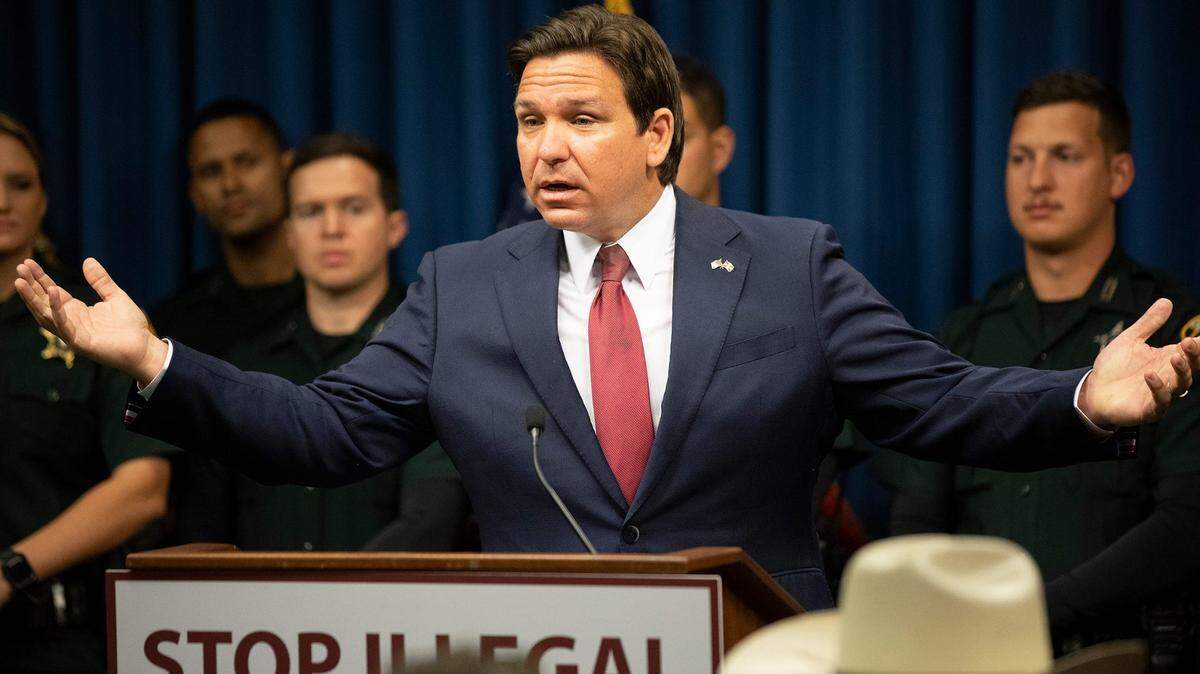
President Donald Trump has started detailing in executive orders how he wants state and local law enforcement officials to investigate and detain people who are in the country illegally — plans that Gov. Ron DeSantis is eager to help carry out in Florida.
But as the dust settles on the president’s immigration orders, Florida Republican legislative leaders are still not saying how they plan to tailor state action to the federal orders next week when they will be in Tallahassee for a special session that DeSantis called to act on immigration.
DeSantis told reporters on Tuesday that he hasn’t spoken with House Speaker Daniel Perez, of Miami, or Senate President Ben Albritton, of Wauchula, since Trump signed the executive orders Monday night. And he suggested that if they decline to do something on the issue next week, he will keep calling them back to Tallahassee until they do.
“You can view me as like a dog that’s got you on the ankle on immigration,” DeSantis told reporters in Tallahassee. “I’m not just going to let it go.”
What is in play in Florida?
Perez and Albritton last week said they wanted to wait on Trump to issue executive orders because they were concerned that rushing state-level action on immigration could end up hurting Trump’s efforts.
Now that Trump’s orders are out, it remains unclear whether they are still concerned about timing given that DeSantis wants them to take action within days.
One of Trump’s immigration orders says the federal government will seek to expand agreements with state and local law enforcement agencies that allow officers to be deputized to perform some of the functions of immigration officers in relation to the “investigation, apprehension, or detention” of people who are illegally in the country.
The agreements are part of a federal immigration program — known as 287g — and most Florida sheriffs have opted into the program in some capacity. Currently, local law enforcement agencies that participate in the program can only enforce it in county jails and only have the ability to hold undocumented immigrants in custody for up to 48 hours if a federal immigration agent sends a detainer request for a detainee.
So far the Trump administration has not made any structural changes to the program. But Trump’s executive order says the Secretary of Homeland Security may structure cooperative agreements in “the matter that provides the most effective model for enforcing immigration laws” in specific jurisdictions — which could open the door to some changes.
DeSantis has alluded to wanting to do more on immigration enforcement than what is currently allowed in the program — or explicitly mentioned in Trump’s executive order.
“We want to make sure that we are expanding our existing authorities so that local and state officials are empowered — and the federal government would have to bless this and I think they will — they should be empowered to detain and deport people who are here illegally,” DeSantis said last week.
DeSantis has also said he wants state lawmakers to give him the authority to remove elected officials from office if they do not comply with the federal immigration program.
Additionally, the governor’s office has proposed criminal penalties for law enforcement officers who do not comply — but that appears to be a non-starter.
Senate President Ben Albritton will not be supporting that proposal, said Katie Betta, a spokesperson for the Florida Senate, told the Herald/Times. The proposal also does not have the backing of Pinellas County Sheriff Bob Gualtieri, an influential law enforcement voice in Tallahassee.
“Generally speaking we oppose any law that would impose criminal penalties on individual line-level law enforcement officers,” said Gualtieri, the legislative committee chair for the Florida Sheriffs Association.
Immigration detention and self-deportations
In Florida, DeSantis has also talked about helping with immigration detentions and alluded to possible plans that could aid in self-deportations.
It remains unclear whether states will be able to have a role in those areas, but Trump’s executive orders do not rule it out.
For instance, Trump has directed Homeland Security to “promptly take all appropriate action and allocate all legally available resources or establish contracts to construct, control, or use facilities to detain removable aliens.”
DeSantis said last week that he believed the state may play a role in immigration detention.
“I think we, in the state, will probably be willing to help with that regard,” DeSantis told reporters. “We are going to coordinate with people in the White House and who is overseeing immigration to see what makes sense.”
But his office has declined to provide specifics when asked by the Herald/Times.
The governor has also proposed expanding a program he used to fly migrants to Martha’s Vineyard in 2022 to “facilitate the deportation of illegal aliens” from the country. The governor’s office has not responded to requests seeking details about those plans or whether it planned to transport individuals outside of the country, as proposed by the governor’s office in a draft to legislative staff.
In an executive order, Trump directed Homeland Security to “adopt policies and procedures to encourage aliens unlawfully in the United States to voluntarily depart as soon as possible.”
Herald/Times staff reporter Lawrence Mower contributed to this report.
This story was originally published January 21, 2025 at 3:33 PM.