How Attorney General Matt Gaetz would help Trump enact an aggressive immigration agenda
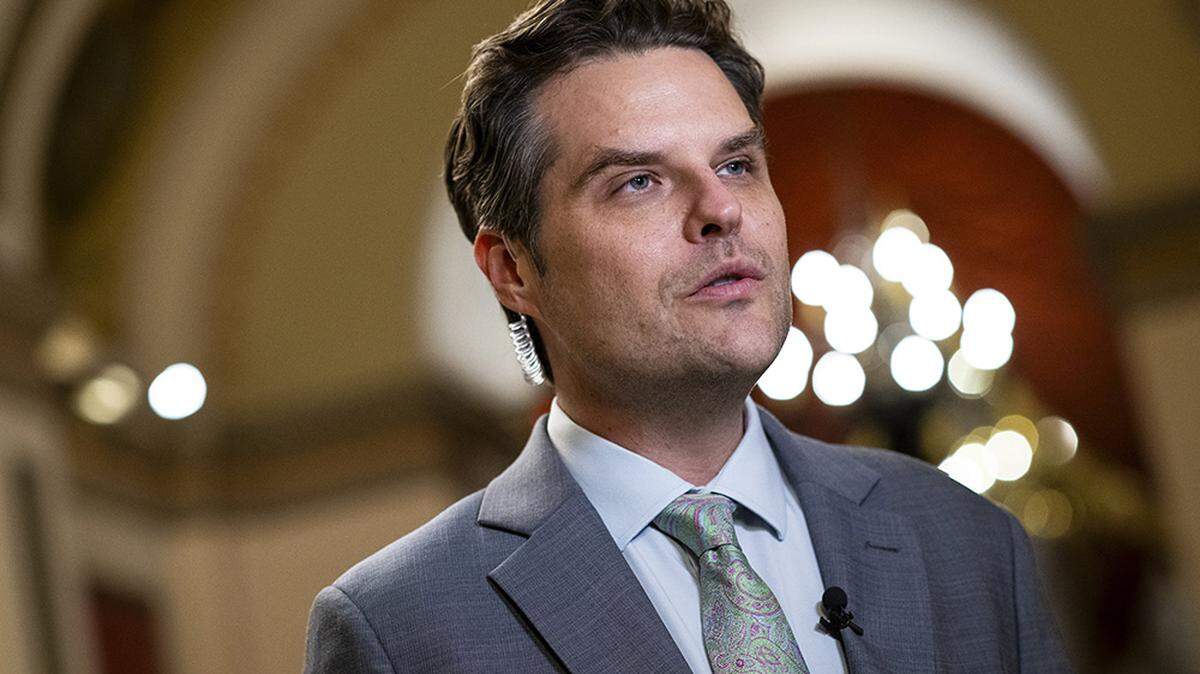
Update: Matt Gaetz announced on social media early Thursday afternoon that he was withdrawing from consideration as attorney general.
Well-known for fiery defenses of president-elect Donald Trump on rightwing media, his fight against sex trafficking allegations and ousting his own party’s speaker, former Florida Rep. Matt Gaetz also has a long and revealing history on immigration policy — a legacy he may soon be able to extend as attorney general.
Though most immigration oversight falls under the Department of Homeland Security, several important tasks remain with the Justice Department and the attorney general. If confirmed, Trump’s nominee for the position would be responsible for appointing immigration judges, selecting members to the Board of Immigration Appeals and providing the president with legal counsel.
Perhaps most consequentially, the attorney general also has the right to take over any immigration case and decide the outcome autonomously — even overruling decisions made by the Board of Immigration Appeals.
Now, Gaetz is on the verge of having free range to pursue a hardline immigration agenda on behalf of an administration that has promised the largest deportation effort in the history of the country.
“If the new administration decides that people cannot apply for asylum on U.S. soil, the attorney general, as the chief law enforcement officer, will have a say in that matter,” said Muzaffar Chishti, a senior fellow at the Migration Policy Institute and director of the institute’s office at New York University School of Law. “He is the government’s lawyer, in defending every action the administration takes, and every action that the immigrants or organizations representing immigrants bring against the government.”
The Miami Herald found that, from the time he was sworn-in as a congressman in 2017 to his resignation last week, Gaetz cosponsored or introduced at least 100 measures to limit immigration or funding for immigration-related organizations, or to penalize and deter illegal immigration — including legislation targeting sanctuary cities and birthright citizenship. He has also voiced support for ending DACA, the Deferred Action for Childhood Arrivals program.
In at least four instances on social media, Gaetz has also supported a philosophy called replacement theory — the idea that non-white immigrants are intentionally being brought into the country to replace white people.
The theory has increasingly made its way from far-right groups into the Republican mainstream, bolstered by a Trump campaign that warns of an “invasion” at the Southern-U.S. border.
“Matt Gaetz has long supported President Trump’s popular vote winning immigration agenda and will enact it as Attorney General,” said Alex Pfeiffer, a Trump transition team spokesperson.
Gaetz’s Immigration Record
Gaetz has taken a strong stance against immigration throughout his time in office — writing about an “invasion” of undocumented Haitian immigrants in an essay titled “Don’t Haiti My Florida” and proposing legislation to restrict birthright citizenship and deny anyone “who holds a passport issued by the Palestinian Authority” entrance to the country.
During the last Trump administration, Gaetz explained his support for Trump’s plan to restart deportation actions for over 500,000 “Dreamers” who entered the U.S. illegally as children by dismissing claims that the U.S. DACA program was compassionate.
“There is nothing compassionate about telling the rest of the world that, so long as a child arrives here, that child will be treated as if they have the same virtues and values of American citizens, if they committed the criminal offense of unlawful entry into the country,” Gaetz told the House of Representatives in September 2017.
Throughout his time in office, Gaetz has cosponsored over a dozen bills supporting the expansion of the border wall separating the U.S. and Mexico, and at least seven measures to penalize sanctuary cities. Among the 100 bills for stricter immigration policy that he sponsored or cosponsored were measures to prohibit federal funding for legal representation for undocumented immigrants; allow DNA testing for adults and children traveling over the border together; prohibit Covid-19 relief from going to states that provide it to undocumented immigrants; and end the Optional Practical Training Program that allows international students to work in the country after graduating.
In 2020, he introduced the Pandemic Act to mandate the deportation of undocumented immigrants held in U.S. Immigration and Customs Enforcement custody during a “national emergency related to a communicable disease.”
In comparison, at least four measures he cosponsored were to expand asylum or immigration access — two of which were different versions of a bill to allow Canadians into the U.S. as long-term nonimmigrant visitors.
Recent immigration legislation introduced by Gaetz includes:
▪ The HARRIS Act of 2024, which would end the tax-exempt status for non-profits that “provide goods or services to individuals who are not citizens or nationals of the United States.”
▪ The State Border Security Act, which would “authorize certain States to erect temporary protective fencing within 25 miles of the southwest border to deter unlawful immigration, and for other purposes.”
▪ The End Birthright Citizenship Fraud Act of 2023, which would restrict the rule established in the 14th Amendment under which children born in the United States to non-U.S. citizens receive citizenship.
Juan Carlos Gomez, the director of the Carlos A. Costa Immigration Human Rights Clinic at the Florida International University College of Law, said that Gaetz’s immigration stances put “millions of lives” “at stake.”
“The very idea of someone who is discussing what birthright citizenship is and those who shouldn’t have it, I’m not sure if that is a view that is consistent with someone who is supposed to make sort of unbiased decisions,” said Gomez.
Chishti, from the Migration Policy Institute, said that Gaetz’s goal will be to support Trump’s policy choices – not unlike his predecessors, such as Jeff Sessions, who took a hardline stance on immigration. He said Gaetz’s “huge priority” will be to “make sure that the President’s campaign promise of mass deportation and shutting the border will have maximum support from the Department of Justice.”
But Chishti said that Gaetz’s previous support for replacement theory makes him a possible “outlier.”
“Jeff Sessions was a principled enough lawyer to know that there were limits to what you can do as Attorney General,” he said. “I’m not sure Gaetz knows that.”
Replacement Theory
Rodney Coates, a sociologist and professor of global and intercultural studies at Miami University in Ohio, said that the support replacement theory has gained in recent years is a response to demographic changes in the U.S. The theory has also been used to push against laws legalizing abortion, he said, by arguing that white women are not having enough children.
“We are projecting that within 20 to 30 years, we’re going to be majority-minority, we’re going to be a majority people of color for the first time in the history of this country,” said Coates. “And that is causing all kinds of frustration, anxiety, fears and stress amongst extreme individuals that are caught up in, let’s say, whiteness and white identity politics.”
The Southern Poverty Law Center found that nearly 7 in 10 Republicans support replacement theory to some degree. A survey from the University of Massachusetts Amherst found that a third of Americans supported the theory, compared with two thirds of Republicans.
A New York Times investigation published in May 2022 found that news commentator Tucker Carlson expressed support for the theory in over 400 episodes of his former Fox News show — one of the most popular shows on cable news at the time.
In 2021, when Carlson got pushback for supporting replacement theory and the Anti Defamation League called for him to be fired, Gaetz came to his defense. He called the ADL “a racist organization” on X and wrote that Carlson was “CORRECT about Replacement Theory as he explains what is happening to America.”
After receiving criticism for supporting replacement theory, Gaetz wrote on X that “the Left/Media think of replacement solely on race/ethnicity terms. I don’t at all.”
“Democrats failed the voters,” he argued. “Now they are importing new voters.”
Leading up to the 2024 presidential election, the Florida representative argued at least twice on social media that replacement theory was a Democratic agenda, and called diversity, equity and inclusion initiatives “racist poison.” On Fox News in 2020, amid country-wide protests following the killing of George Floyd, Gaetz said a “cultural genocide” was taking place in the U.S. — claiming that “the left wants us to be ashamed of America so that they can replace America.”
Rachel Fugardi, a senior research analyst at the Southern Poverty Law Center who has previously worked for the Anti-Defamation League, said that the theory has a long history — and was popularized in 2011 by a French writer named Renaud Camus.
It has also taken different tones and views by different proponents, she said. In extreme examples, mass shooters have cited it as a motivation for massacres at the Tree of Life Synagogue in Pittsburgh, Pennsylvania in 2018, El Paso, Texas in 2019, and Buffalo, New York in 2022. Some versions of the theory argue that it is being led by Jewish people.
On Nov. 13, Jonathan Greenblatt, the president of the ADL — an organization countering antisemitism — took to the social media site to criticize Gaetz’s nomination.
Greenblat wrote that Gaetz “has a long history of trafficking in antisemitism,” citing among other examples the representative’s support of replacement theory. (Gaetz has said in the past, as reported by Politico, that “antisemitism is wrong. I condemn it in any form.”)
“He should not be appointed to any high office,” Greenblatt wrote, “much less one overseeing the impartial execution of our nation’s laws.”
This story was produced with financial support from the Esserman Family Fund for Investigative Journalism at The Miami Foundation. The Miami Herald maintains full editorial control of this work.
This story was originally published November 21, 2024 at 11:34 AM.