
From Tea Party darling to secretary of state? Rubio’s climb has always been to the top
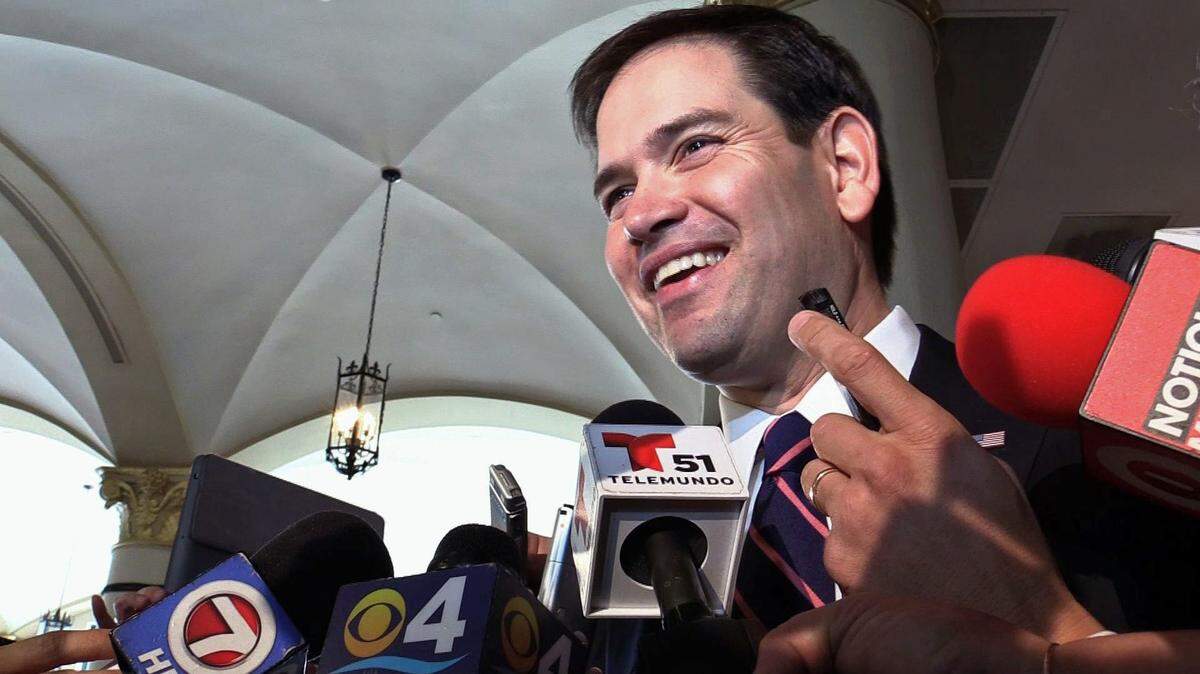
In a move that marks the political transformation not just of Marco Rubio, but of the Republican Party, Donald Trump is expected to pick Florida’s senior U.S. senator to be his secretary of state, the Miami Herald and other outlets reported Monday.
The pick, made just a week after a landmark election victory by Trump, comes with monumental political implications for Florida. If he assumes the office, Rubio must resign his Senate seat two years after voters elected him to a third six-year term. Gov. Ron DeSantis would appoint his replacement. It’s also one of at least two major Florida appointments for Trump: the president-elect also asked U.S. Rep. Michael Waltz to be his national security adviser.
Perhaps most profoundly, the nomination shows how much has changed in Republican politics in the Trump era. Rubio, whom the 45th — and soon-to-be 47th — president once described as a sweaty, big-eared “lightweight,” could now be Trump’s No. 1 voice on foreign policy.
When Rubio has been asked how he came to join forces with Trump, his onetime foe, he’s mostly brushed off the question. Campaigns get heated, he’s said, and 2016 was just another campaign.
A Rubio spokesperson did not respond to a request for comment as of about midday Tuesday.
A review of Rubio’s more than a quarter-century in elected office shows that his willingness to fall in line with Trump is just the latest move in a career centered on ambition. As he climbed from one elected position to the next, Rubio time and again proved a deft politician: nimble on policy, loyal to his political patrons and — perhaps above all — opportunistic.
“I wouldn’t be surprised if he’s governor some day,” then-state Rep. Dennis Baxley, R-Ocala, told the then-St. Petersburg Times in 2007. “Or maybe even president.”
Young, ambitious, conservative
Rubio was a 28-year-old lawyer and city commissioner from West Miami when he was first elected to the Florida House of Representatives in 2000. Within three years, Rubio was the House majority leader, whipping votes and galvanizing support for Republican priorities.
He carried the GOP flag with zeal. In 2003, when the speaker of the state House faced criticism for shelling out for a 13-person communications staff amid budget cuts, Rubio gave a fiery defense of the leader, telling his colleagues not to let “the pundits and editorial boards try to bully us into abandoning our principles.”
Many of those same colleagues elected him speaker three years later.
“People would say, ‘Why are you voting for a member from Miami?’” remembered Aaron Bean, now a U.S. representative from Fernandina Beach who served on Rubio’s leadership team back then. “I would say, ‘You haven’t heard him speak yet.’”
In the months before his first legislative session as the House’s top Republican, Rubio launched an ambitious tour to solicit suggestions from Floridians. He went to each stop with a book titled, “100 Innovative Ideas for Florida’s Future.” At first, the pages were blank. Rubio wanted to fill them at “idearaisers” all over the state.
Fill them he did. Some of the proposals were right out of Republican orthodoxy: requiring a supermajority vote for tax increases, abolishing some Florida agencies. Others, like offering incentives to buy hybrid cars, might seem out of place in today’s party.
So would his mentor at the time, former Gov. Jeb Bush — now an anti-Trump Republican outcast. (On X, Bush called the Rubio pick a “fine choice.”)
“He’s been a huge influence, probably as much as anybody,” Rubio told the St. Petersburg Times during his first legislative session as House speaker.
Mr. Rubio goes to Washington
In Tallahassee, Rubio spent much of his energy appealing to conservative Republicans. He campaigned around the state to keep property taxes low. He endorsed Arkansas Gov. Mike Huckabee, a favorite of Christian conservatives, in the 2008 presidential race. A bill to require pregnant women to get an ultrasound before having an abortion passed his chamber in 2008 before the state Senate killed it.
Almost immediately after the 2008 elections left him term-limited out of Tallahassee, Rubio began to explore a run for higher office. A U.S. Senate seat looked at first like an uphill climb, with even Rubio declaring at one point that then-Gov. Charlie Crist would make the best candidate.
But after Crist, a Republican-turned-independent, embraced Democratic President Barack Obama’s economic stimulus package, a lane opened for a conservative to enter the race. Rubio took advantage.
“In 2010, he could have gone and been a state senator and coasted in and been a lobbyist and made millions of dollars. He put all of that on the line to run for the U.S. Senate. Now it looks easy,” Bean said. ”You’ve got to understand, at the time it was literally David vs. Goliath.”
Rubio’s timing couldn’t have been better. During the Tea Party summer of 2010, Rubio drew passionate crowds at campaign stops across the state. He coasted to the Republican nomination, then trounced Crist in a three-way race. Not yet 40, Rubio was a U.S. senator.
It wasn’t a job he took a particular shine to right away. The Senate, with its preening and partisan gridlock, frustrated Rubio in his first term.
Growing into the job also came with some embarrassment. When his party tapped him to make the Republican rebuttal to Obama’s State of the Union in 2013, a parched Rubio made headlines by awkwardly reaching for water in the middle of the speech. (Rubio now often pokes fun at the gaffe.)
Rubio made a splash with his role in pushing through the Senate an immigration reform bill that would have provided a path to citizenship for some immigrants living in the country illegally.
However, after it became clear that conservatives didn’t support the bill, the senator turned against it. The legislation was never taken up by the House.
With the GOP base, the damage was done. It wouldn’t take long for the effort that may have been his signature policy win to morph into a political liability.
Running in the Trump era
When Rubio announced he was running for president, he looked like a front-runner. An inspiring first-generation American speaker from working-class stock. The conservative answer to Obama. If anyone stood in Rubio’s way, pundits predicted, it was his old mentor Jeb Bush.
But this time, Rubio’s timing was abysmal.
Trump captured the imagination of the Republican voter in 2016 by appealing not to the Republican Party’s multicultural future, but predominantly to its white, nativist present. Trump scored easy political points bashing Rubio over the 2013 immigration reform package, combining policy grievances with more personal attacks about Rubio’s appearance.
Rubio tried to respond in kind.
“He doesn’t sweat because his pores are clogged from the spray tan that he uses,” Rubio said of Trump at one February 2016 rally. “He’s always calling me ‘Little Marco.’ And I’ll admit, he’s taller than me. He’s like six-two. Which is why I don’t understand why his hands are the size of someone who’s five-two ... and you know what they say about men with small hands.”
But it seemed voters only wanted Trump-style personal attacks from Trump himself. Rubio dropped out of the race after Trump crushed him in his home state primary. The senator, who claimed he wouldn’t run again for the Senate, seemed destined to return to private life.
A quieter term
In June 2016, the massacre at the Pulse nightclub in Orlando changed Rubio’s plans, he said. He filed to run for a second term, and in November, carried the state by a far greater margin than did Trump.
With Trump in the White House, few eyes were on Rubio. From his post on the Senate Intelligence Committee, he quietly but steadily established himself as an expert on foreign policy in Latin America, denouncing authoritarian regimes in Venezuela, Cuba and Nicaragua.
As White House scandals mounted, Rubio was neither Trump’s staunchest defender nor a reliable quote for reporters looking for a Republican to criticize the president. Rubio’s icy relationship with Trumpworld thawed.
Rubio’s legislative chops were put to perhaps their greatest test during the coronavirus pandemic. He was instrumental in crafting the $800 billion Paycheck Protection Program, which gave forgivable loans to small businesses that kept staff on the payroll during the worst of the lockdowns. Although the program saw its share of fraud, it also served as a lifeline to thousands of struggling Americans. Rubio has called it the “greatest success story from the pandemic.”
He campaigned on that legislative win in 2022, earning a third term with a blowout over Democrat Val Demings.
Now, Rubio may be signing himself up for the kind of partnership that has proven politically fatal to many seasoned Republicans.
Ironically, Trump has picked Rubio after fulfilling the Floridian’s onetime promise to the GOP: creating a party that appeals to a more diverse electorate.
In the closing stages of the 2024 campaign, Rubio proved to be one of the president’s most enthusiastic campaigners. In the moments after the assassination attempt on Trump in Pennsylvania over the summer, Rubio took to Twitter to offer his support — and his criticism of the way the event was covered in the press.
“God protected President Trump,” Rubio wrote on X.
But even what appears to be a strong partnership comes with risk. Trump’s original secretary of state pick, Rex Tillerson, became a Trump critic after leaving his administration. So have many of the people Trump appointed to similar positions.
Rubio has, at times, been a Trump critic himself. When the former president lost the 2020 election and his supporters stormed the U.S. Capitol, Rubio blasted the riot, calling the perpetrators “unpatriotic,” “un-American” and “low-lives.”
Three years later, as Trump’s secretary of state pick, Rubio will work for the man who has called the people who stormed the Capitol that day “hostages” and “patriots.”
For those who two decades ago saw limitless potential and endless ambition in a young lawyer from Miami, it appears they were right. Rubio’s always done what it takes to get the next job. This could be his greatest test yet.
This story was originally published November 12, 2024 at 5:16 PM.