No more Joe Saunders vs. Moe Saunders: Candidate’s aunt can run, but under new name
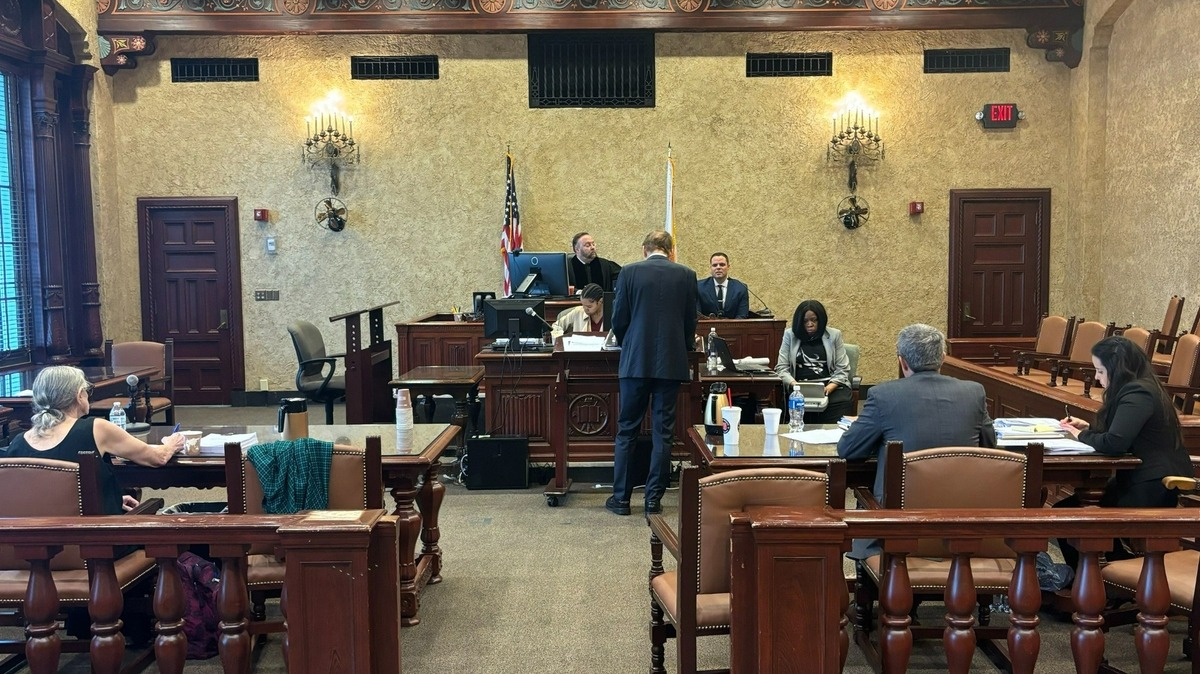
The estranged aunt of Florida House candidate Joe Saunders can stay on the ballot after she filed to run against him under the nickname “Moe Saunders,” but she has agreed to go by a less similar name — Mo Saunders Scott — after a daylong court hearing Thursday.
Miami-Dade Circuit Judge Robert Watson blocked an effort by Joe Saunders’ campaign to have Scott removed from the ballot entirely, saying he doesn’t believe Scott is running “a sham campaign.” The evidence showed that Saunders’ aunt, whose legal name is Maureen Saunders Scott, sometimes goes by “Mo,” and more often spells it without an “e.” Watson seemed prepared to let her remain on the ballot as “Mo Saunders.”
But in a last-minute twist, the judge allowed Saunders’ attorneys to confer with Scott about what name she would be comfortable using on the ballot. Scott, who did not have legal representation, agreed to use “Mo Saunders Scott,” a name that appears less likely to confuse voters as Saunders, a Democrat, seeks to unseat incumbent Republican Fabian Basabe.
Saunders’ lawyers had argued that Scott created her nickname deliberately to mislead the public, noting that Scott has previously gone by the nickname “Mo” but never “Moe.” In an affidavit, she swore she had not “created the nickname to mislead voters.”
“Admittedly, the candidate’s candidacy and campaign is unconventional,” Watson said. Still, he said he did not have strong enough evidence “that her intent was to deceive voters.”
After Thursday’s hearing, Saunders, a former state representative for Orlando who now lives in Miami Beach, told reporters that the outcome “is a win because [Scott] will not appear on the ballot representing as a name that is one letter away from mine.”
Scott, 63, is an aggrieved relative of Saunders, 41, and has made repeated public claims about his character on social media. On Twitter, she has accused Saunders and other family members of failing to speak out about a relative whom she alleges sexually assaulted her in the past.
Saunders testified Thursday that he has tried to support Scott, but distanced himself from her due to her history of “taking really wild swings” at him and other members of his family.
“I believe it is her intention to try to ruin my candidacy this year,” Saunders said.
In June, Scott, who lives near Jacksonville, filed to run as a no-party candidate against Saunders for a Florida House seat that covers Miami Beach and other coastal cities.
State elections officials deemed Scott a qualified candidate on June 13. That day, about a week after Scott had initially filed to run as Maureen Saunders Scott, she filed an affidavit to say that she would be running under the nickname Moe Saunders. Scott’s maiden name is Saunders. She is divorced from a man with the last name Scott.
Saunders sued Scott later that month.
“It was not my intention to deceive,” she told the judge on Thursday.
The primary election for Basabe’s seat is in August, followed by a general election in November in which Scott will appear on the ballot. Basabe will face attorney Melinda Almonte in the Republican primary.
Nickname affidavits became required in Florida under an election reform bill passed last year that came in response to an alleged 2020 “ghost candidate” scheme in which a man was paid more than $40,000 by former Republican state Sen. Frank Artiles to run as a no-party candidate in a Florida Senate race. That case is pending in Miami-Dade Circuit Court.
Candidates wishing to run under a nickname are now required to file a sworn affidavit attesting that they are “generally known” by the nickname or “have used it as part of [their] legal name,” along with a promise that the name isn’t being used to mislead voters.
During Thursday’s hearing, family drama played out in public as Scott spoke about the abuse she says she has faced.
Saunders and one of his uncles also took the witness stand, saying Scott has a history of erratic behavior toward family members and that she had threatened to hurt Saunders’ political career in a November 2023 email after she didn’t receive money from the sale of her mother’s home.
“I prefer to just get what’s mine and go away,” Scott wrote in the email, while telling her siblings to think about their family members who “want to be public figures.”
An attorney for Saunders, former U.S. Attorney for the Southern District of Florida Kendall Coffey, said the email was “evidence of an attempt at extortion.”
Scott testified that, if her family members had simply acknowledged the abuse she previously suffered during the November email exchange, she wouldn’t have filed to run for office against Saunders.
“If my family acknowledged what had been done, I would have gone away quietly,” she said.
When Scott said she would be running as Moe Saunders, it raised alarm bells among Democrats who saw it as an attempt to confuse voters and thwart efforts to unseat Basabe.
Saunders’ legal team highlighted a 2006 ruling in which former state Rep. J.C. Planas succeeded in knocking his cousin off the ballot after the cousin tried to siphon votes from Planas under the name “J.P. Planas” amid a family dispute. Florida’s Third District Court of Appeal said Planas’ cousin had not previously “transacted private and official business” under the name J.P. and therefore couldn’t remain on the ballot.
Saunders was a Democratic state representative in the Orlando area from 2012 to 2014 and was one of the first openly gay members of the Florida Legislature. He is now the senior political director for LGBTQ advocacy group Equality Florida.
READ MORE: Florida candidate Joe Saunders is suing to get his aunt, ‘Moe Saunders,’ off the ballot
_fitted.png "1668230480729 (1)_fitted.png")
After filing suit in June, Saunders’ campaign claimed Basabe and the Republican Party were involved in a “coordinated and orchestrated effort to fool voters” by having Scott on the ballot.
In an opening statement during Thursday’s evidentiary hearing, an attorney for Saunders, Scott Hiaasen, said Scott exchanged messages on Twitter and spoke on the phone with Basabe and told him of her intent to run for House District 106 before she filed to run in June.
Scott said in a deposition that she initially contacted Basabe in hopes of working for his campaign to help him defeat Saunders, and that she and Basabe spoke on the phone multiple times.
But there was no evidence presented Thursday that showed Basabe or anyone else advised Scott to run for office or to use the nickname Moe Saunders.
Basabe, a former New York socialite and reality TV star who was elected in 2022, has denied any involvement in Scott’s campaign. Scott also told the judge Thursday that Basabe never encouraged her to run and that no other candidate or political operative has given her funds.
Scott is registered to vote in St. Johns County and lives in a townhouse she owns outside Jacksonville, about 300 miles from Miami. In court, Saunders’ legal team argued that Scott has no intention of moving to Miami-Dade and that she had never even set foot in the county before Thursday’s hearing.
Florida law says state legislator candidates are only required to live in the district in which they are seeking office once they are elected.
Watson, the judge, said of Scott that there were “many indications here of a serious candidate,” including that she drove twice to Tallahassee to file campaign paperwork and paid a filing fee of near $1,200.
Saunders’ team questioned how Scott, who has admitted to financial challenges, was able to obtain the money for the fee, which she paid in cash.
“Nothing about today changes my belief that there is a scheme afoot and that she has been either coached or coerced to do this,” Saunders said after the hearing.
Watson said that “courts have to be concerned about fraud in campaigns.”
“But on the flip side of that is, in our system, people have a right to present their ideas and their views to the public, to the electorate,” he said, “and we don’t necessarily want to restrict that.”
This story was originally published August 1, 2024 at 9:13 PM.