Suarez can get big campaign checks from the wealthy. Can he get $1 from regular folks?
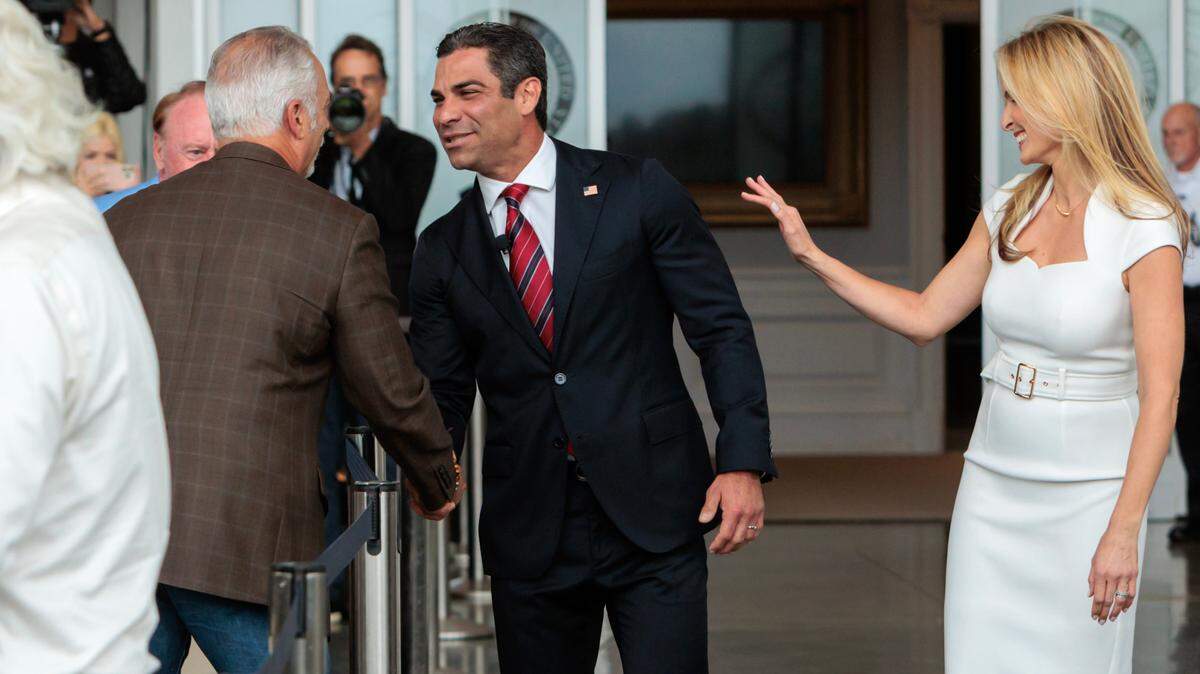
In his local campaigns, Miami Mayor Francis Suarez has had no problem raising millions in political donations through large checks from high-rollers in real estate and tech, some with business before the city. As he runs for the Republican nomination for president, the challenge has not been rounding up deep-pocketed donors, but convincing regular folks to give him $1 each.
He needs 40,000 individual donors, with 200 from more than 20 different states, to qualify for the first Republican primary debate Aug. 23. To get there, he’s raffled off tickets to see Lionel Messi’s debut for Inter Miami, and he’s offering $20 gift cards to people who give him just $1. That might sound like a bad business model, but it’s just an example of how the rules push obscure candidates to meet the debate threshold.
And July 21, the Suarez campaign tweeted he would be raffling off tickets to a Miami concert showcasing Pitbull, Ricky Martin and Enrique Iglesias, only to almost immediately delete the tweet. The campaign hasn’t explained what happened.
On Friday, after this story was published online, Suarez tweeted that he had met the 20-state benchmark, putting him “one step closer to next month’s debate.” The mayor and his campaign have not answered the Herald’s questions about his campaign’s finances. It’s unclear if Suarez is anywhere close to meeting the 40,000 donors threshold, though in a television interview Friday, he said he thinks he’ll hit that mark within 10 days.
He did not say how many individual donors he has so far, and he declined to share specific numbers in another recent TV interview.
On a live Fox News Business broadcast July 19, the mayor was asked how many dollars he had raised through the Inter Miami raffle. When Suarez said he didn’t have an exact number, host Stuart Varney pressed him for an estimate.
“It’s a lot,” the mayor said, prompting Varney to chuckle. “It’s in the thousands for sure.”
Sean Foreman, a political science professor at Barry University who has watched Suarez‘s political career, said the the fundraising strategies could signal trouble for the campaign.
“It’s a gimmick. It’s a sign of desperation,” Foreman said. “How else can you explain giving away $20 in exchange for $1?”
Gift-card campaigns, which did not originate with Suarez, have raised a “big red flag” for longtime election attorney Paul S. Ryan, who told told the Herald the tactics could violate a federal election law that bans straw donors. Ryan said Suarez is essentially contributing to his own campaign through people who receive gift cards. Those people could be seen as straw donors.
“I’m concerned about the precedent this sets because the Federal Election Commission may have a hard time getting the straw-donor genie back in the bottle.”
One expert said the gift-card tactic, which was also employed this campagn cycle by North Dakota Gov. Doug Burgum — a billionaire who says he has since met the 40,000-donor benchmark — distorts the value of political donations and how they measure support for candidates.
“This type of scheme is bad for our democracy because it involves a candidate using their wealth (or that of their wealthier donors) to manipulate our political system,” wrote Saurav Ghosh, director of federal campaign finance reform at Campaign Legal Center. “Political contributions — especially from small donors — are a longstanding way to gauge political support and this type of stunt undermines that.”
In a NewsNation interview Friday, Suarez said that because he entered the race late, he’s had to find ways to quickly meet the Republican National Committee’s debate qualifications. In response to critics, he said candidates are being “innovative” to meet benchmarks that prioritize small donors,
“That’s something that’s healthy for democracy,” Suarez said. “Before, as you know, most fundraising done was behind the scenes, in ballrooms, where sometimes people would be embarrassed when they were recorded for trying to say things to donors that they wouldn’t say in public.”
READ MORE: FEC is asked to investigate $500K to PAC backing Francis Suarez from Chinese straw donor
To make the Aug. 23 debate in Milwaukee, the mayor has to meet the Republican National Committee’s criteria to qualify by Aug. 21.
And he faces another obstacle.
Suarez needs to reach 1% in three national polls or in two national polls plus two separate polls from states with early primaries or caucuses. According to opinion poll analysis website FiveThirtyEight, Suarez has reached 1% in only one poll, a Fox News Business survey of Iowa voters. He’s under 1% in major national polls, according to poll data aggregator RealClearPolitics.
While he campaigns in Iowa and New Hampshire, the mayor has faced a swirl of scrutiny in Miami, including over a business arrangement with a real estate developer who paid him at least $170,000 in consultant fees while seeking approvals from the city.
Foreman suggested the headlines haven’t helped.
“Since the day he announced, it’s been nothing but bad news, and most of it he should’ve anticipated coming out,” Foreman said.
This article has been updated with information from a Friday television interview.
This story was originally published July 28, 2023 at 8:38 AM.