
Emboldened DeSantis wants to expand ‘inadequate’ immigration policy he once championed
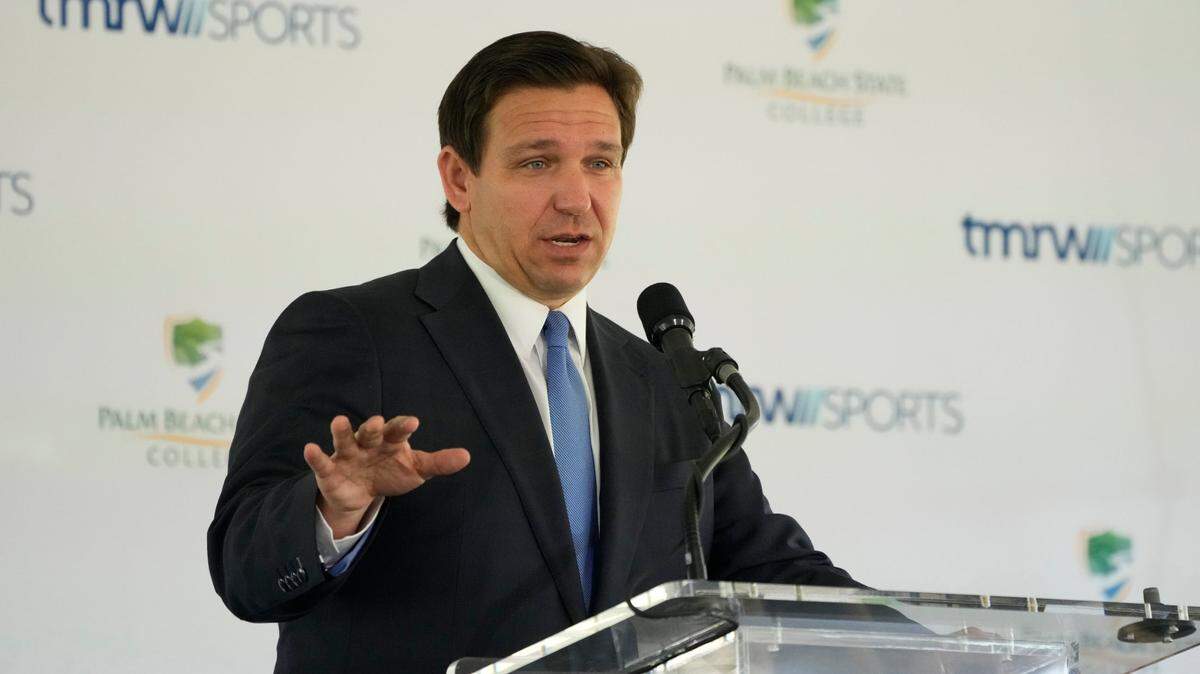
Gov. Ron DeSantis on Thursday revived a push to adopt more stringent hiring protocols to prevent the employment of undocumented workers, acknowledging that a state law he championed during his first term in office has been ineffective.
Florida law currently requires all government employers and their contractors to use a federal electronic system, known as E-Verify, to check the immigration status of new hires. DeSantis, however, says the mandate should be expanded to include all private employers in the state, saying the current law was a “compromise” reached by the Legislature following pushback from Florida’s agriculture, tourism and construction industries.
“We ended up with a compromise version that was inadequate,” DeSantis said at a press conference in Jacksonville.
Now, DeSantis wants the Republican-led Legislature to help him deliver on the promise he made to voters when he first ran for governor in 2018. After overwhelming Republican victories in 2022, DeSantis argued, the “political context” is working in his favor this time around.
“Now, we have super majorities in the Legislature,” DeSantis said. “We have, I think, a strong mandate to be able to implement the policies that we ran on and these are policies that I’ve been for since the day I became governor over four years ago.”
READ MORE: Florida Legislature votes to send weakened E-Verify bill to DeSantis
The E-Verify proposal is part of a larger immigration package that DeSantis is building ahead of a possible run for the Republican nomination for president in 2024, and that he is expected to use to attack President Joe Biden’s immigration policy to reach conservative voters not just in Florida, but on a national level.
To further bolster his immigration platform, DeSantis wants, among other things, to ban out-of-state tuition waivers at colleges and universities for undocumented students and prohibit local governments from issuing identification cards to migrants.
READ MORE: Florida Gov. Rick Scott signs bill to give in-state tuition to undocumented students
DeSantis, as usual, announced the immigration package at a news conference and outlined the broad policy proposals in fliers. Because no legislation has been filed, the details of the proposals remain murky and it is unclear what state lawmakers will be considering during the 2023 legislative session, which starts March 7.
Sen. Blaise Ingoglia, a Republican from Spring Hill, will be the sponsor of the proposals. At the press conference, he said the governor’s proposal should be an example for the rest of the country.
“It is so bold that it should be the blueprint for the other 50 states,” Ingoglia said. “Because the only way the federal government is going to react is when the states finally push back.”
Immigration crackdown record
The proposals unveiled at the press conference are in line with DeSantis‘ political stance on undocumented labor and immigration, even though in practice, his own administration has at times struggled to fully abide by those standards.
Records and reporting from the Times/Herald show that in at least two instances, the DeSantis administration has paid contractors that paid undocumented workers to get the job done.
The administration has maintained its contractors follow “strict hiring procedures,” such as E-Verify, to ensure undocumented workers are not hired. Reporting, however, shows that a Venezuelan migrant unable to legally work in the United States was paid to help DeSantis’ migrant flight program.
The administration also continued to pay more than $8 million to a construction company after authorities found it had hired several undocumented workers — including two men who have been charged in connection to the death of a Pinellas County deputy. The administration defended the contractor, who said federal hiring guidelines were followed and that both individuals arrested were “processed and authorized for employment through the federal E-Verify system.”
At the press conference, DeSantis said the E-Verify law he championed in 2020 has allowed the state to hold some employers accountable, but said “it hasn’t been effective enough.”
Under the law, private businesses that do not use E-Verify and who do not contract with a public employer are required to keep a three-year record of the documents employees use to complete “I-9” forms, which the federal government uses to verify workers’ identities and legal eligibility to work in the U.S.
Federal law already requires businesses and workers to fill out the forms. DeSantis said the state has been able to hold some businesses accountable through audits.
The Florida Department of Law Enforcement recently told a legislative committee that it was seeking $1 million so it could hire 11 more workers to conduct E-Verify audits. The agency has flagged 4,200 businesses for audits, but it has not responded to requests seeking comment on whether those employers were singled out for a potential violation or a routine review.
Repealing his Lieutenant Governor’s efforts
One of the governor’s immigration proposals would roll back a policy that Lt. Gov. Jeanette Núñez backed in 2014 to offer in-state tuition for undocumented students at Florida colleges and universities.
Former Gov. Rick Scott signed the measure into law and enlisted the help of two former Republican governors, Jeb Bush and Bob Martinez, to push the measure through the Legislature. “Dreamer” students, who were brought to the U.S. illegally as children, were a frequent presence in the state capital as the measure was considered by lawmakers.
Now, DeSantis wants to remove that option.
“Why would we subsidize a non-U.S. citizen when we want to make sure we can keep it affordable for our own people,” DeSantis said.
This story was originally published February 23, 2023 at 11:54 AM.