
‘A butter knife into a machine-gun fight’: Democrats blame Florida blowout on cash woes
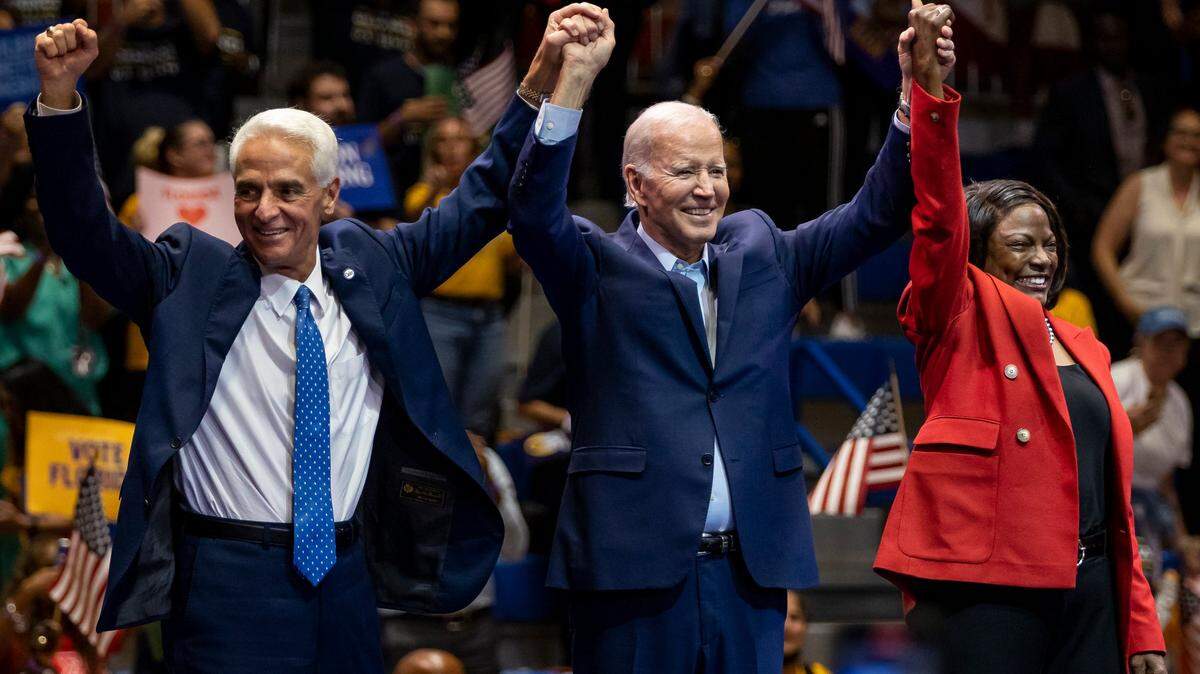
A Florida Democratic Party bracing for a difficult Election Day was still shocked — and embarrassed — by Tuesday’s historic blowout defeat.
Leading party operatives say there’s at least one simple explanation for the drubbing: The party didn’t have nearly enough money.
A deliberate decision from deep-pocketed liberal donors and outside groups to divest from the state this election cycle led to a massive spending disparity with GOP Republicans, strategists say, and turned a swing state already trending Republican into a deep-red stronghold.
It’s not the only reason for the party’s failure in Florida, they emphasize, but it does explain why the election results for Democrats this week were exponentially worse than in previous years.
“What people were expecting folks in Florida to do is to take a butter knife into a machine-gun fight,” said Raymond Paultre, executive director of Florida Alliance, a network of progressive donors. “And it will never work.”
Paultre said a preliminary estimate from his group found that, when including state legislative races, independent groups, and statewide contests, Republicans spent $350 million this election cycle, led by GOP Gov. Ron DeSantis.
The Democrats’ lack of spending, in turn, throttled the party’s turnout operations in cities and other urban areas, leading to a massive shortfall in votes for the party’s candidates.
Democratic gubernatorial nominee Charlie Crist received about 3.1 million votes, or nearly a million fewer votes than the party’s 2018 nominee, Andrew Gillum, received. Florida Senate nominee Val Demings didn’t fare much better, receiving nearly 3.2 million votes, roughly 900,000 fewer votes than 2018 Senate nominee Bill Nelson won.
“Democrats just did nothing. They did not come out to vote,” said Sean Shaw, the Democratic nominee for attorney general in 2018. “And we gotta ask ourselves, why? We gotta roll up our sleeves and ask how we fix that.”
Shaw added that the turnout shortfall appeared to include Black voters, despite the presence of an African-American woman on the ticket in Demings, and cited the deficit as proof of how the party’s lack of investment in turnout efforts hurt.
“Sometimes there’s a thought that if there’s a Black person on the ticket, that takes care of Black turnout,” he said. “I hope that we’re past that now.”
BAD LOSSES
Democrats’ failures in this year’s election are the most recent in a string of setbacks for the party in recent years, losses that have thrown into question whether Democrats, led by President Joe Biden, will even bother to compete in Florida during the 2024 presidential election.
The party’s pre-existing skepticism about Florida’s competitiveness led grassroots organizing groups to announce earlier this year that they would be pulling back on voter registration efforts in the state, and helped explain why Crist’s fundraising lagged despite his foe’s national prominence, and why well-funded outside groups didn’t help Demings even as her own campaign raised big money.
Democrats say the lack of funding at least partially explains why DeSantis will win by nearly 20 percentage points, despite barely winning in 2018, and why GOP Sen. Marco Rubio roughly doubled his margin of victory from 2016. The wins came even as Democrats nationally over-performed expectations in the 2022 midterms, winning an array of battleground Senate and governor’s races in which the GOP was favored.
“A lot of the scale of the loss can be attributed to the fact that Democrats didn’t have money to get out a message,” said Joshua Karp, who worked for Crist’s campaign and is a longtime party operative in the state. (Karp said he was not speaking for the Crist campaign in this story.)
READ MORE: DeSantis rewrote the political map in Florida. Will the changes be permanent?
According to Karp, DeSantis spent about $17 million on TV and radio ads in Miami alone, or the total amount Crist spent throughout the state.
DeSantis, through his campaign and political action committee alone, spent about $130 million in total in 2021 and 2022. A lot of that money, Karp added, was spent on issue-focused ads that boosted not only the governor’s campaign but state legislative candidates down the ballot, who were running on the same issues.
“Republicans had the money to make their arguments, and they did so very clearly and very loudly for a good four months,” the strategist said.
Democrats registered surprise that Demings, widely considered the party’s best Senate candidate in years, performed only marginally better than Crist, earning a little over 41% of the vote to her gubernatorial counterpart’s 40%.
“Val Demings is built in a lab for how to energize, or theoretically energize the party and go across the aisle,” Paultre said. “And we lost by 18 points.”
The progressive organizer said Demings’ profile or message as a candidate wasn’t the main problem.
“It’s not messaging,” Paultre said. “It’s year-round operations and infrastructure at scale to compete.”
CAVEATS
Many Democrats, of course, acknowledge that the party’s problems run deeper than a shortfall of money in a single election cycle. The party has had more resources in the past and still lost elections, and some liberal operatives acknowledge that Florida Republicans have made serious inroads with the state’s Latino and Black voters through an aggressive and well-funded outreach effort of their own.
The lack of money didn’t help, said Democratic state Sen. Jason Pizzo, but even if the funding had been even, he said he wasn’t sure it’d have led to victories at the top of the ticket.
“I don’t know that even if Charlie and DeSantis had gone dollar for dollar, that Charlie would have won,” Pizzo said.
The senator noted how even a lawmaker with his background, as a former assistant state attorney in Miami-Dade, found himself wrongly criticized as a Democrat who supports defunding the police. When Republicans repeat the message enough, he said, it starts to stick with voters no matter the truth.
The senator said he also wasn’t sure the Florida Democratic political organization would know how to efficiently and quickly spend the money, even if it did receive an infusion of cash.
“I don’t know if they would have recognition in real time where to spend those resources,” Pizzo said.
Other Democrats were more blunt in their assessment of Crist, a former Republican governor who has now lost two gubernatorial elections as a Democrat and a Senate race as an independent in the last dozen years.
“Nominating Charlie was giving up,” said Kevin Cate, a Democratic strategist in Florida.
Demings, for her part, outraised and outspent Rubio but still managed to do only marginally better than Crist.
“It’s bad,” Shaw said. “You wouldn’t be being realistic if you were to come around from Tuesday and not be upset if you’re a Florida Democrat.”
This story was originally published November 11, 2022 at 5:00 PM.