
Judges say new courthouse and district aren’t needed. Legislature is doing it anyway
.jpeg "A judge’s gavel.")
State lawmakers are preparing to carve out a new appellate court district based in the hometown of the Senate’s powerful appropriations chairperson, giving Gov. Ron DeSantis the chance to appoint seven new conservative judges.
Although the number of appeals court cases in Florida is at the lowest point in years, lawmakers have agreed to spend $50 million on a new courthouse and at least $4 million more each year on judges and support staff.
Appellate judges themselves say a new district is not needed. But proponents of the plan argue that adding a district will increase public confidence and provide Jacksonville better representation on the bench.
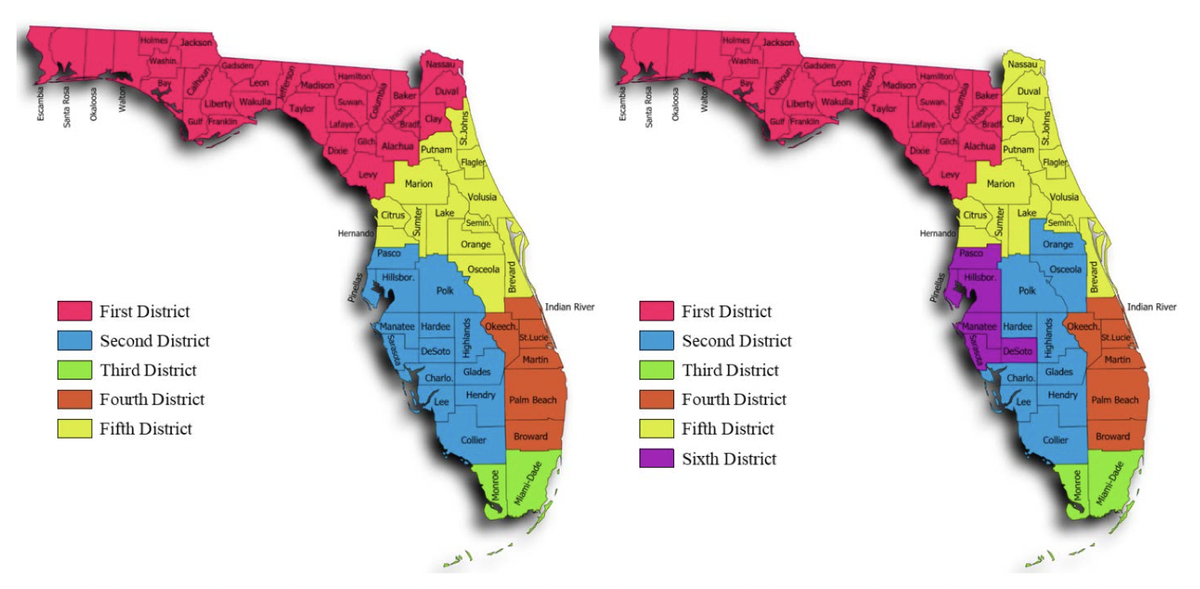
The new court district and its seven judges, appointed by DeSantis, would stretch from Orange County through the middle of the state to Collier County.
Although the deal has yet to be finalized, the new court is likely to be based in Lakeland, the hometown of Senate Appropriations chairperson Kelli Stargel and her husband, John Stargel, an appellate court judge who lives 35 miles from the new courthouse in St. Petersburg.
The proposal has sailed through the Legislature this year with little debate or opposition.
Support from high places
That’s in part because the deal has powerful supporters. As head of the Appropriations Committee, Stargel has considerable power over crafting the state budget. The idea has also been endorsed by the Florida Supreme Court’s chief justice, Charles Canady, who is also from Lakeland and whose wife, Jennifer, is running for the House of Representatives as a Republican representing the area.
Lakeland used to be the site of the Second District’s courthouse, but it fell into disrepair and was closed in 2016. Nearly all the court’s business is being held in a rented space near downtown Tampa.
Last year, House Speaker Chris Sprowls, R-Palm Harbor, all but promised that Stargel would get her courthouse.
Last legislative session, Sprowls and Stargel had a rare intraparty clash over a new $50 million courthouse for the Second District Court of Appeal. Stargel tried to have it built in Lakeland, and Sprowls, a former prosecutor, wanted it built in St. Petersburg and named after one of his mentors, the late Pinellas-Pasco State Attorney Bernie McCabe.
Sprowls won out last year, but afterward, he said in a statement that Stargel’s “long-term vision for addressing the judicial needs of [Polk County] will be realized.”
Twelve days later, Canady created a working committee of judges and lawyers to evaluate the workload of the state’s appellate judges.
Florida’s appellate judges handle appeals in civil and criminal trials across the state. Since 1979, the state has had five appellate districts, each with a courthouse, judges and staff. There are currently 64 district appellate judges spread across the five districts.
Working group says it’s unnecessary
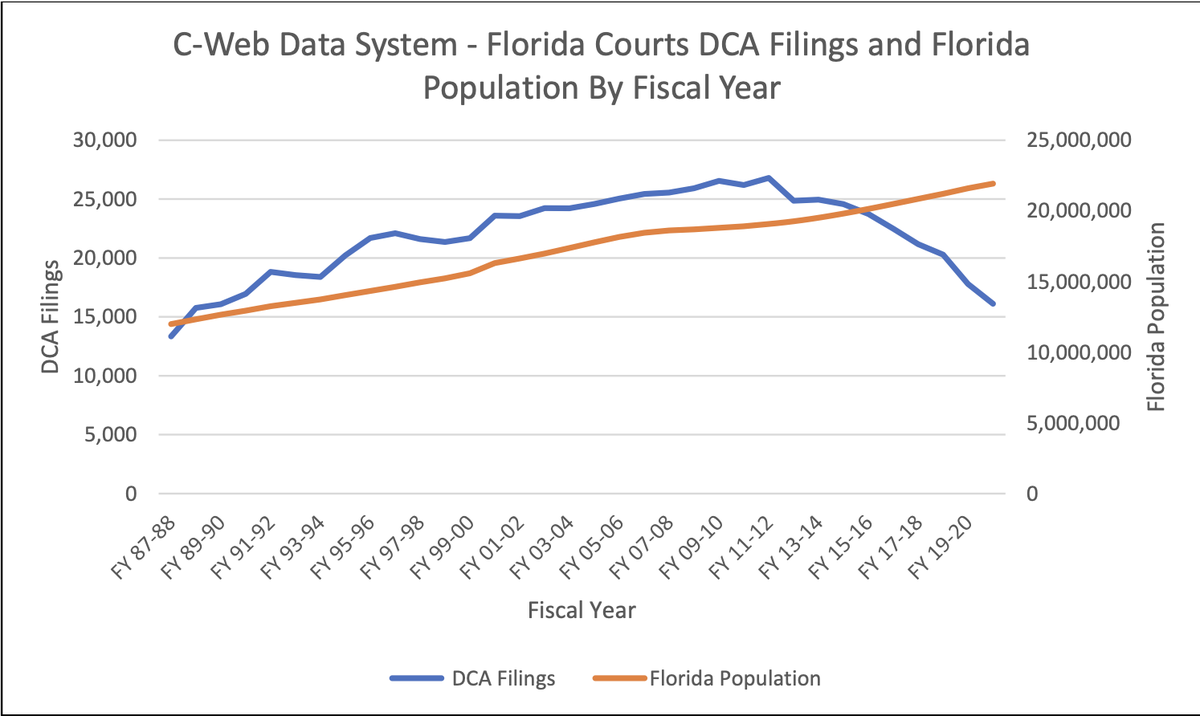
The last time the Supreme Court convened a committee to evaluate appellate court workload was in 2006. At the time, appeals court cases were on a sharp rise, but the working group found there was no “compelling need” to create a new district.
When the Supreme Court’s working group met last year, appeals were in sharp decline. Since the 2011-12 fiscal year, criminal appeals cases have fallen 30%, while civil cases dropped 19% between 2014-15 and 2018-19, according to the working group’s final report.
Despite the numbers, a majority of members on the working group recommended creating at least one more new district.
“The primary rationale for the recommendation,” the majority wrote, “is that creation of an additional [District Court of Appeals] would promote public trust and confidence.”
But the only people who seem to be aware of the appellate court’s existence are other lawyers, said Blaise Trettis, public defender for Brevard and Seminole counties who served on the working group.
“It didn’t make any sense to me,” Trettis said.
Trettis joined four of the five appellate judges on the working group to recommend against the new district. (The other appellate judge on the group did not vote.) The five district chief judges also wrote that the new district wasn’t needed.
“There is no need to increase, decrease, or redefine appellate districts,” they wrote.
But Canady and the majority of Florida’s Supreme Court justices disagreed.
They wrote the new district and corresponding judges were needed, in part, because judges from Jacksonville suffered from “serious under representation” on the First District Court of Appeal, which stretches from Jacksonville to Panama City.
They wrote that only two of the 15 judges on the First District, or 13%, were from the Jacksonville area, even though the area made up 29% of filings for the district. “Even more striking,” they added, the Jacksonville area made up 37.5% of the population in the district.
Ricky Polston, the only dissenting justice, wrote that their reasoning was flimsy.
“No additional district court of appeal judges are needed,” Polston wrote in a follow-up opinion. “None.”
He wrote that the Supreme Court’s standards for redistricting are based on court filings, not population. And cases from Duval County — not other counties — showed that at most the court needed one or two more judges from Jacksonville, which the court could create and appoint without creating an entirely new district.
Polston also noted that judicial rules require the justices to consider less disruptive adjustments. Creating an entirely new district is “analogous to rebuilding a ship for what should be swapping out a couple of deck chairs at most,” he wrote.
And Polston wrote that the problem with the lack of Jacksonville judges was because the governor had not chosen them for the court — something out of the court’s control.
$50 million to buy ‘public confidence’
The Supreme Court’s endorsement provided the impetus for the Legislature to fund the new appellate district this year. House Bill 7027 has already passed the House, and the details are up to negotiations between the House and Senate. Both chambers have already agreed on $50 million for a new courthouse.
During one of the bill’s two committee stops, Rep. Tommy Gregory, R-Sarasota, repeated that the new court would boost “public confidence,” because appeals would not take as long with more judges.
That would help Floridians who can’t afford to keep attorneys on the rolls for a year, said Gregory, an attorney.
“You cannot have law and order if the public loses confidence in their cases,” Gregory said. “A vote for creation of a sixth [appellate district] and the additional judges is really a vote for the little guy in the system, who may be up against somebody with deep pockets.”
This story was originally published March 8, 2022 at 10:34 AM.