
Dark money group seeks to block disclosure of donor names in ghost candidate probe
Lawyers for a dark money group run by a prominent Republican operative asked a Miami circuit court judge Monday to block the release of bank records that would disclose its donors, arguing that the release of such information would violate donors’ constitutional rights and could “chill speech across the political spectrum.”
In a 12-page motion, lawyers for Let’s Preserve the American Dream, a Tallahassee-based nonprofit organization run by Ryan Tyson, argued that the bank records must remain secret because they contain privileged information protected by the First Amendment and Florida’s criminal procedure rules.
“Similarly, in today’s highly-charged political climate, LPAD’s donors could face reputational and economic harm as a result of their association being made public,” the lawyers argued. “And, on a broader scale, disclosure in this case could chill speech across the political spectrum, as donors to other nonprofit organizations may choose to forgo future donations out of the fear that their association may one day be made public.”
The bank records were obtained by investigators who are examining potential election and campaign finance law violations stemming from a 2020 Miami-Dade election scheme. Investigators are also looking at $550,000 in untraceable money that paid for political mail advertisements in support of the sham candidates involved in the scheme.
The half a million dollars in spending was paid for by another dark money group, Grow United. According to a 2020 tax return obtained by the Orlando Sentinel, Tyson’s group reported that it gave $1.15 million to Grow United in 2020.
The Sentinel later reported that records show Tyson instructed an accountant and banker to wire Grow United $600,000 on Sept. 29, 2020.
Days later, Grow United sent $550,000 to the two political committees that paid for the advertisements.
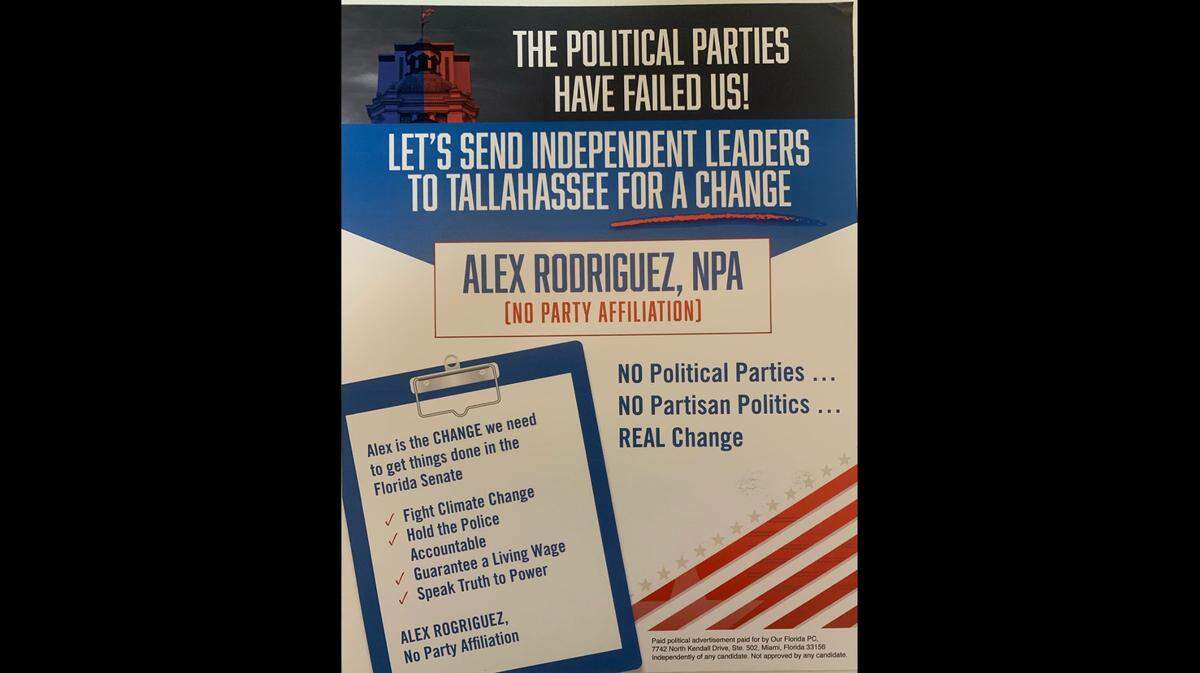
No charges have been brought against Tyson or his dark money organization, and neither have been accused of wrongdoing, his lawyers said. They also said that Tyson voluntarily appeared for an interview with prosecutors to “demonstrate that LPAD complies with all state, federal and local laws.”
Unlike political committees, which are legally required to disclose their donors, dark money groups are not required by law to do so, which makes them useful for funders who don’t want their identities revealed when backing certain campaigns or causes.
Dark money groups also don’t have spending limits as a result of the Supreme Court’s 2010 ruling in Citizens United v. Federal Election Commission, which reversed campaign finance restrictions. These groups are used by Republicans and Democrats alike.
A broad investigation
Let’s Preserve the American Dream is not the only target of prosecutors amid the ongoing investigation in Miami.
Prosecutors have also targeted Alex Alvarado, a Republican consultant; Dan Newman, a prominent Democratic fundraiser; and Richard Alexander, the chairman of the dark money group Grow United.
On Dec. 23, 2021, each was sent what is known by prosecutors as a “prior to” letter, which generally precedes criminal charges in a case. As of Monday, no charges have been filed.
Prosecutors last year filed charges against Frank Artiles, a Republican operative and former Miami state senator, and auto-parts dealer Alexis Pedro Rodriguez, who investigators say was paid more than $40,000 by Artiles to run as a no-party candidate to sway the outcome of the 2020 Miami-Dade Senate District 37 election.
Both men were charged with conspiracy to make or accept campaign contributions in excess of legal limits, accepting and making those excess campaign contributions, false swearing in connection to an election and aiding in (and eventually, submitting) false voter information. Under state law, each of those charges carry sentences of up to five years in prison if convicted.
Both pleaded not guilty in April and asked for jury trials. In August, Rodriguez took a plea deal and agreed to help prosecutors build their case against Artiles, the man who recruited him to run for office. In exchange for his guilty plea, Rodriguez will serve three years’ probation, including one year on house arrest with a GPS monitor.
Lawyers for Tyson’s organization argue bank records that would show donations and contributions from Let’s Preserve the American Dream, from February 2020 to August 2021, are “irrelevant” to Artiles’ case.
They further argue that the release of the records would only benefit reporters who “continue publishing fanciful stories insinuating that LPAD and Mr. Tyson participated in criminal conduct.”
Lawyers for the Miami Herald, along with several other news outlets, filed motions to intervene in previous arguments to protect records in this case.
The lawyers representing the media confirmed Monday that they would oppose Tyson’s motion.
Donors’ secrecy
Ian Vandewalker, a senior counsel for the Democracy Program at the Brennan Center for Justice, said it makes sense why a 501(c)4 would prioritize protecting its donors, noting that politically active groups like Let’s Preserve the American Dream may explicitly pitch to donors that their names would be kept secret.
“Some of the big super PACs at the national level have another organization that is the same people, just another piece of paper,” said Vandewalker, whose work addresses the influence of money in politics and foreign interference in U.S. elections. “They say, ‘You can give to us and we’ll disclose or you can give to the 501(c)4 and we won’t.’ ”
Up until 2019, Tyson served as vice president of pro-business lobbying group Associated Industries of Florida, which has denied being involved in the committees.
“LPAD has already faced reputational and economic harm as a result of news articles about the State Attorney’s investigation, and it is likely that disclosing the bank records similarly would lead to interference with LPAD’s donors’ freedom to associate,” the lawyers said.
Other court records revealed in the case show Tyson’s group paid Artiles’ Atlas Consultants more than $125,000 for “South Florida research services” dating to 2017, just a few months after Artiles resigned from the state Legislature for using a racial slur in front of Black colleagues.
The last payment to Artiles’ firm from Let’s Preserve the American Dream was Nov. 15, 2020, three days after the Democratic incumbent in Senate District 37 lost in a manual recount.
In a statement, Tyson said his group terminated its relationship with Artiles after his arrest in March 2021, and that neither he nor his group “had any knowledge of the allegations now being made against Senator Artiles.”
Artiles’ case underway
Last month, Artiles’ lawyers asked a Miami Circuit Court judge for the second time to hold back releasing the potential evidence to the public because it would infringe on his right to a fair trial and violate the privacy rights of people like Artiles’ wife and daughters.
A similar protective motion was filed by Artiles’ lawyers in May. The Miami Herald, along with several other news outlets filed motions to intervene and in July, Judge Andrea Wolfson — who did not preside Thursday — granted parts and denied parts of the motion.
Miami-Dade State Attorney Katherine Fernández Rundle’s office launched an investigation into “possible election violations” in the race to represent Senate District 37 a few days after the November 2020 election, and arrests were made in March.
Rodriguez was cooperating with state investigators around the same time that the Herald found through several sources that Artiles had recruited and publicly bragged about planting Rodriguez as a no-party candidate in the race.
While Artiles’ case is playing out in court, investigators are also continuing to look into who was behind the dark money that paid for deceptive political mail advertisements that promoted Rodriguez’s candidacy and no-party candidates in two other Florida Senate races.
Last month, prosecutors sent prominent Republican and Democratic operatives in Florida what is known as a “prior to” letter, which generally precedes criminal charges in a case.
Legal experts say the letters are sent to the targets of a state or federal investigation to notify them that they could face criminal charges in the future or to give them a chance to present their side of the story.
This story was originally published January 10, 2022 at 6:30 PM.