
Midnight madness: A flurry of back-room deals before lawmakers settle on $79 billion budget
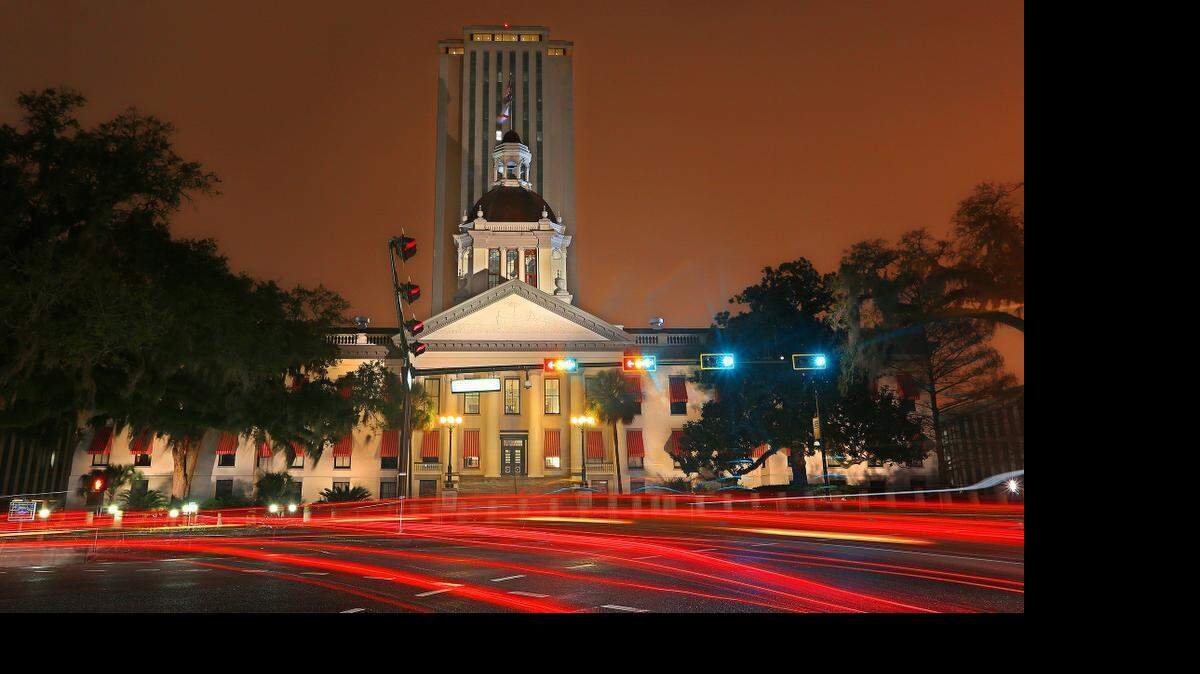
They were running out of time, but they weren’t out of money yet.
Florida legislators finished work on a $79 billion state budget in a final flurry of spending, emerging from behind closed doors near midnight Monday with long lists of hometown projects and provisions tilted to favor vendors.
It’s the Capitol’s version of Midnight Madness.
“This is the democratic process,” said Senate Appropriations Chairman Tom Lee, R-Brandon. “We’ve been under a lot of pressure up here to get a budget done. We’re racing against the clock a little bit.”
At 11 p.m. Monday, as the Tampa Bay Lightning’s dream of a Stanley Cup faded away, local bars emptied and a Capitol committee room swelled with lawmakers and lobbyists, some of them still clutching Styrofoam cups.
Then the paperwork began flying, as fast as a hockey puck.
One legal-size handout, then six, then 12 and finally 15 — 90 pages totalling $300 million in spending and policy, shaped in private by a relative handful of lawmakers and rushed to passage in 20 minutes.
The proposed budget has language creating a $500,000 online education program by a specific Pensacola vendor, allocating $1 million to promote the beef industry and requiring the state to buy more police radios from Harris Corp. as its lucrative contract nears renewal.
The spending plan now awaits a ratification vote by lawmakers on the last day of a special session Friday and then a review by Gov. Rick Scott.
“This is our budget. I’m going to stand here and own it,” Lee said. “We were as transparent as we could be.”
Lawmakers called it the result of give-and-take in which each side respected the other’s priorities.
Back-room horse-trading on parochial projects is nothing new in Tallahassee. But stunned lobbyists, buried in paperwork, sat on the floor of a committee room attempting to make sense of it like children frustrated by a Rubik’s Cube puzzle.
Legislative leaders insist that they and not bureaucrats know how to best allocate taxpayers’ money because they understand the needs back home, and they traditionally hoard a secret stash of public money as a cushion to resolve differences and fund the wish lists of favored members.
The Legislature will give $2 million to IMG Academy, a private, for-profit sports factory in Bradenton with a powerful cheerleader, House Speaker Steve Crisafulli.
Backed by a team of well-connected lobbyists, IMG, which received $7.3 million from the state in the past two years, charges students more than $70,000 a year in tuition to excel at golf, tennis, soccer and football, and it trains pro athletes in the off-season — such as Carolina Panthers quarterback Cam Newton, who recently signed a $103 million contract extension.
“It’s a great economic development project for the state and provides quality academic and athletic opportunities for young people striving for a bright future,” said Crisafulli, a Merritt Island Republican.
While legislative rules require local projects to be vetted through local hearings and the budget-making process, IMG never had to withstand such scrutiny. The House slotted $50,000 for the project on Saturday, and it ballooned to $2 million Monday with no public explanation or documentation for how IMG will spend the money.
Senate President Andy Gardiner, R-Orlando, used his power to secure $3 million for a performing arts school at Dr. Phillips High in Orlando, as well as tens of millions of dollars for programs for people with special needs.
The last-minute projects came after Gardiner had warned that money was especially tight because of the need to spend $400 million in tax revenue to shore up the loss of federal money in the low-income pool for hospitals.
“We’re in a new world order now,” Gardiner said. “When you take over $400 million out of the budget and put it into healthcare, there’s going to be impact.”
A $500,000 grant to the Urban League that had been quietly mumbled into the budget over the weekend swelled to $2 million — with no explanation.
Projects that were rejected two days earlier in budget areas that had been closed out suddenly sprang back to life, like a $1 million appropriation for expansion of the Charlotte County Justice Center. Nearly $7 million for student uniforms in public schools appeared — a priority of Crisafulli in the regular session in March.
The budget has hundreds of millions of dollars in stormwater projects, beach renourishment, museums, performing arts centers and programs for rape victims, the blind, the elderly and veterans.
A flood of water projects ran for four pages and totaled $70 million. Enterprise Florida, the public-private job creation agency that complained of being short-changed by legislators, got another $8.5 million to market Florida and $11 million more in incentive money.
When it was over, lawmakers outside the loop struggled to understand what had happened.
“It’s a process that never has been designed for anybody to have the opportunity to get down into the nuts and bolts,” said Senate Democratic Leader Arthenia Joyner, D-Tampa.
Some Democrats shared in the budget bonanza as Rep. Darryl Rouson, D-St. Petersburg, secured $300,000 for a day of service project named in memory of his father, Dr. W. Ervin Rouson, at St. Petersburg College.
Monday night’s orgy of “supplemental funding issues” almost seemed to dare the governor to sharpen his veto ax.
The Legislature cannot approve the budget before 5:37 p.m. Friday. If it’s immediately delivered to Scott, he would have 11 days to dissect its 438 pages. This is the latest the Legislature will have passed a budget since 1992.
Surrounded by reporters, the two budget chairmen, Lee and his House counterpart, Rep. Richard Corcoran, R-Land O’Lakes, defended the result.
“If you talk to members, I think they would tell you that we were very open, very transparent, more than in any years previous,” Corcoran said. “This is the way government should work.”
A few minutes later, Corcoran waved goodbye to a throng of reporters.
“It’s 11:45, and I’ve got six kids,” Corcoran said. “I wish you all a good night.”
Herald/Times reporter Michael Auslen contributed to this report.
Contact Steve Bousquet atbousquet@tampabay.com or (850) 224-7263. Follow @stevebousquet.
Hometown projects, lots of money
The state budget is full of projects that pump money into lawmakers’ districts. Some are relatively small — $50,000 here and $100,000 there — but others represent massive state investments.
Here are some of the largest South Florida projects in this year’s proposed budget:
▪ Mt. Sinai Medical Center, $4 million
▪ The SEED School of Miami, $2 million
▪ Improvements to the Ludlam Trail Corridor, $3 million
▪ Land acquisition at Florida International University, $5 million
▪ Cultural facility in Opa-Locka, $1 million
▪ Infrastructure improvements for the Miami Design District, $1 million
▪ Military Museum of South Florida, $1 million
Source: Florida Legislature
This story was originally published June 16, 2015 at 9:09 AM with the headline "Midnight madness: A flurry of back-room deals before lawmakers settle on $79 billion budget."