Coronavirus fears catch up to Florida legislators on final day
As Florida legislators spent most of the final regular day of the legislative session scrambling to piece together a $300 million contingency plan to address the novel coronavirus, bills died, the budget shrank and legislators worried.
In the end, after ignoring the coronavirus for the past month, legislative leaders succumbed to the threat of the contagious scourge and revamped their budget, then scheduled an overtime session to finish their financial work.
House and Senate leaders announced they will continue to negotiate the $92 billion spending plan and complete it by Saturday, which would start the constitutionally required 72-hour waiting period before a final vote could be taken. They plan to return to take a final vote by Friday.
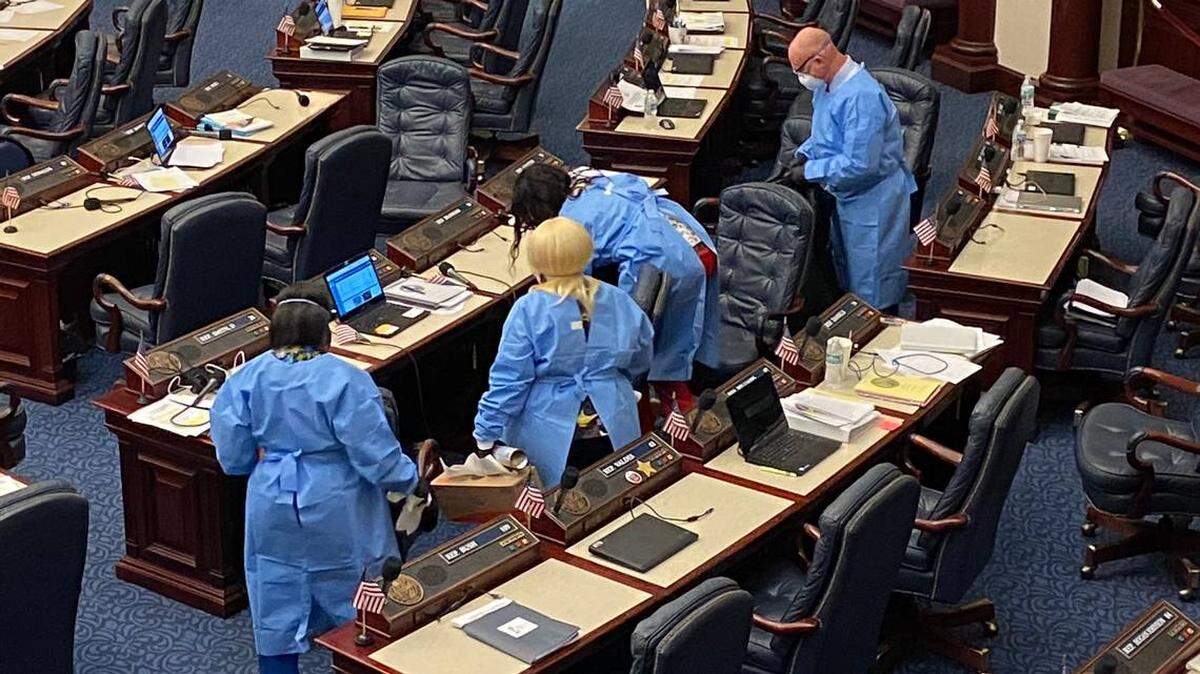
But just as the threat of the spreading pandemic forced legislative leaders to reconfigure the state budget, worried lawmakers asked for legislative leaders to reconsider returning to the Capitol to avoid infecting each other.
“I have to ask if there is not some possibility that we could investigate a way that would allow some of us, particularly those of us who are high risk, to be able to cast a vote electronically,’’ asked Sen. Joe Geller, D-Aventura.
Rep. Joy Goff-Marcil, a Maitland Democrat whose brother served as the House’s “doctor of the day,” said he strongly urged legislators to not return next week.
“He must have said 100 times to the members here that he thinks it’s a really bad idea to come back next week,’’ she said. Judging by the way the disease progressed in Italy, “he says we’re all going to be exposed to it ... It is should be hitting us like a wave next week.”
House Speaker José Oliva, R-Miami Lakes, said he would investigate the options but wasn’t optimistic.
“We must be here present in order to vote on this budget,’’ he said, adding that he considers the reaction to the pandemic and the subsequent impact on the state economy to be somewhat overblown.
“There’s a great deal of hysteria going on,’’ he told House members. “There’s a great deal of people acting in extreme ways. There’s no real way to fully understand what the impact of the decisions of very large companies and theme parks have done.”
The avalanche of closings and surge of Floridians testing positive forced legislators to confront the impact the crisis will have on the state budget, which by law does not need to be completed until June 30.
On Thursday, they started plans to scale back a tax cut bill that was about $150 million less than they had initially hoped to spend, and in the last two days they found another $100 million by eliminating budget projects. More than $300 million will be set aside in the budget stabilization fund, Oliva said, to be used to offset declining state revenues as needed to continue to operate government.
Standstill and flurry
As the focus shifted Friday, many bills died.
“This is the slowest Day 60 I’ve ever had,’’ said Rep. Jamie Grant, R-Tampa.
Among the casualties was a proposal to create a statewide resiliency office and sea level rise task force, a long-sought attempt to update Florida’s sentencing laws like many other states, and a school safety bill that would have implemented some recommendations of the post-Parkland commission.
Two criminal justice reform bills also died. One would have allowed judges to impose sentences less than the mandatory minimums for certain drug crimes, and prohibit low-level drug possession crimes to result in prison time for more than a year. The other would have made it easier for prisoners to get post-conviction DNA testing, which proponents said could lead to some inmates being exonerated and cold cases being solved.
After hours of standstill, both chambers convened at 9 p.m. passed the $48 million tax package and then passed a flurry of bills.
Among the last-day action, legislators sent to the governor SB 646, a bill to allow college athletes to earn off-field compensation for the use of their names, images and likenesses. They also passed a plan to expand the number of Florida specialty license plates, including adding plates for three out-of-state colleges. And they adopted a bill to expand taxpayer-funded voucher programs, allowing nearly 29,000 more students to go to private schools
Legislators also approved Gov. Ron DeSantis’ priority to increase minimum teacher salaries to $47,500. The measure makes Florida’s minimum base salaries the second highest in the nation, next to New Jersey, with $400 million in new money for starting teachers and $100 million for veteran teachers.
But the state’s largest teachers union, the Florida Education Association, predicts the measure will create deep inequities between inexperienced and veteran teachers in at least 45 of the state’s 67 counties.
Partisan differences were apparent on a handful of late bills. The GOP-controlled Senate confirmed the controversial appointment of state Surgeon General Scott Rivkees, a pediatric endocrinologist and professor at the University of Florida, on a 31-9 vote.
Republicans passed a late-session surprise amendment to voter laws along party lines, allowing anyone who carries a vote-by-mail ballot to the polls that isn’t their own ballot to be arrested and charged with a misdemeanor.
The measure fixed the state’s voter registration form, which was blasted by a federal judge in a lawsuit over Amendment 4, the provision allowing felons to vote. But the late amendment by Rep. Blaise Ingoglia, R-Spring Hill, also outlawed the collection of any ballots for a “pecuniary or other benefit.”
Currently, it’s illegal to collect more than two ballots under those circumstances and Democrats warned that it would allow the arrest of people for probable cause for violating the vote-by-mail ballot laws.
Unfinished budget
Left unfinished was the $92 billion budget, the only piece of legislation lawmakers are required by law to pass. But with the threat of the coronavirus looming, budget leaders warned that this may not be the final time legislators update the budget.
“We may be coming back in coming weeks as we evaluate the economy and the impact our budget,’’ said Rep. Travis Cummings, the Fleming Island Republican and chair of the House Appropriations Committee.
Legislators said they hope to preserve agreement on a 3%, across-the-board pay raise for state employees which would begin in October. About $625 million in water improvement projects intended to offset the state’s algae problems has also been tentatively agreed to, as has $100 million for Florida Forever, the land preservation program.
For the first time in more than a decade, legislators have agreed to spend the full $387 million the state collects for affordable housing on affordable housing programs. And Visit Florida, the state’s tourist marketing agency will draw $50 million next year and be extended into 2023 — avoiding a scheduled June 30 expiration date.
Priorities
Before the final day, legislative leaders had achieved many of their priorities. They passed a measure that would ban insurers from using genetic information to price policies, pushed by incoming House Speaker Chris Sprowls, R-Palm Harbor.
They signed off on a proposal to bring the state’s tobacco laws into compliance with federal law, by raising the age to use tobacco products — including e-cigarettes and vaping products — from 18 to 21, a priority of Senate President Bill Galvano, R-Bradenton.
DeSantis quickly signed into law proposals, at the top of House Speaker José Oliva’s wish list, expanding the roles that advanced practice registered nurses and pharmacists play in Florida’s healthcare system.
And on Thursday, the Senate delivered to the governor a watered-down E-Verify bill, giving the governor a minor victory on a proposal that was a cornerstone of his 2018 bid for governor.
Legislators also added an amendment to the November ballot by passing HJR 369 and HB 371, which will allow the voters to decide whether to extend the homestead exemption portability period from two to three years. If 60% of the voters approve, the law will take effect on Jan. 1, 2021.
Information from the News Service of Florida was used in this report.
Tampa Bay Times reporters Lawrence Mower and Emily Mahoney contributed to this report.
This story was originally published March 14, 2020 at 6:00 AM.