
Florida Senate approves making the Constitution harder than ever to change
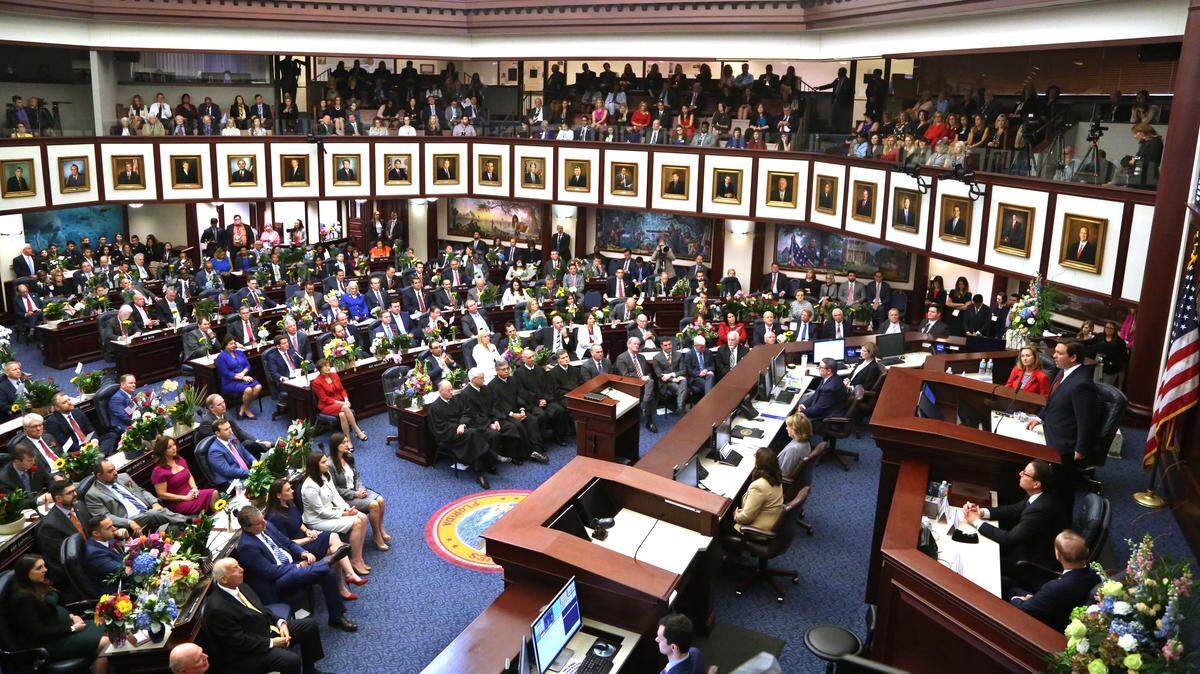
The Florida Senate on Monday passed a sweeping bill making it even harder for grass-roots organizations to change the state Constitution, an effort to stop future petition efforts opposed by major Republican donors.
On a 23-17 party-line vote, senators approved the bill and sent it to the House, where it is expected to pass. Both chambers would have to pass the bill to make it to Gov. Ron DeSantis’ desk.
Under the bill, petition organizers would have to gather far more signatures to trigger a required review of the ballot measure by the Florida Supreme Court, while raising what they pay for each signature to be reviewed.
House Bill 7037 and Senate Bill 1794 would require organizers jump through several more hoops and spend a lot more money to see their proposed amendments become reality.
Currently, organizers have to gather signatures from 10 percent of the number of votes cast in the most recent election in at least a fourth of the state’s 27 congressional districts. That’s just to trigger a review by the Florida Supreme Court, which determines whether the amendment is legal.
What Republicans want to do is require organizers to gather 50 percent of signatures in at least half the congressional districts. That would force groups to spend more money on a measure before knowing whether it will pass the Supreme Court’s review.
Gathering signatures would also get much more expensive. Signatures have to be verified by the local supervisor of elections. Currently, supervisors can charge no more than $0.10 to review each signature.
The bill would allow elections supervisors to charge the “actual cost” to review each signature. Bill sponsor Sen. Travis Hutson, R-Elkton, said supervisors told him the cost ranges from $0.42 to $1.02.
On top of those changes, the bills would allow any citizen file a court petition to challenge whether the person gathering petitions is registered with the state.
The bills would also require the Florida Supreme Court, when reviewing a ballot proposal, to consider whether it violates the U.S. Constitution. That provision is apparently meant to target future gun control measures, including a proposal to ban assault weapons that organizers are now trying to get on the 2022 ballot.
The provisions would take place immediately and would apply to the general election this fall.
Democrats said the measures would keep petitions out of reach for most grass-roots organizations, with only petitions backed by millionaires or corporate interests able to afford it. Florida’s electric utilities, for example, spent $22 million on a failed amendment in 2016 that would have solidified their hold on solar power. An initiative to raise the minimum wage, set for this fall’s ballot, is backed by Orlando mega-lawyer John Morgan.
Sen. José Javier Rodríguez, D-Miami, said the bill should be renamed “the ballot for billionaires.”
“What are we accomplishing here?” Rodríguez said. “We’re just making the citizens initiative process more complicated and expensive.”
Hutson said the effort had two purposes: to eliminate “fraud” in the petition-gathering process and to alleviate the workload on the Supreme Court. He identified two recent cases where petition groups gained enough signatures to merit the court’s review, but did not gather the full 766,200 signatures to make it on the ballot.
“The Supreme Court wasted their time,” Hutson said on Friday. “Their time is valuable.”
He did not produce examples of fraud in the process, however, and said he had not contacted the Supreme Court about their workload.
It’s the second year in a row that lawmakers have made it harder to change the Constitution. DeSantis has been the driving force each time.
After the recent success of groups that have amended the Constitution to allow for medical marijuana, expand voting rights to felons and preserve environmental land, DeSantis, Republican lawmakers and their large corporate donors have tried to crack down on the process. Morgan’s amendment to raise the minimum wage is adamantly opposed by corporations.
“We have far too much budget and policy in the Constitution,” Sen. Dennis Baxley, R-Ocala, said Monday.
Some of that “budget” in the Constitution comes from lawmakers themselves. In 2018, they proposed their own amendment requiring a two-thirds vote of the Legislature to raise taxes, which voters approved.
The House on Friday also advanced another constitutional amendment, HJR 7093, which would require petition organizers to gather signatures from all 27 congressional districts to trigger a review by the Supreme Court.
It follows up a bill revived and passed last year in the final hours of the legislative session at DeSantis’ urging. The bill targeted the people who are typically paid to gather signatures, requiring that those people be Florida residents and requiring they be paid by the hour, rather than by the signature.
This story was originally published March 9, 2020 at 8:41 PM.